
Bank Signage Compliance: Reg DD Rate Boards, Required Notices and What Screens Can Show
Bank signage rules in one place: Reg DD rate boards, FDIC and NCUA signs, Equal Housing Lender posters, and which notices a lobby screen can carry.

On this page
Reply within 2 business hours Ask a signage specialist Tap to open the quote form
Bank signage is two different things that get mixed up: the printed notices regulators require, and the screens and signs you use to sell. Most compliance trouble comes from treating one like the other. A rate board can live on a screen. The FDIC sign at the teller window, in practice, can't.
We install branch screens and build the rate templates, so this guide is written from the wall, not the courtroom. Every rule below is quoted from the eCFR as it read on November 8, 2026, with a link. None of it is legal advice. Your compliance officer signs off on every template before it goes live.
The short answer: printed or screen?
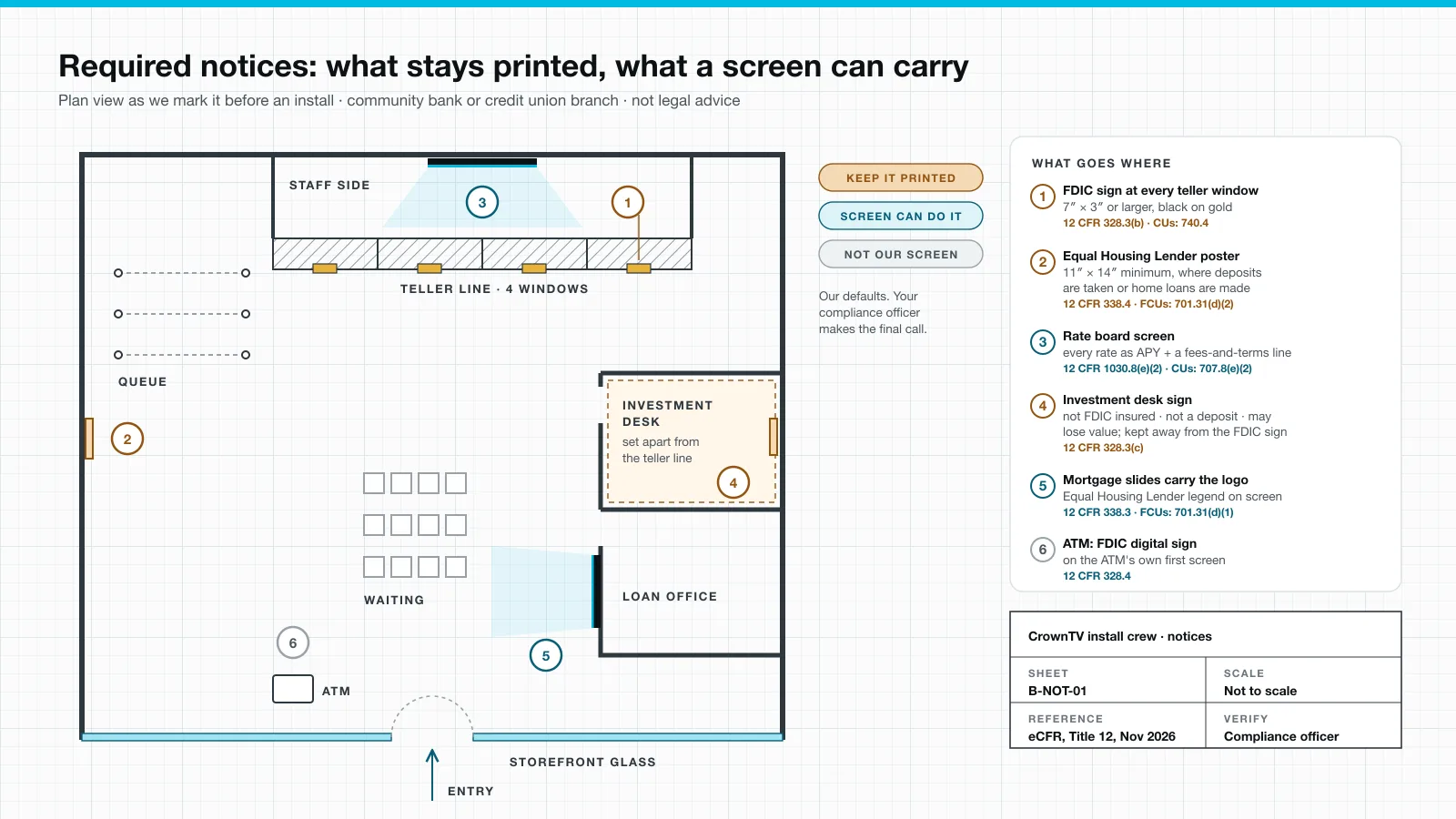
| Notice | Rule | Our default |
|---|---|---|
| Rate board | 12 CFR 1030.8(e)(2); credit unions 707.8(e)(2) | Screen. APY on every rate, fees-and-terms line always on |
| FDIC official sign | 12 CFR 328.3(b) | Printed, at every teller window |
| NCUA official sign | 12 CFR 740.4 | Printed, at every teller station |
| Equal Housing Lender poster | 12 CFR 338.4; federal credit unions 701.31(d)(2) | Printed, on the wall |
| Equal Housing Lender logo on home-loan ads | 12 CFR 338.3; federal credit unions 701.31(d)(1) | On every mortgage and home-equity slide |
| Non-deposit product sign | 12 CFR 328.3(c) | Printed, in the investment area, away from the FDIC sign |
| FDIC digital sign on ATMs | 12 CFR 328.4 | The ATM's own screen, not a lobby screen |
The drawing at the top of this page puts each one on a typical branch plan. Here's the reasoning, rule by rule.
Rate boards: what Regulation DD requires
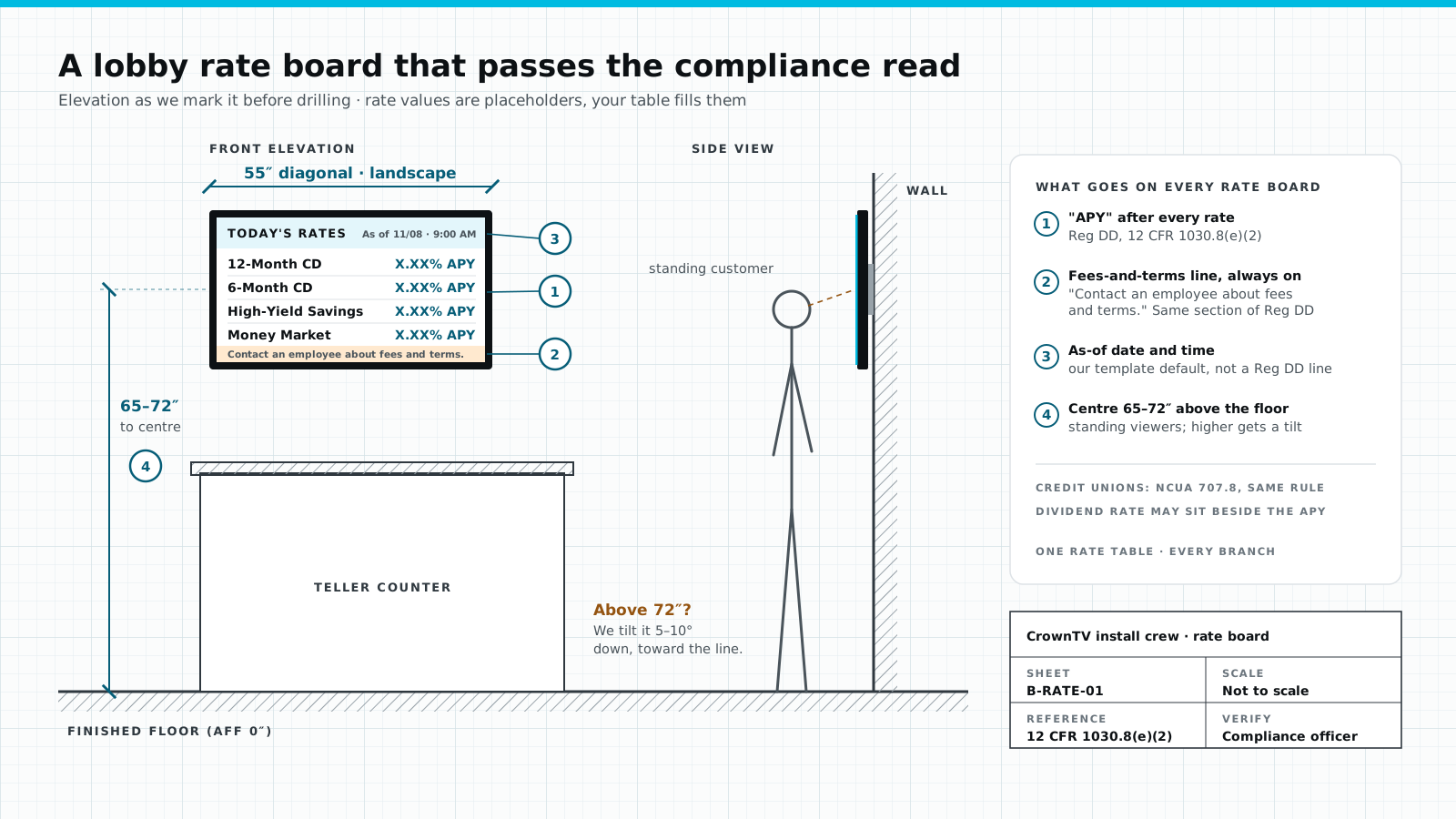
Regulation DD has a short paragraph just for signs inside the branch: 12 CFR 1030.8(e)(2). Indoor signs skip most of the advertising disclosures (minimum balance, fee effects, time-account terms). In return, if a sign states a rate, it has to do two things:
- State the rate as an annual percentage yield, using that term or "APY". No other rate, except the interest rate shown alongside the APY it belongs to.
- Tell customers to contact an employee for more information about fees and terms.
Two things catch people out. First, the indoor-sign exemption doesn't cover paragraph (a). A lobby slide still can't call an account "free" or "no cost" if a maintenance or activity fee may be charged, and still can't use the word "profit" for interest. Second, it covers signs inside the premises. A window screen aimed at the sidewalk is a judgment call; ask your compliance officer whether it should carry the full advertising disclosures in 1030.8(c).
How we build it so it can't drift: one rate table, edited centrally and pushed to every branch at once. The APY label and the fees-and-terms line are locked into the template, so a branch manager can change a number but can't delete the line. We add an as-of date and time in the header. Regulation DD doesn't require that on an indoor sign; it just stops arguments.
Credit unions: the same rule in NCUA Part 707
| Bank (Reg DD) | Credit union (NCUA 707) | |
|---|---|---|
| Where | 12 CFR 1030.8(e)(2) | 12 CFR 707.8(e)(2) |
| Rate on the sign | APY; interest rate may sit beside it | APY; dividend rate may sit beside it |
| The required line | Consumers: contact an employee about fees and terms | Members: contact an employee about fees and terms |
| Also exempt | Newsletters sent only to existing members, under the same conditions |
Same template, one word different. If you run credit union digital signage, we set the fees line to say "members".
The FDIC and NCUA signs: keep them at the window
12 CFR 328.3(b) says an insured bank must display the official FDIC sign "continuously, clearly, and conspicuously" wherever customers transact with deposits. Where deposits are taken at teller windows, that means a sign at each window, 7 by 3 inches or larger, black lettering on gold. A bank that doesn't offer non-deposit products on the premises may instead post the sign where it's visible from the teller windows, big enough to read from anywhere in that area.
Here's the part screen salespeople quote: 328.3(d) lets banks use electronic media to display the official sign and the non-deposit sign. That's real. But the sign still has to be there continuously. A slide that comes round every 40 seconds isn't continuous. A permanent corner of a screen might be, if the screen is where the rule needs the sign and it never goes dark, and that is your compliance officer's call. Our default is simpler: the printed placard stays at every window, and the screen does other work.
Credit unions follow 12 CFR 740.4: the NCUA sign at each station or window where insured funds are normally received. It's stricter on format. A credit union can resize the sign for its website and member documents, but not on the signs at its stations. Printed, then.
Investments and annuities: keep them apart
If the branch sells non-deposit products, 328.3(c) requires them to be physically set apart from the area where insured deposits are taken. Where they're offered, a sign must say the products are not FDIC insured, are not deposits, and may lose value, and that sign can't sit close to the official FDIC sign.
| Screen slide about | Where we run it | What it carries |
|---|---|---|
| CDs, savings, checking | Teller line, lobby | APY and the fees-and-terms line if it states a rate |
| Mortgages, home equity | Lobby, loan office | Equal Housing Lender logo and legend |
| Annuities, investments, insurance | The investment area only | Not FDIC insured · not a deposit · may lose value. Never the FDIC logo |
The "never the FDIC logo" part is from 328.6(e): an advertisement about non-deposit products alone can't include the official advertising statement or anything suggesting deposit insurance. Keeping those slides off the teller-line screen, which sits next to the FDIC placards, is our own rule, not the regulation's. It just avoids the question.
Equal Housing Lender: the poster and the slides
Two separate rules, and screens touch only one of them.
- The poster. 12 CFR 338.4 requires an FDIC-supervised bank that makes home loans to display the Equal Housing Lender poster, at least 11 by 14 inches, in a central spot where deposits are received or home loans are made, clearly visible to the public. Federal credit unions have the matching lobby notice in 701.31(d)(2). Keep it printed.
- The ads. 12 CFR 338.3 says home-loan advertising must show the bank lends without discrimination; on a visual ad, the Equal Housing Lender logo and legend does it. Federal credit unions: 701.31(d)(1). On a screen, that means every mortgage and home-equity slide.
Other charters have their own version of these rules. Your compliance officer knows which one is yours; we just need to know which logo goes in the template.
"Member FDIC" on screen slides
328.6(c) requires the official advertising statement ("Member FDIC" or a short form) in most deposit advertising. But 328.6(d)(3) exempts "signs or plates" in the bank's offices. Whether a lobby screen counts as a sign is a question for your compliance officer. Two practical points: if the same artwork also runs on your website or social channels, it follows the advertising rule there, and adding the short title to deposit slides costs nothing.
ATMs are a different screen
As amended in January 2026, 12 CFR 328.4 puts an FDIC official digital sign on the initial screen of ATMs and like devices that take deposits. An idle screensaver or ad doesn't count as the initial screen. Machines placed into service on or before April 1, 2027 may use the physical sign instead. That's the ATM's own software, handled by your ATM provider. It's not a lobby screen, and we don't touch it.
Our pre-install compliance checklist
1. Rate template: APY label and fees-and-terms line locked; "members" wording for credit unions. 2. Mortgage template: Equal Housing Lender logo built in. 3. Investment slides: tagged to the investment-area screen only, three statements on the slide, no FDIC logo. 4. Printed FDIC or NCUA placards at every window, untouched by the install. 5. Equal Housing Lender poster still on the wall after the screen goes up. 6. Your compliance officer approves each template once; after that, branches change numbers, not layouts.
For screens that crawl rates along the bottom, the same APY rule applies to every rate in the crawl; our ticker displays page has the installed package. For the queue screen over the teller line, see bank queue screens. For the whole branch, start with bank digital signage, and if you're choosing a provider, our shortlist of the best digital signage for banks compares 14.
Prices, if you're budgeting: a 55-inch rate board is $3,450 installed and a 43-inch teller-line screen is $3,150, each with the commercial display, mount, media player, installation and the first year of software. Software after year one is $20 per screen per month.
FAQ
What does Regulation DD require on a bank lobby rate board?
Under 12 CFR 1030.8(e)(2), a sign inside the branch that states a rate of return must state it as the annual percentage yield, using that term or APY, and must tell consumers to contact an employee for more information about fees and terms. It may show the interest rate alongside the APY, but no other rate.
Do credit unions follow the same rate-board rule?
Yes, in NCUA Part 707.8(e)(2). The rule is the same, except the dividend rate may appear next to the APY and the statement advises members to contact an employee about fees and terms.
Can the FDIC sign be shown on a digital screen?
12 CFR 328.3(d) lets banks use electronic media to display the official sign, but 328.3(b) requires it to be displayed continuously, clearly and conspicuously at each teller window, 7 by 3 inches or larger, black on gold. A slide in a rotation is not continuous. We keep the printed placard at every window and let the screen do other jobs.
Does a lobby screen need Member FDIC on every slide?
12 CFR 328.6(d)(3) says signs or plates in the bank's offices don't need the official advertising statement. Ask your compliance officer whether your screens count as signs. If the same artwork also runs online or in print, it follows the advertising rules there.
Do mortgage slides need the Equal Housing Lender logo?
For FDIC-supervised banks, 12 CFR 338.3 requires home-loan advertising to show that the bank lends without discrimination; on visual ads, the Equal Housing Lender logo and legend does that. Federal credit unions have the same rule in 12 CFR 701.31(d)(1). We put the logo in the slide template.
Can a screen replace the Equal Housing Lender poster?
We don't recommend it. 12 CFR 338.4 calls for a poster at least 11 by 14 inches, displayed conspicuously where deposits are received or home loans are made. Keep the printed poster on the wall and run the logo on your mortgage slides as well.
Can lobby screens advertise investments or annuities?
Carefully. 12 CFR 328.3(c) requires non-deposit products sold in the branch to be physically set apart from the deposit area, with a sign saying they are not FDIC insured, are not deposits and may lose value, kept away from the FDIC sign. Run those slides in the investment area, carry the same three statements, and never put the FDIC logo on them.
Is this legal advice?
No. We install branch screens and build the templates. The rules quoted here are from the eCFR as of November 2026, and your compliance officer has the final word on every template before it goes live.
Get a rate board your compliance officer will sign
Send us your current rate sheet and a photo of the teller wall. We'll mock up the board with your rates, the APY labels and the fees line, for your compliance officer to approve before anything is installed. Get a quote in 2 business hours.
Keep reading
More guides like this
Operator-grade playbooks, weekly.
Proof, not pitches
See real installs
Live deployments across hospitality, retail, and offices.
Ready to deploy?
Get a quote in 2 business hours
Reply within two business hours. No call required.