
Best Healthcare Digital Signage Companies in 2026: the buyer's shortlist
The best healthcare digital signage companies in 2026, ranked on scope, published pricing, G2 ratings and clinic proof, from installers to waiting-room TV.

On this page
Reply within 2 business hours Ask a signage specialist Tap to open the quote form
The best healthcare digital signage companies in 2026 split three ways: full-service installers, software platforms, and waiting-room TV services paid for by sponsors, ads or a monthly fee. We checked 13 against scope, published pricing, G2 ratings and real healthcare proof. Our #1 is CrownTV. That's us, and the scoring is below. We rank first because we survey, source, mount, install and run clinic screens under one contract with published per-screen prices. For free screens, PatientPoint leads the other healthcare digital signage companies.
Key Takeaways
- Decide who controls the screen before you compare names. Free services like PatientPoint and Atmosphere are funded by sponsors or ads, so part of every hour isn't yours. Paid software and full-service providers keep the screen about your practice.
- No patient data on patient-facing screens. Names, dates of birth and appointment details don't belong in a waiting room. Now-serving screens should call anonymous ticket numbers. Any screen on this list can run that way if the content is set up right.
- Published prices are common now, except at the enterprise end. Rise Vision, Pickcel, ViewMedica and Relevant all publish prices, from $11 per screen per month to $1,665 a month for a full patient-education library. Korbyt and Visix quote by project.
- G2 samples are thin in healthcare. Rise Vision (1,004 reviews) and Atmosphere (265) have real samples. PatientPoint has 0 reviews on G2, and Visix has 6, so lean on references instead.
- Most vendors leave the install to you. Only CrownTV publishes an installed per-screen price that covers the survey, screen, mount, install and software. The software platforms and content services leave the screen and the install to you, and for a 40-clinic rollout that handoff is where schedules slip.
What healthcare digital signage actually is (and what it is not)
Healthcare digital signage is a set of commercial screens in waiting rooms, at check-in windows, in pharmacies, cafeterias, corridors and staff rooms, each driven by a media player and managed from one content platform. In a clinic it does three jobs. It tells patients what happens next. It introduces the providers and services they didn't know about. And it fills the wait with something calmer than cable news.
If you're building the business case, our page of sourced digital signage statistics has the numbers in one place.
The healthcare version has one hard rule that a store screen doesn't: no protected health information on any screen a patient can see. That means no names on a now-serving board, no birthdays on a staff-recognition slide that faces the lobby, and no appointment lists. Queue screens call anonymous ticket numbers. Staff-only content runs on separate screens with separate permissions, and the media players sit on their own network segment, away from clinical systems.
What it is not: it is not a medical device, and it is not your EHR. The screens display content; they don't read patient records. It is also not a TV with a streaming stick and a cable subscription. Consumer TVs aren't built to run 10 to 12 hours a day, and their warranties usually limit business use. And it isn't free just because the screen is. A sponsor-funded screen costs nothing in dollars, but the sponsor gets part of the airtime.
So the right company depends on the job. A single practice that wants patient education without lifting a finger needs a content service. A health system with an in-house communications team needs software. A clinic group starting from blank walls in five states needs someone to actually install the screens.
Real CrownTV install · Upperline Health
Send us your clinic list. We'll price every site: a media player for a working TV, or a new screen package.
Get a free quote in 2 business hours →How We Ranked These Healthcare Digital Signage Companies
We checked 13 companies on November 8, 2026, using each company's own website and its G2 product page. Every figure below can be checked the same way. We scored five things:
- Scope under one contract (1 to 4 layers). Display, media player, content (software or programming) and installation with support. The more layers one company owns, the fewer handoffs you manage.
- Published pricing. Whether a practice can see the price without a sales call, and the number if so. "Free" counts as published, with the funding model noted.
- G2 rating and review count. Anything under 50 reviews is noted as a thin sample. No G2 profile is noted as unrated.
- Named healthcare proof. Hospitals, health systems or clinic groups the company names on its own site, and any numbers it publishes from that work.
- Who controls the screen. Whether all the airtime is yours, or sponsors or advertisers share it.
Samsung VXT, Yodeck, ScreenCloud and Loop TV were reviewed but not ranked: they're general-purpose platforms, and we ranked the companies with the most healthcare-specific proof or offers ahead of them. They're in the comparison table so you can see how they score.
The Best Healthcare Digital Signage Companies in 2026
The list runs from full service, to free and paid waiting-room services, to software. The first pick is our own company, so we've been specific about where it falls short. If you want free screens, start at #2. If you already own screens and have a content team, read #3, #7 and #8.
1. CrownTV, best for clinic groups that want survey, screens, install and software from one company
- Installed from $3,150 per 43″ screen
- 4.9★ on Google (267+ reviews)
- Founded 2012, New York
- 16,000+ screens running
CrownTV is a turnkey digital signage company. For a clinic, that means one company does the whole job: a site survey, the Samsung commercial display with a 3-year commercial warranty, the mount, a media player set up before it ships, installation by licensed, insured technicians, content software and design, and monitoring that raises an alert when a screen goes offline. Prices are on our pricing page: $2,950 for a 32″, $3,150 for a 43″ and $3,450 for a 55″, each including the first year of software. After that, software is $20 per screen per month.
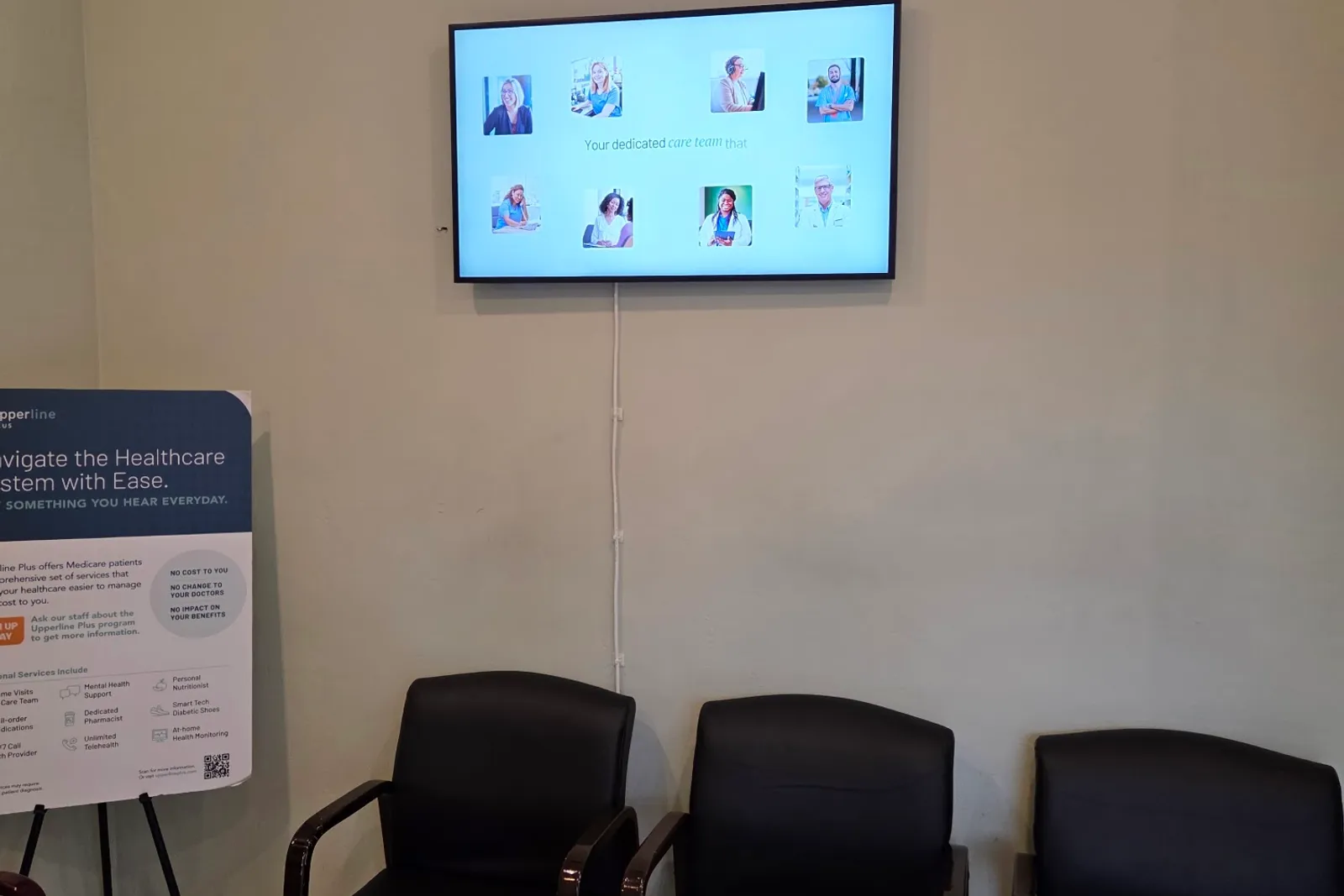
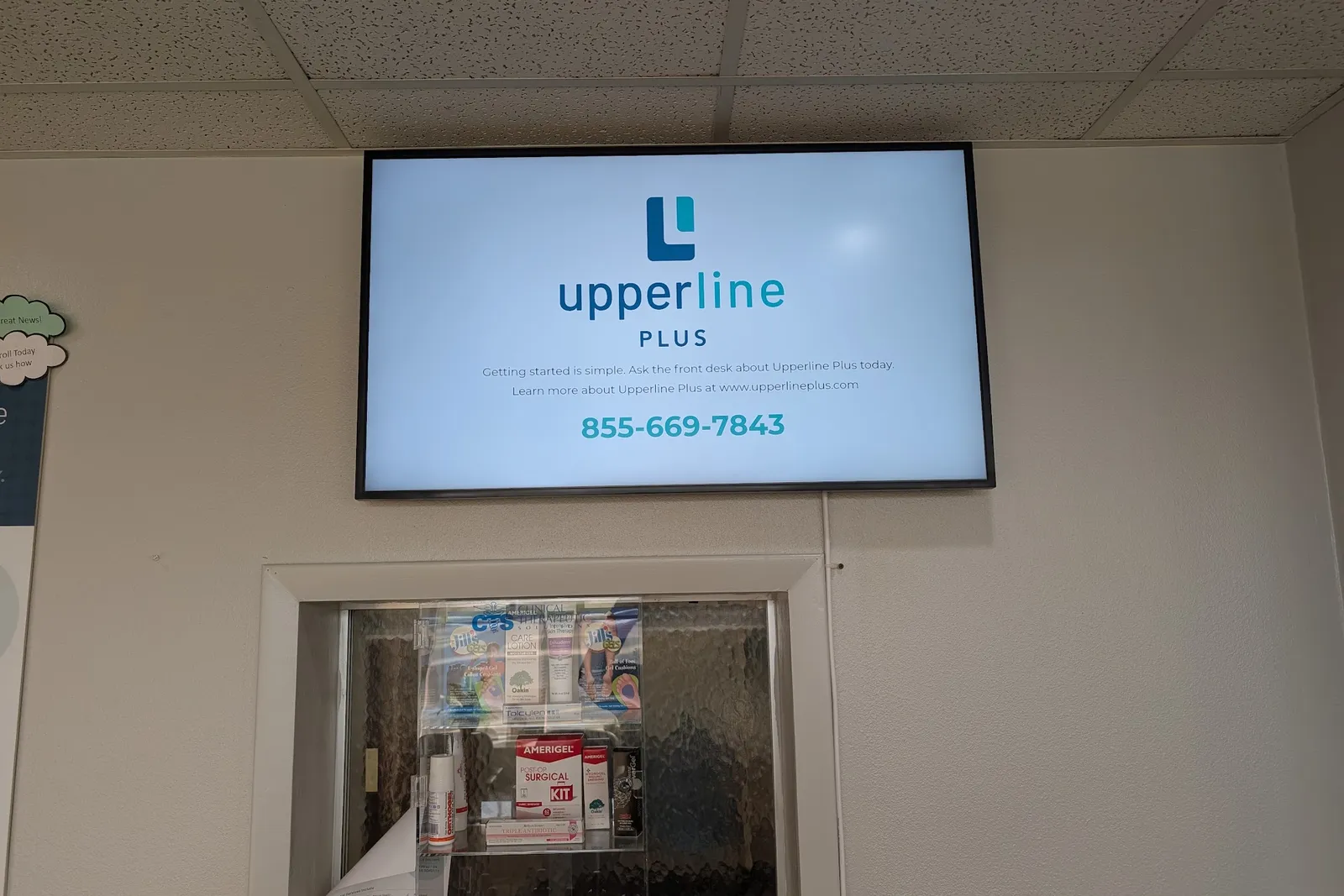
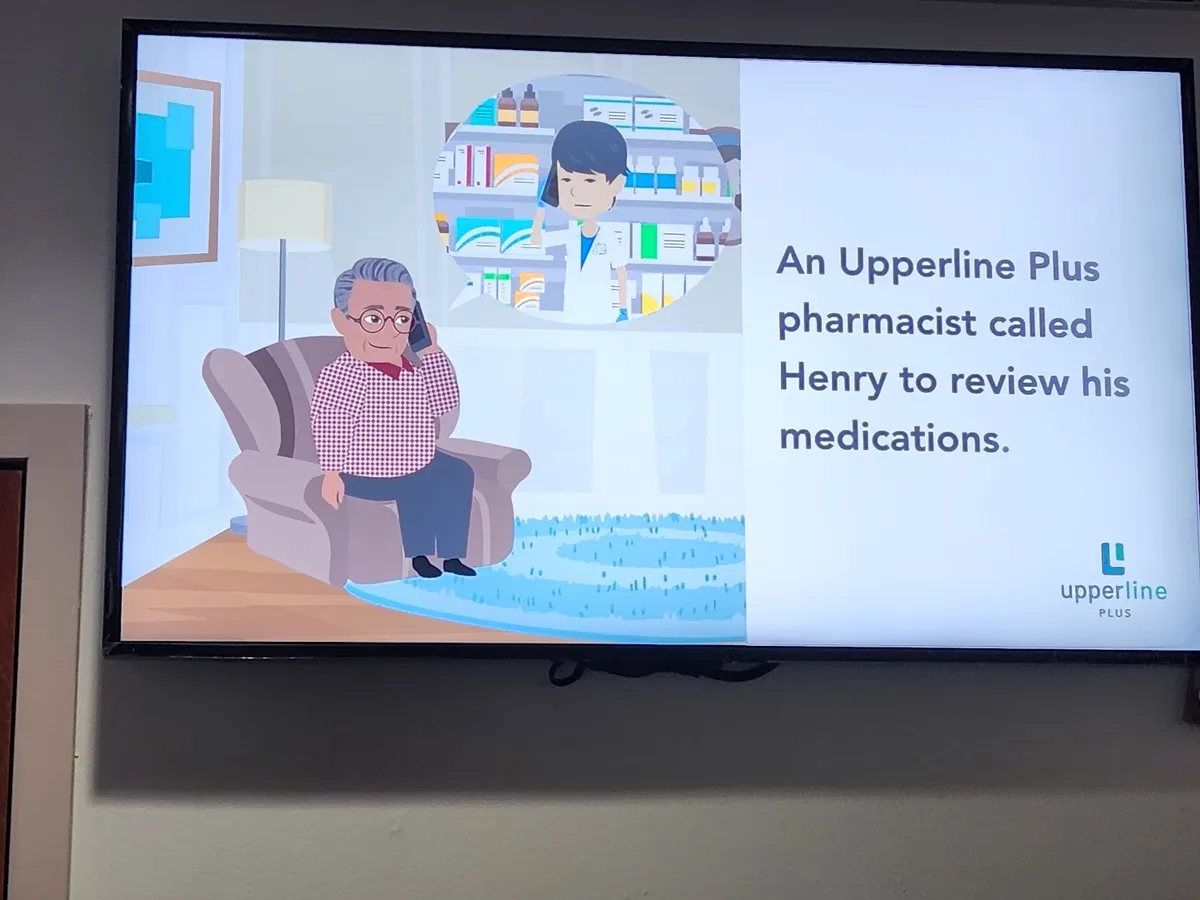
Our healthcare proof is the Upperline Health clinic program. It started with a pilot, then rolled out state by state, with Georgia as the first full wave in September 2026. Every clinic gets a site code and a survey that decides its kit: a media player for a TV already on the wall, or a new 32″ or 43″ commercial screen package. The outlet is confirmed before a technician is booked, crews run clustered routes with GPS check-in, and every site closes out with 7 photos taken with no patients in frame. Content, including the Upperline Plus pharmacist program explainers, is managed centrally.
Our honest gaps: we have no G2 reviews yet (the profile there is unclaimed), and our Capterra listing has only 2 reviews, both 5.0. We don't do electrical work, so outlets are on the clinic's side. And there's no self-serve free trial; you start with a quote.
Clinic groups, practices and dental chains that are rolling out to several sites and want one company accountable for every screen. It's also the simplest path if some clinics already have a TV and others need a new one.
Disclosure: CrownTV publishes this article. We scored ourselves on the same five criteria as everyone else and listed our gaps above.
2. PatientPoint, best for independent practices that want free, sponsor-funded screens
- "At no cost to your practice"
- 32,000 offices, 169,000 devices
- G2: 0 reviews
PatientPoint runs what it calls "the largest digital screens network at the point of care". Its about page lists 32,000 offices, 169,000 digital devices and 125,000 healthcare providers across 14+ specialties. It offers three screens: a waiting-room screen, an exam-room screen and a staff meeting-room screen. For a side-by-side with an owned screen, see PatientPoint vs CrownTV.
The model is the reason it's #2. PatientPoint says its "sponsor-supported model" provides the technology, patient education and ongoing support "at no cost to your practice". Sponsors pay for the network. That's a real saving for a single practice, but it also means sponsor messages share your screen, so ask what share of each hour is sponsored and whether you can block categories.
It's also where Outcome Health ended up. PatientPoint combined with Outcome Health on March 9, 2021, to form PatientPoint Health Technologies; the announcement put the combined reach at roughly 750 million patient visits a year. PatientPoint publishes outcome numbers, such as "30% consultation services" at a dermatology practice over six months in 2023, but they come from its own studies and claims analysis.
On G2 the profile is claimed but has 0 reviews, so there's no independent rating to lean on. The company is based in Cincinnati, per the 2021 announcement's dateline. Ask for two practices in your specialty you can call.
Independent physician practices that want screens and patient education without a budget line. It's less of a fit if you want every minute of airtime for your own services.
3. Rise Vision, best for hospitals and health systems that run their own content
- From $11 per display per month
- G2 4.7★ (1,004 reviews)
- 12,300+ organizations
Rise Vision has the strongest healthcare logo list of any software platform we checked. Its healthcare page shows Tampa General Hospital, Novant Health, Tallahassee Memorial Healthcare, Community Health Network and Citizens Memorial Hospital, among 25 healthcare logos. Megan Romer, marketing coordinator at HCC Network, is quoted saying it gave them a way to get announcements and "digital flyers" out to each health clinic space.
Pricing is published: Basic at $11 per display per month, Advanced at $138 and Enterprise at $164 per display per year, plus a $1,399 per-school license aimed at education. Its healthcare page promises 30 days risk-free. G2 rates it 4.7 from 1,004 reviews, the largest sample among the software picks here. Rise Vision says 12,300+ organizations use it on 77,846 displays, and it traces its history to 1992.
The healthcare features are the ones hospitals ask for: emergency alerts through Common Alerting Protocol (CAP) integrations for lockdowns and weather, wayfinding directories, donor walls, cafeteria menu boards and staff screens. The page shows a SOC 2 badge. It doesn't claim HIPAA certification, which is normal: a signage platform shouldn't be holding patient data in the first place.
Rise Vision sells its own media player and Avocor displays, or runs on hardware you already own. Installation is yours to arrange.
Hospitals and health systems with a marketing or communications team and screens across many buildings. It's a strong fit when emergency alerts need to reach every lobby and corridor at once.
4. ViewMedica VMcast, best for specialty practices that want a patient-education video library
- $85 to $1,665 per month
- 2,593 patient-education videos
- Publisher founded 1998
ViewMedica is the pick when the screen's job is teaching. Its publisher, Swarm Interactive, was founded in 1998 and says its library holds 2,593 patient-education videos. VMcast is the waiting-room channel built from that library.
Pricing is fully published, which is rare in this category. Starter is $85 a month for 25 videos (about an hour) on one stream. Provider Plus is $125 for 75 videos and up to an hour of your own video. Multispecialty is $375 for 250 videos on 3 streams. All-Inclusive is $1,665 for the full 2,593-video library on 10 streams. Extra streams are $20 a month. The listed plans cover practices with fewer than 20 providers and hospitals with fewer than 500 beds; bigger organizations get a custom quote. There's a 30-day money-back guarantee, and you can change plans or cancel anytime.
Hardware is simple: VMcast runs on Amazon's Signage Stick and any screen with an HDMI port. One stream drives one screen, unless you split the same broadcast with an HDMI splitter. It's content-only, so the screen, mount and install are yours.
We found no G2 listing for ViewMedica and no published customer count, so ask for references in your specialty. The library covers what a condition or procedure is; it won't introduce your providers unless you add your own video, which the Provider Plus plan and up allow.
Surgical and other specialty practices whose patients ask the same procedure questions every day. It suits practices that want the education handled and are happy to buy their own screen.
5. Relevant, best for ad-free waiting-room TV on a Roku, Fire TV or Apple TV
- $59 to $112 per box per month
- "No third-party ads, EVER"
- Norwalk, Connecticut
Relevant sells a custom TV channel for waiting rooms: licensed TV programming, a news ticker, local weather, your social-media posts and your own slides and videos, mixed into one broadcast. The difference from the free services is that it's ad-free: its homepage promises "No third-party ads, EVER", and its medical page describes a Competitive Ad Block that keeps out ads from competing offices and pharmaceutical companies.
Pricing is published on a 12-month agreement. Just the technology, with your own content, is $68 a month for one box or $59 per box for two or more. Licensed TV programming plus the technology is $112 for one box or $89 per box for two or more. There's also a sponsored plan at $0 net cost, where a sponsor covers the monthly rate. Setup is normally $299, and the site currently shows it waived for a limited time. Monthly no-contract plans cost slightly more.
No special hardware is needed: the app runs on a Roku, Fire TV or Apple TV plugged into the screen you already have. The medical page says changes appear within an hour and content updates several times a day.
Relevant names no customers on its site, publishes no founding year, and we found no G2 listing. Its address is 17 High Street in Norwalk, Connecticut.
Medical and dental practices that want TV-style programming without anyone else's ads. It works best when the practice already has a decent screen and someone to add a few slides.
6. Atmosphere, best for free waiting-room TV if you're fine with ads
- Free, ad-supported
- G2 4.8★ (265 reviews)
- 60K active customers
Atmosphere is the free option most practices have already heard of. It streams audio-optional programming, and it runs a healthcare channel, Atmosphere Wellness, which it says is designed for healthcare settings. Its medical pitch is content that is "always upbeat, never political, and never polarizing".
The deal is spelled out in its FAQ: the content is free, and "in return, we include advertising within our programming." You can add your own promotions, and Atmosphere says it dedicates the first ad spot in each break to you. You can't use your own streaming device; Atmosphere ships a free one that plugs into any TV with HDMI.
The numbers are solid. G2 rates Atmosphere 4.8 from 265 reviews, the largest healthcare-relevant sample after Rise Vision. Its homepage claims 60K active customers in 35+ countries. It doesn't publish a founding year, and its site says it isn't available for personal or in-home use.
The question for a practice is control. Ads you didn't choose will run in your waiting room, alongside your own slides. For a small office that wants something better than cable news at no cost, that's a fair trade. For a clinic group with its own patient campaigns, it usually isn't.
Single-location practices and urgent-care clinics that want calm, free programming and don't mind ads. It's a sensible stopgap while you plan your own content.
7. Pickcel, best for clinics that need queue displays and an on-premise option
- $13.50 or $22.50 per screen per month (annual)
- G2 4.9★ (36 reviews)
- 9,000+ businesses, 150,000+ screens
Pickcel is software with a strong hospital use case. Its hospital waiting-room page covers health education, department-specific playlists, wayfinding, emergency broadcasts to every screen and live queue numbers, with one administrator managing screens across buildings and cities. Pickcel is clear that it shows what your queue system publishes rather than replacing it: "Real-time queue numbers and estimated wait indicators can run on waiting room screens" when connected to a queue management system.
Its healthcare case study is Manipal Hospitals in India, where Pickcel manages a network of 250 displays across the Bengaluru and New Delhi branches, running notices, check-up schedules, doctor information and live queue status. The study doesn't publish a measured result. Pickcel also sells an on-premise version, which matters for hospitals whose IT won't allow a cloud CMS.
On compliance, Pickcel says it is SOC 2 Type II and ISO 27001 certified, and it doesn't store patient health records on screens. It also says, sensibly, that a hospital's compliance team should review its data handling before deployment.
Pricing is published: Professional at $13.50 and Business at $22.50 per device per month, billed annually, with Enterprise quoted. There's a 14-day free trial. G2 rates it 4.9, but from 36 reviews, so treat it as a thin sample. Pickcel says 9,000+ businesses use it on 150,000+ screens in 70+ countries; it's made by LaneSquare Technology and doesn't publish a founding year on its pricing page.
Clinics and hospitals with a queue system that want its numbers on the waiting-room screen. It's also a good fit when IT requires an on-premise CMS.
8. Korbyt, best for health systems that tie screens to staff communications
- Pricing not published
- G2 4.4★ (27 reviews)
- Foundation Medicine: 80%+ time saved
Korbyt combines digital signage, room booking and employee communications on one enterprise platform. Its lineage runs from Symon to RMG Networks and, since September 2020, Korbyt; Wikipedia places its headquarters in Dallas. Its own site says it is "trusted by Fortune 100 and leading enterprises" but gives no customer count.
Its healthcare-adjacent proof is Foundation Medicine, where Korbyt says its signage tools cut the time spent on content management "by more than 80%" at the new headquarters. Outside healthcare, it publishes one of the clearest reach results in the industry: at the University of Notre Dame, screens grew from 80 to 222, an exposure increase of 177.5%.
Korbyt's healthcare blog (July 2023) covers interactive wayfinding and real-time wait-time and queue updates. It partners with BrightSign for media players.
G2 rates Korbyt 4.4, but from only 27 reviews, so treat it as a thin sample. Pricing isn't published, and we found no free trial. Expect an enterprise buying process: security review, implementation services and a longer contract. Screens and installation come from someone else.
Health systems and life-sciences companies whose communications team wants staff screens, lobby screens and meeting-room panels on one platform. It's more than a single clinic needs.
9. Visix, best for hospital campuses that want wayfinding, room signs and kiosks from one vendor
- In business since 1980
- 4,000+ clients, 1,000+ campuses
- G2 2.7★ (6 reviews)
Visix is one of the oldest names in this market. It says it has been in business since 1980, and it is based in Peachtree Corners, Georgia. It claims 4,000+ clients and 1,000+ campuses, and its homepage logos include Medical City Healthcare, Anthem Health, Johnson & Johnson, MIT and Yale.
For hospitals, the appeal is breadth. Visix sells its AxisTV Signage Suite alongside ePaper and interactive meeting-room signs, interactive wayfinding and kiosks, and its homepage pitches self-service kiosks to "ease stress in the waiting room". Its software licenses allow an unlimited number of users and media players, which helps when many departments need access.
Pricing is by quote. Its pricing page asks about screen count, hardware and room-sign needs, then sends a recommendation. It offers Hardware as a Service to cut the upfront cost, and lists support as 24/7/365. We found no free trial; it offers a free demo.
The G2 rating is 2.7 from 6 reviews, too small a sample to mean much either way. Visix publishes no measured healthcare result on its homepage, so ask for a hospital reference that runs wayfinding and room signs together.
Hospital and medical-school campuses that want lobby screens, wayfinding kiosks and room signs from one vendor. It suits facilities teams that prefer to own the system and pay for it as a service.
Side-by-Side Comparison
The same five criteria: scope under one contract, published pricing, G2 rating and review count, named healthcare proof, and who controls the screen. All figures were checked on November 8, 2026, on each company's site and on G2. The four companies we reviewed but didn't rank are at the bottom.
| Company | Type | Layers | Published price | G2 | Healthcare proof or scale | Your screen? |
|---|---|---|---|---|---|---|
| CrownTV | Full service | 4 of 4 | $2,950–$3,450 per screen, installed | No reviews (4.9 Google) | Upperline Health clinic program | Yes, all of it |
| PatientPoint | Sponsored network | 3 of 4 (install terms not published) | Free to the practice | 0 reviews | 32,000 offices | Shared with sponsors |
| Rise Vision | Software | 2 of 4 | From $11 per display/mo | 4.7 (1,004) | Tampa General, Novant Health | Yes |
| ViewMedica VMcast | Education channel | 1 of 4 | $85–$1,665 per month | Not listed | 2,593-video library | Yes, plus own video |
| Relevant | Waiting-room TV | 1 of 4 | $59–$112 per box/mo | Not listed | None named | Yes, no third-party ads |
| Atmosphere | Waiting-room TV | 2 of 4 | Free | 4.8 (265) | 60K active customers | Shared with ads |
| Pickcel | Software | 1 of 4 | $13.50 / $22.50 per device/mo (annual) | 4.9 (36) | Manipal Hospitals, 250 displays | Yes |
| Korbyt | Enterprise software | 1 of 4 | No | 4.4 (27) | Foundation Medicine | Yes |
| Visix | Software + room signs | 2 of 4 | No (quote) | 2.7 (6) | Medical City Healthcare logo | Yes |
| Samsung VXT (not ranked) | Display + software | 3 of 4 | No | 4.6 (55) | None healthcare-specific | Yes |
| Yodeck (not ranked) | Software | 2 of 4 | $8–$16 per screen/mo | 4.7 (3,310) | 65,000+ customers, all industries | Yes |
| ScreenCloud (not ranked) | Software | 1 of 4 | $20 / $30 per screen/mo (annual) | 4.7 (455) | 10,000+ organizations, all industries | Yes |
| Loop TV (not ranked) | Waiting-room TV | 2 of 4 | Not published | 0 reviews | 4,000+ screens | Shared with ads (paid ad-free option) |
Which healthcare digital signage company fits your organization
| Your situation | Best fit | Why | Ask before you sign |
|---|---|---|---|
| Clinic group rolling out to several sites, some with TVs already | CrownTV | Survey, screens, install and software under one contract | "What's the price per clinic on our list?" |
| Independent practice, no budget for screens | PatientPoint | Sponsor-funded screens and patient education | "How much of each hour is sponsored?" |
| Hospital or health system with a comms team | Rise Vision | Healthcare logos, CAP emergency alerts, published price | "Can we call Tampa General's team?" |
| Specialty practice with repeat procedure questions | ViewMedica VMcast | 2,593-video education library, published plans | "Which videos cover our procedures?" |
| Practice that wants TV programming with no outside ads | Relevant | Ad-free, Competitive Ad Block, runs on a Roku | "What's the yearly price for our locations?" |
| Small office that wants free programming now | Atmosphere | Free, 4.8 on G2 from 265 reviews | "Which ad categories can we exclude?" |
| Clinic or hospital with a queue system | Pickcel | Live queue numbers, on-premise option | "Which queue systems do you connect to?" |
| Health system linking staff comms and signage | Korbyt | Signage, room booking and employee comms in one platform | "What does implementation cost for our screen count?" |
| Campus that needs wayfinding and room signs | Visix | Kiosks, room signs and signage from one vendor | "What does Hardware as a Service cost over 3 years?" |
What results look like
Healthcare signage results are hard to prove, and we won't invent them. PatientPoint's outcome numbers come from its own studies, and a 2018 systematic review in the European Journal of General Practice found that waiting-room screens probably improve what patients know, with effects on behavior still unsettled. What we can show is what a clinic rollout looks like when it's done properly.
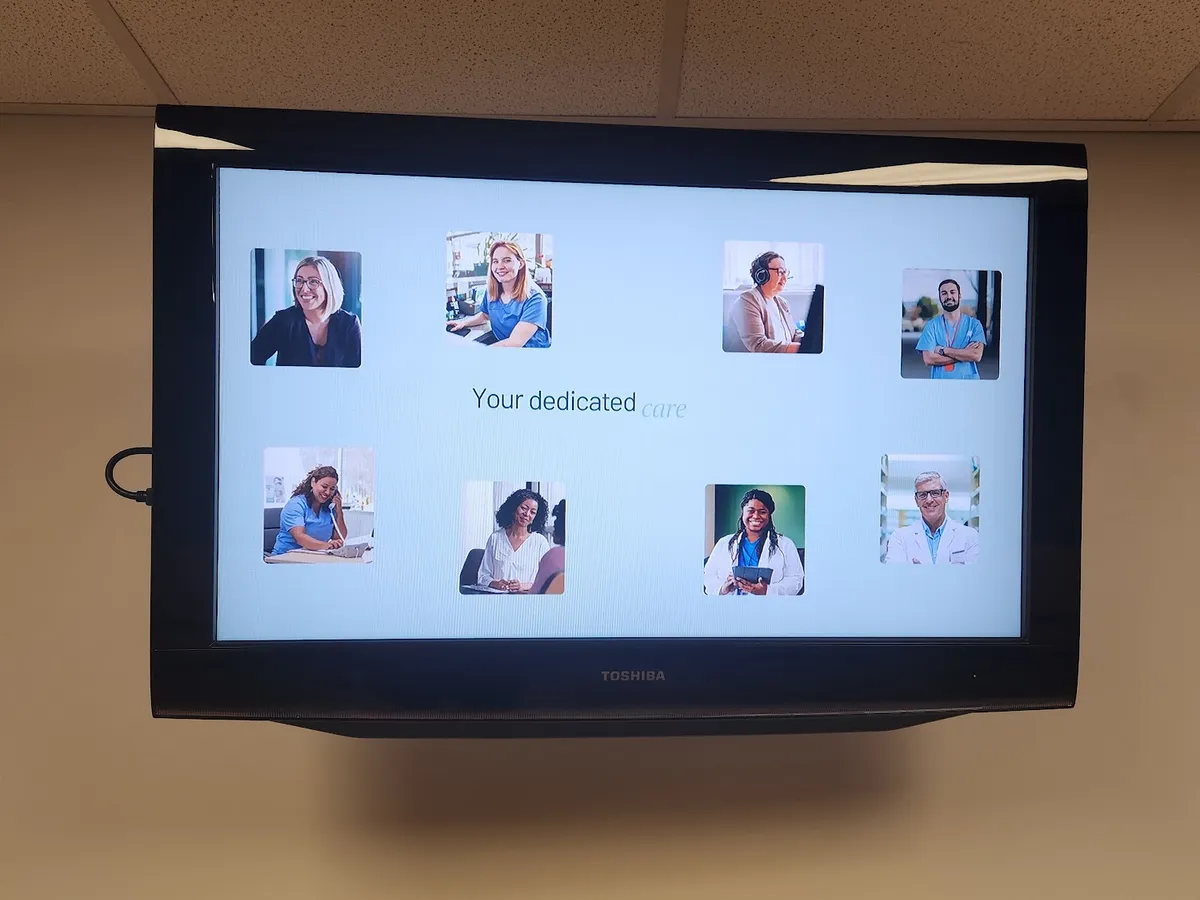
- Pilot first, then waves. Upperline Health started with a pilot, then rolled out state by state. Georgia was the first full wave, in September 2026.
- One site code on everything. Each clinic's code goes on the box, the player, the work order and the photo folder, so nothing gets lost between states.
- The survey picks the kit. A clinic with a working TV gets a media player. A clinic without one gets a new 32″ or 43″ commercial screen package. The outlet is confirmed before a technician is booked.
- Proof at close-out. Technicians run clustered routes with GPS check-in and leave only when content is playing, with 7 close-out photos and no patients in frame.
- Content from one place. Every clinic's loop, including the Upperline Plus pharmacist program explainers, is managed centrally.
The full clinic process is on our healthcare digital signage page, and you can browse installs across every industry on our case studies page.
Frequently asked questions
What is the best digital signage company for hospitals and clinics?
It depends on what you already have. If you need the screens, the install and the software from one company across several sites, CrownTV ranks first on our criteria. If you own screens and have a content team, Rise Vision has the strongest healthcare logo list and a 4.7 G2 rating from 1,004 reviews.
How do you keep healthcare digital signage HIPAA-safe?
Keep protected health information off every patient-facing screen: no names, dates of birth, chart numbers or appointment details. Queue and now-serving screens should call anonymous ticket numbers, and the media players should sit on their own network segment, away from clinical systems.
How much does healthcare digital signage cost?
Software-only platforms publish prices from about $8 to $30 per screen per month, and waiting-room TV services run from free (ad- or sponsor-funded) to $1,665 a month. CrownTV's installed package is $3,150 for a 43-inch screen, including the commercial display, mount, media player, installation and the first year of software.
Is PatientPoint really free for medical practices?
PatientPoint says its sponsor-supported model provides its screens, content and support at no cost to the practice. The trade-off is that sponsor messages share the screen, so ask what share of each hour is sponsored before you sign.
What happened to Outcome Health?
Outcome Health combined with PatientPoint on March 9, 2021, to form PatientPoint Health Technologies. The Outcome Health network now runs under the PatientPoint name.
What should a medical waiting room screen play?
Short, captioned slides about your services, your providers, check-in steps and patient education, with the sound low or off. Leave out cable news, and never put anything on screen that identifies a patient.
How long does a clinic install take?
For CrownTV, installation is typically 5–7 business days after the paid invoice, and a single clinic screen is one visit. Multi-clinic programs start with a pilot and then roll out in waves by region.
What is the difference between a waiting-room TV service and digital signage software?
A waiting-room TV service like Atmosphere, Relevant or ViewMedica supplies the programming, so you mostly add your own slides around it. Digital signage software gives you an empty schedule to fill with your own content, which means more control and more work.
Get a free quote from CrownTV
Send us your clinic list and tell us which sites already have a TV on the wall. We'll come back within 2 business hours with an itemized, installed price for every site. Clinics with a working TV get a media player quote, not a new screen. The rest get the exact Samsung panel, mount and player, with software after year one spelled out. Get your free quote here.
Whoever you choose, get two things in writing before you sign: the all-in price per clinic, and who owns the airtime on the screen. If you'd like both from us first, request a quote for your clinics and compare it against the rest.
Real CrownTV install · Upperline Health
One company for the survey, the screens, the install and the content.
Get a free quote →Itemized and installed, back within 2 business hours.
Keep reading
More guides like this
Operator-grade playbooks, weekly.
Proof, not pitches
See real installs
Live deployments across hospitality, retail, and offices.
Ready to deploy?
Get a quote in 2 business hours
Reply within two business hours. No call required.