The deployment, in detail How we built Janie and Jack's install — operator to operator.
A long-form walkthrough of the brief, the hardware decisions, and the live result. The version we'd send another business owner if they asked us how this kind of program actually ships.
Inside the brief
Janie and Jack came to CrownTV with a problem most premium children's brands recognize: the storefront has to do most of the marketing in a mall corridor. Parents push a stroller past a hundred storefronts on a Saturday afternoon. The window has somewhere between three and six seconds to make them stop. A static visual merchandising display does some of that work — a high-brightness, synchronized digital window display does substantially more, especially when paired with interior screens that complete the brand story once the customer is through the door.
The chain's footprint made the technical brief unusual. Janie and Jack runs 115+ stores in the United States plus a flagship in London — that is a multi-vendor installation challenge if you let it be one. The team did not want to manage three different content management systems for window displays, interior displays, and the London store. They wanted one platform, one hardware kit per store, and content choreography that produced the same brand moment in Brookfield Place that ran in the King's Road flagship at the same time. Synchronized — not just scheduled — across every screen in every store.
Acquired by Go Global Retail in 2021 and operating in mall and street-retail formats, Janie and Jack also needed the install to be fast across a chain that size. The brief baked in low per-store deployment time, a uniform hardware kit that worked across mall outlets, freestanding stores, and the international flagship, and a CMS that the central marketing team could operate without per-location IT involvement. Anything that required a per-store conversation about cabling routes was off the table.
Inside the install
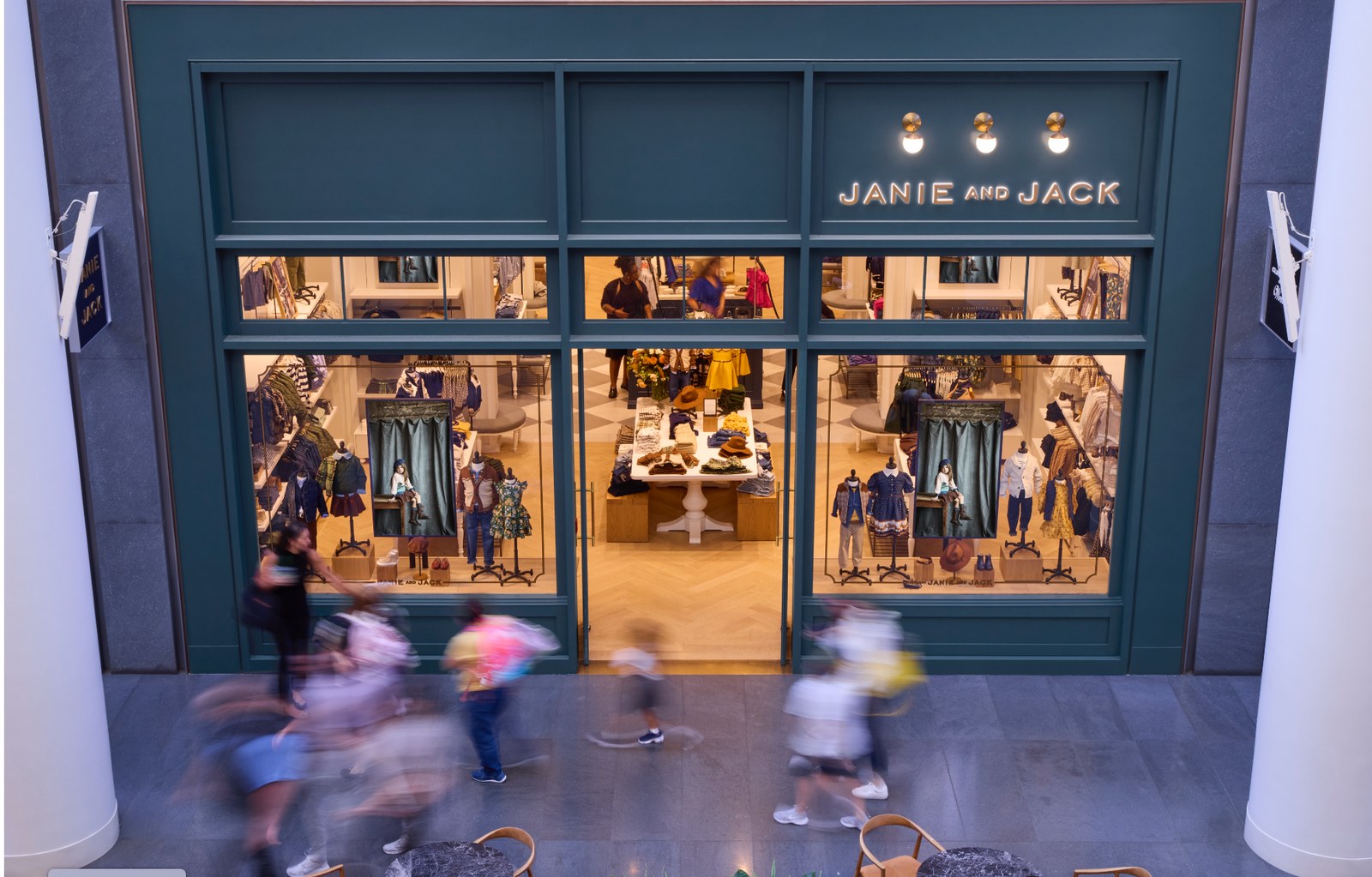
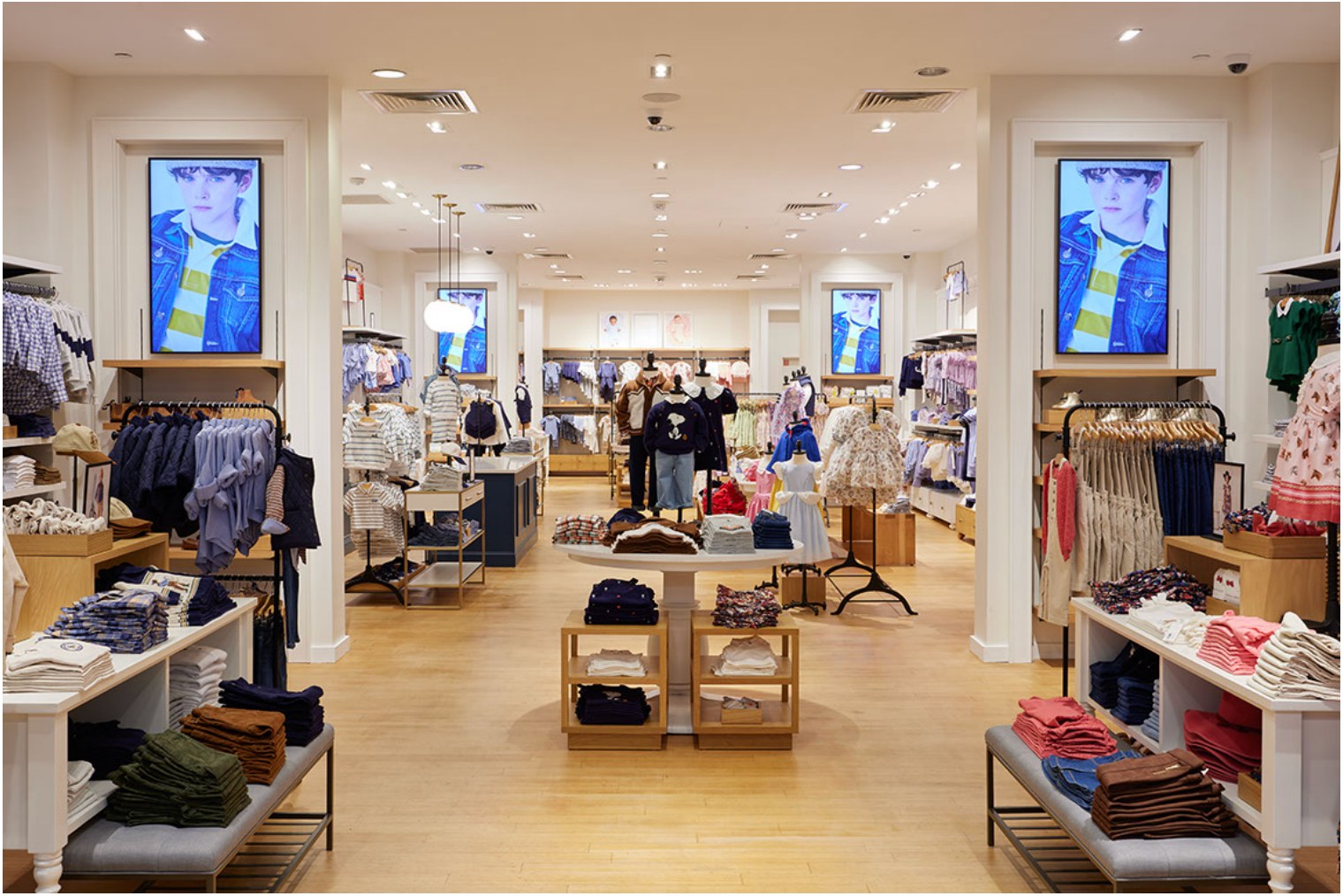
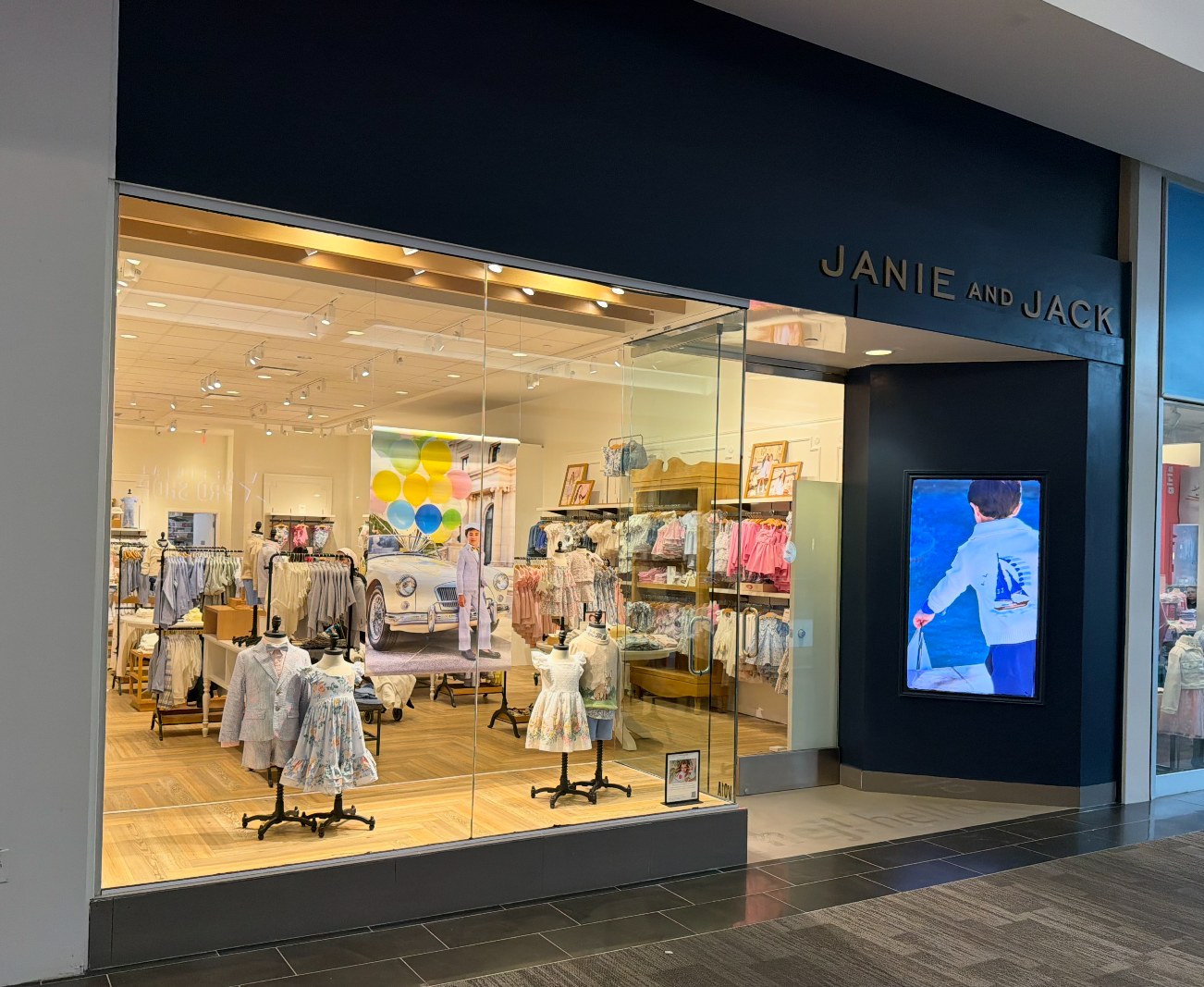
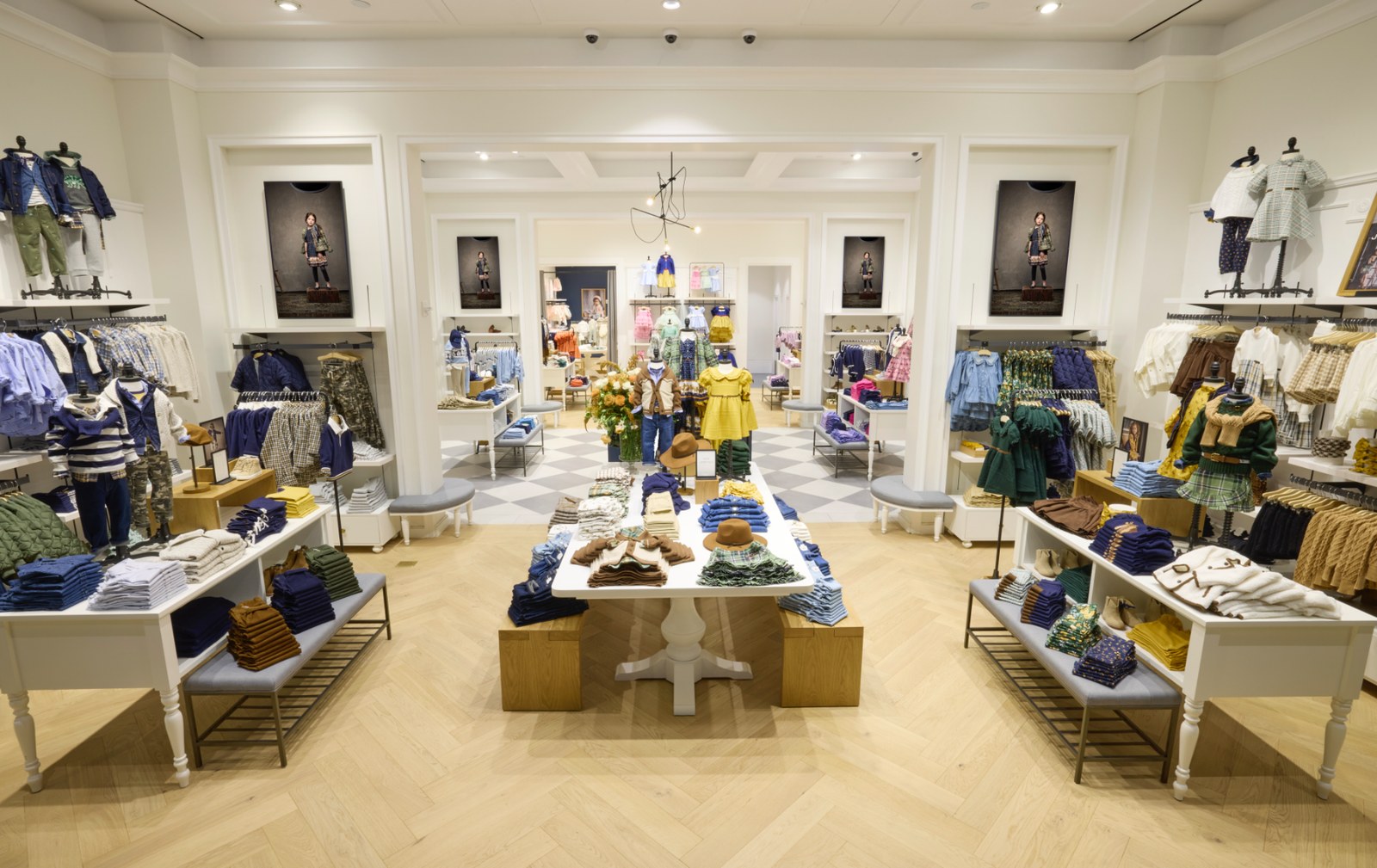
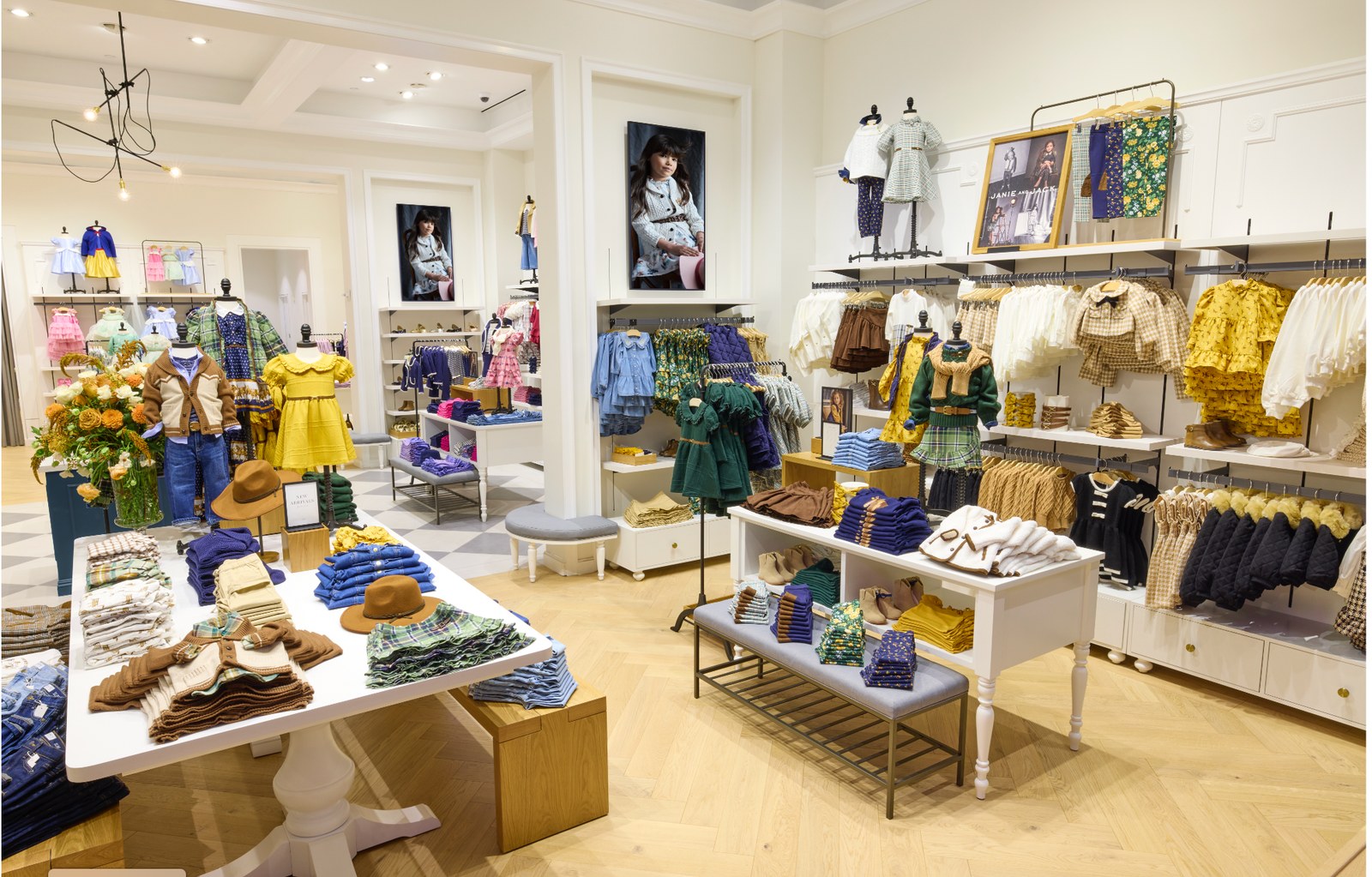
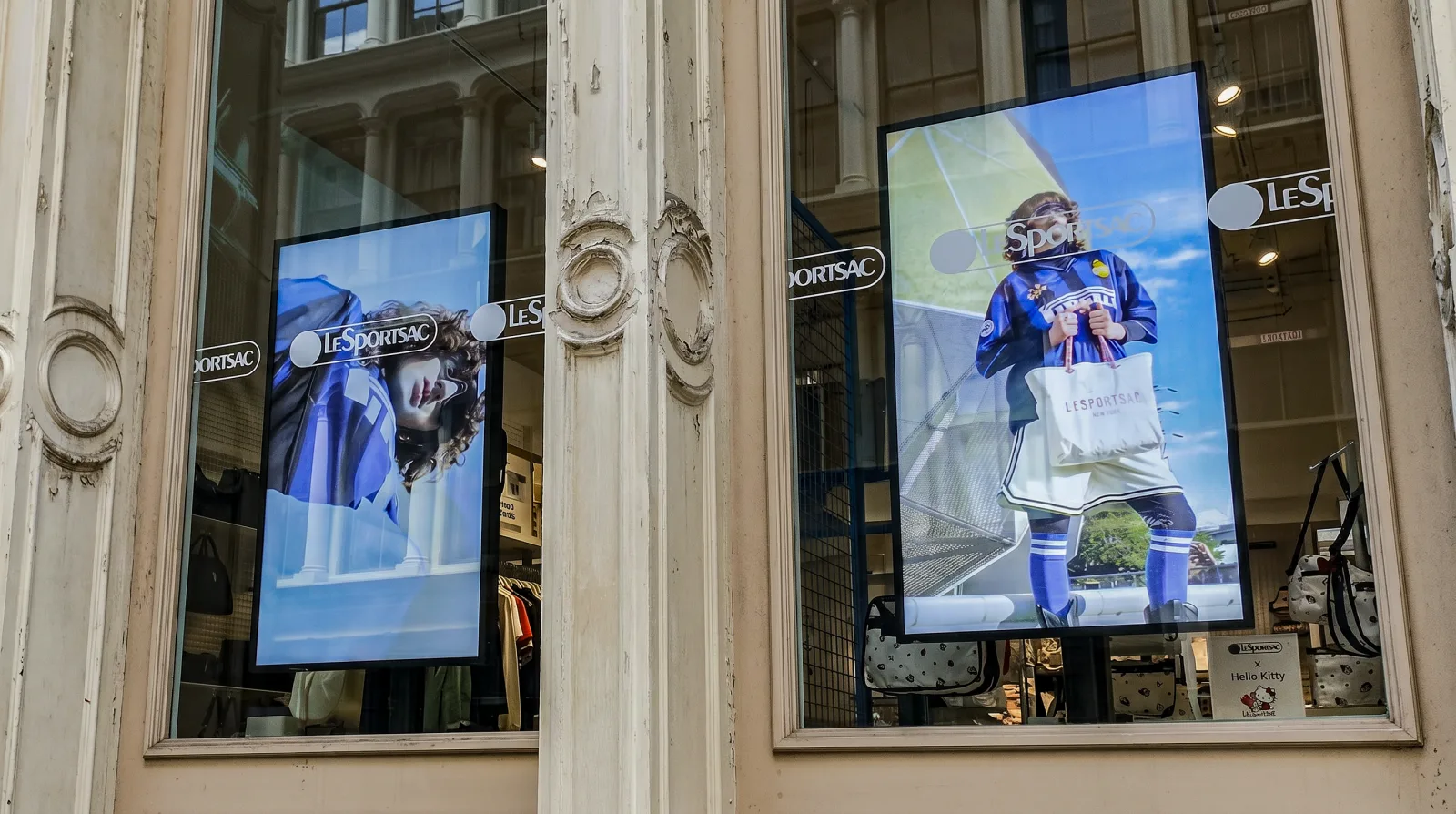
The screen mix per store is the headline of the install: up to six screens — two window-facing and four interior — driven by a single CrownTV media player. The window-facing screens are Samsung OM55B 55-inch panels rated at 3,500 nits. That brightness rating is non-negotiable for a mall storefront — a consumer TV at 350 nits washes out behind glass under daytime mall lighting and disappears entirely if the store has a sun-facing exposure. The OM55B is built for window-facing operation, and its commercial heat management lets it run all day without thermal throttling. The interior screens are Samsung QM55C — 55-inch commercial 4K panels — mounted on ceiling-mount brackets and recessed wall mounts to fit the millwork and herringbone-floor aesthetic of a Janie and Jack store. The hardware spec is uniform across the chain: every store ships with the same kit, regardless of mall or street format.
Synchronization is what makes this install do the work the brief asked for. The trick is signal routing. We use a single CrownTV media player per store with an HDMI splitter — one input, six outputs — so every screen receives an identical 4K signal at the same instant. There is no inter-screen network synchronization to drift, no per-screen content delivery latency to worry about, and no per-store CMS configuration the brand team has to manage. The CMS sees one playback target per store and ships the brand-templated content to it. The HDMI splitter does the rest, frame-perfect.
Window-facing OM55B panels are mounted on floor-mounted stands that we specified to fit each store's window depth — that mounting choice keeps the panel forward in the storefront window without obscuring the merchandise behind it. Interior QM55C panels run on a mix of ceiling-mounted brackets and recessed wall mounts. We co-engineered both mount types with the in-store millwork program so the mounts read as part of the architecture, not as bolted-on hardware. The floor-mounted window stands also let store managers reposition a storefront panel during a remerchandising cycle without calling a contractor.
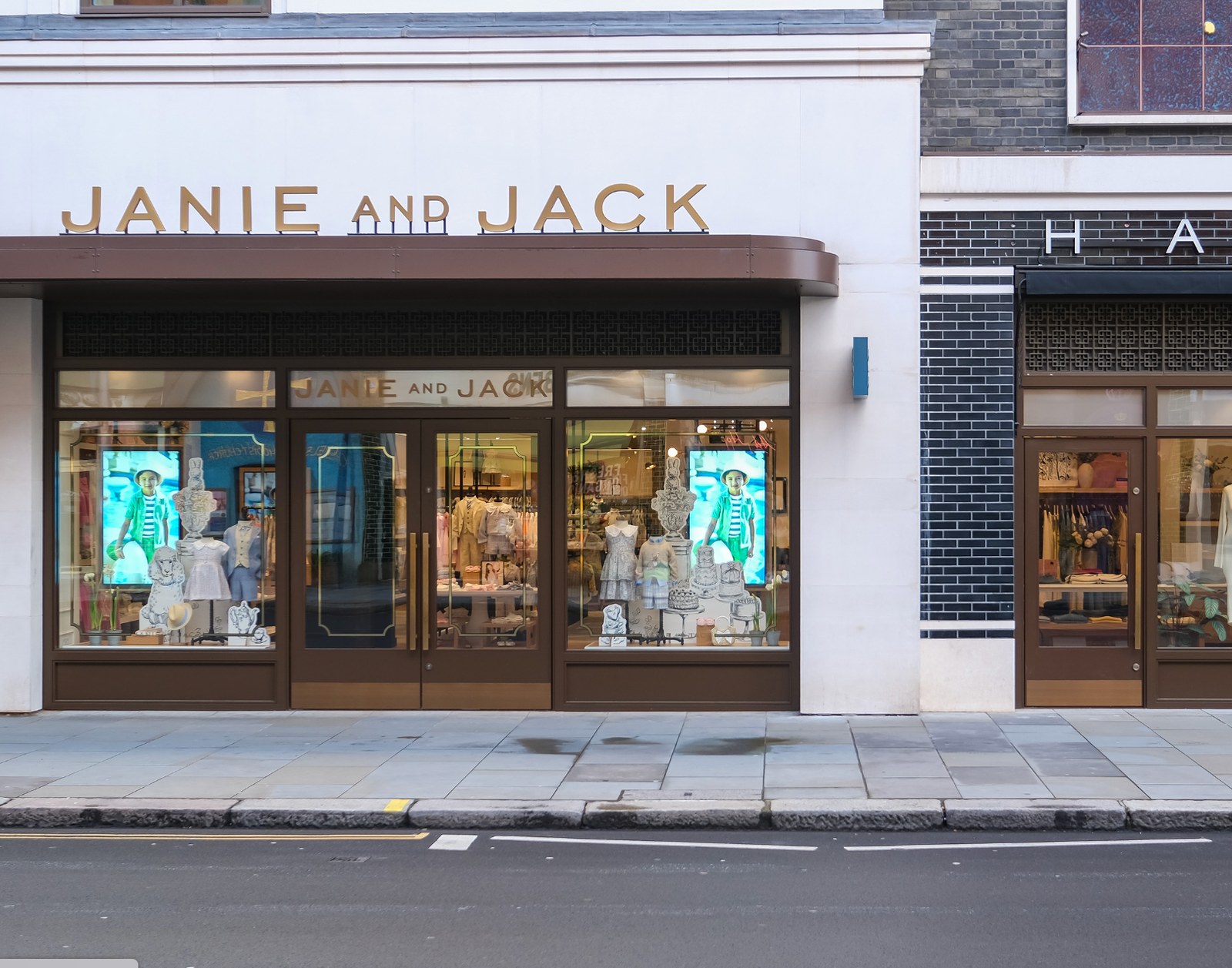
The London flagship runs the same hardware kit and the same CMS as the US fleet. From the brand team's perspective, scheduling content for King's Road is no different from scheduling for Brookfield Place. The London install ships from the same production process, the same content templates, and the same CrownTV Cloud Dashboard. Time zones, regulatory differences, and a transatlantic shipping timeline were the only real variables in deploying the international flagship, and we treated those as deployment logistics, not as platform problems.
After go-live
The synchronized 'wow effect' happens at every store the moment a customer walks past or steps inside. Two storefront panels and four interior panels carrying identical 4K creative at the same instant produces a continuity that a single screen or a non-synchronized program cannot. That is the visceral result. The operational result is more important: the brand team publishes one campaign from headquarters, and within minutes the same visual story is running on six panels per store across 115+ US stores plus the London flagship.
Per-store install time stayed low because the hardware kit was uniform. The team learned the kit on the early rollouts and applied the same playbook to every subsequent store. Content updates publish chain-wide from a single dashboard with no per-location intervention. Real-time device monitoring catches a panel fault before the store reports it — a window panel going dark on a Saturday is something we hear about from the network before the store manager does.
The London flagship is the proof that the platform scales internationally without changing the operational model. Same kit, same CMS, same support process — the only delta is shipping logistics. That has implications for any chain considering further European expansion: the platform is already running the same way it would run in Paris or Berlin or Manchester.