The deployment, in detail How we built L'Occitane en Provence's install — operator to operator.
A long-form walkthrough of the brief, the hardware decisions, and the live result. The version we'd send another business owner if they asked us how this kind of program actually ships.
Inside the brief
L'Occitane en Provence is a French personal-care brand with global retail distribution and a clear North American growth thesis. The brief that came to CrownTV reflected that thesis directly: deploy digital signage across the entire North American retail footprint — 150+ boutiques across the United States and Canada — and run them as one program. The hard part was never the panel count. It was the operational model.
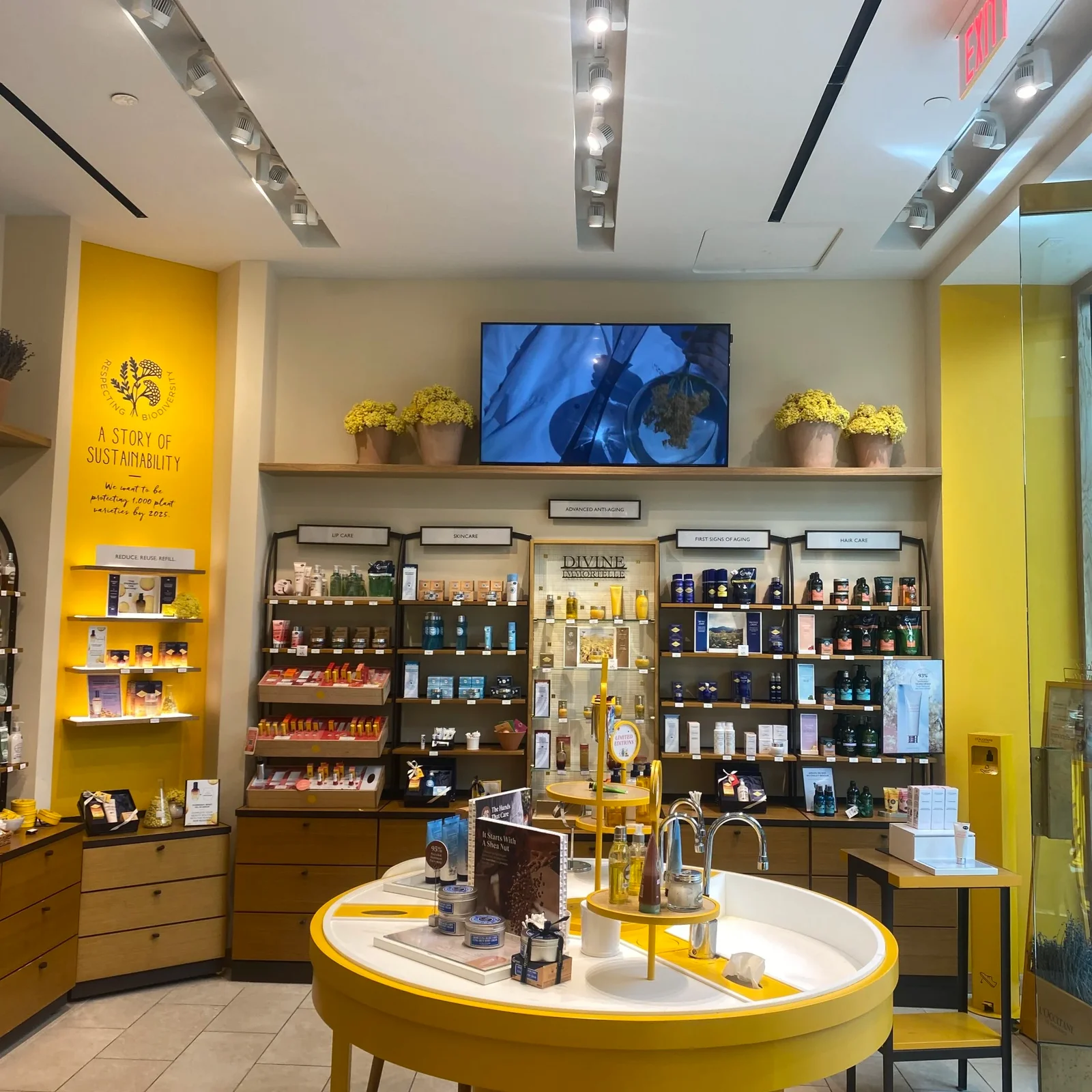
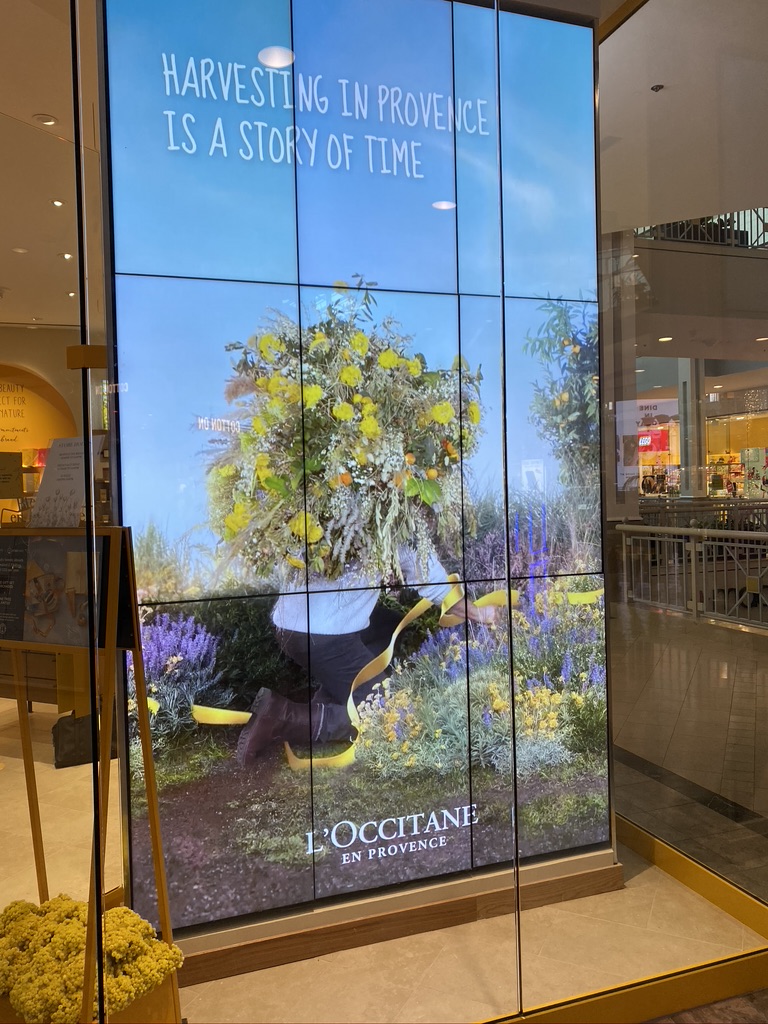
L'Occitane operates retail in three formats. Flagship boutiques in destination malls and high streets host the full brand experience including video walls. Standard boutiques run a smaller screen estate with one or two video positions. Mall outlets and smaller satellite stores often have a single window display or cash-wrap screen. A signage platform that works for the chain has to ship the same content language across all three formats — a 3×3 video wall in a flagship and a single portrait window panel in a mall outlet need to read as the same brand on the same day.
The other half of the brief was the permission model. L'Occitane's IT team owns infrastructure and security. The central marketing team owns brand creative and seasonal campaigns. Store managers know their local customer base and want to ship local promotions and Instagram-feed content on their own screens without escalating. Any platform that put all three groups on the same workflow would fail — the brand campaigns would get blocked by store-manager edits, or the store managers would get locked out and stop using the system. The CMS had to scope permissions properly from day one.
Inside the install
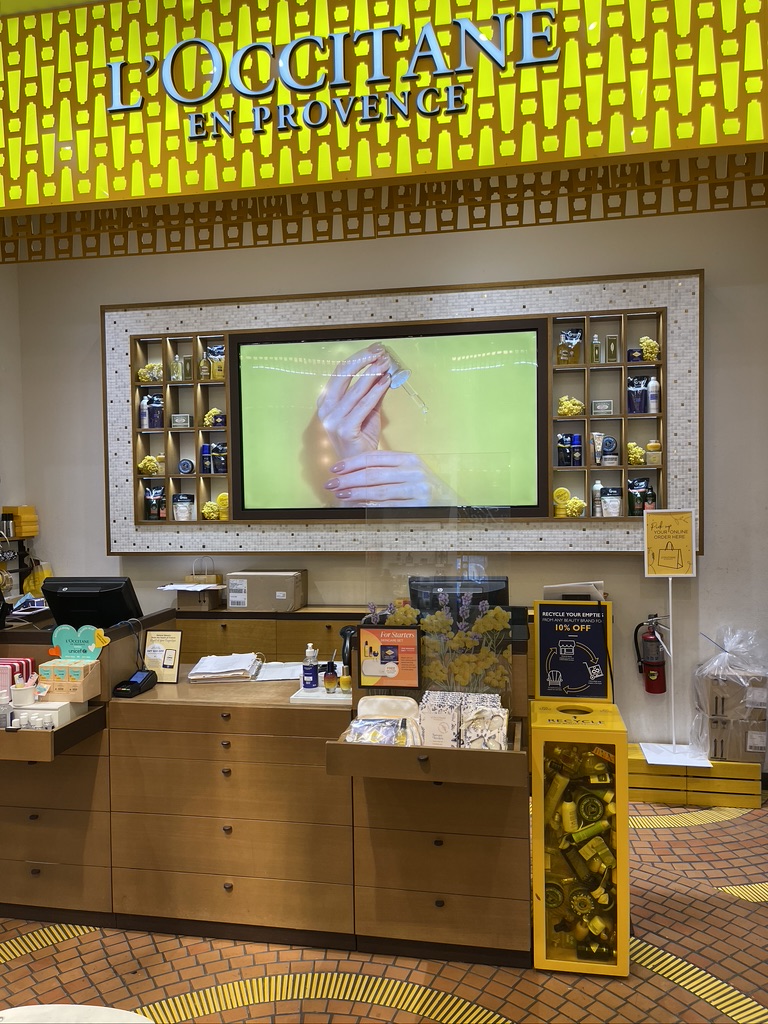
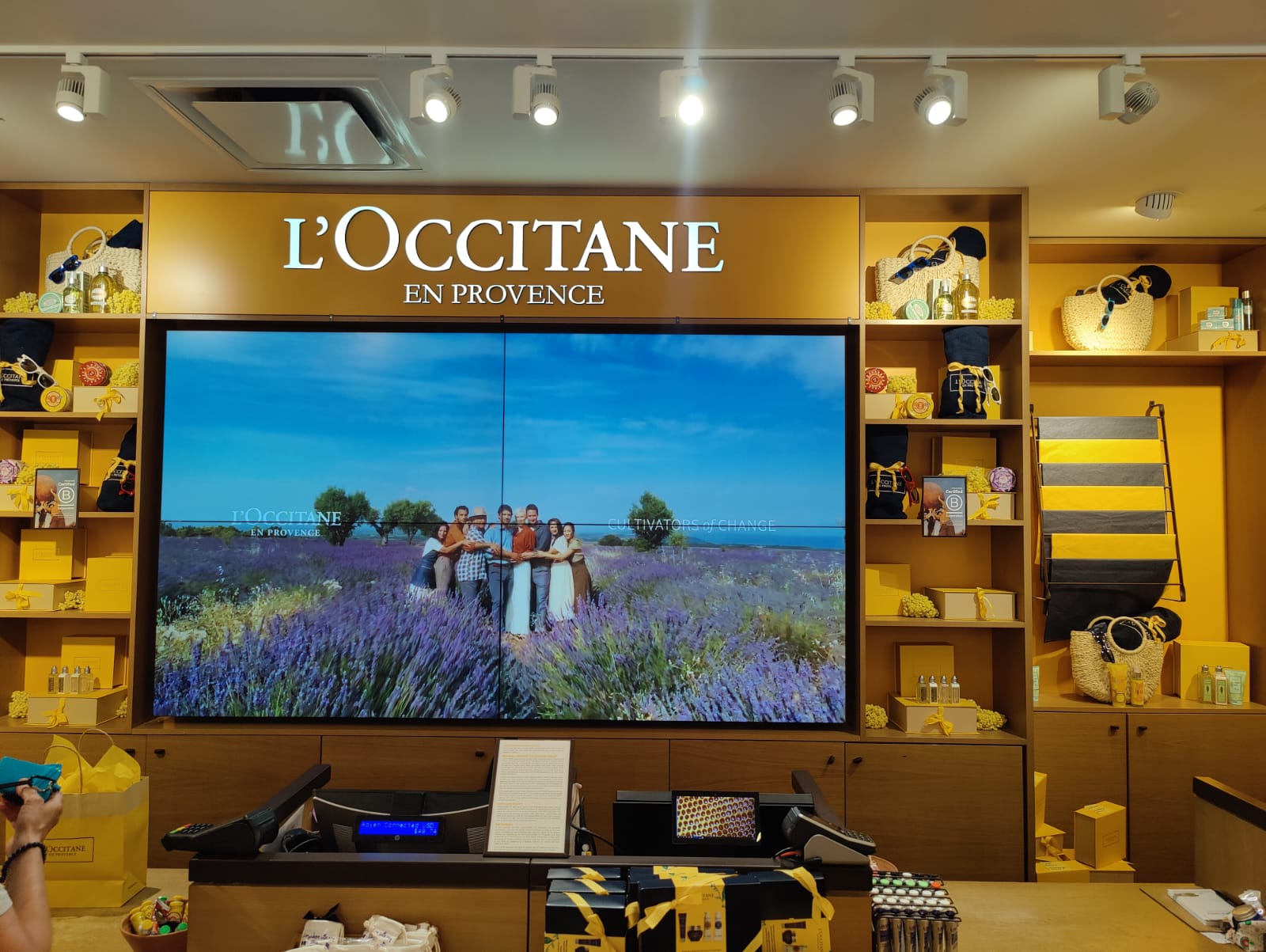
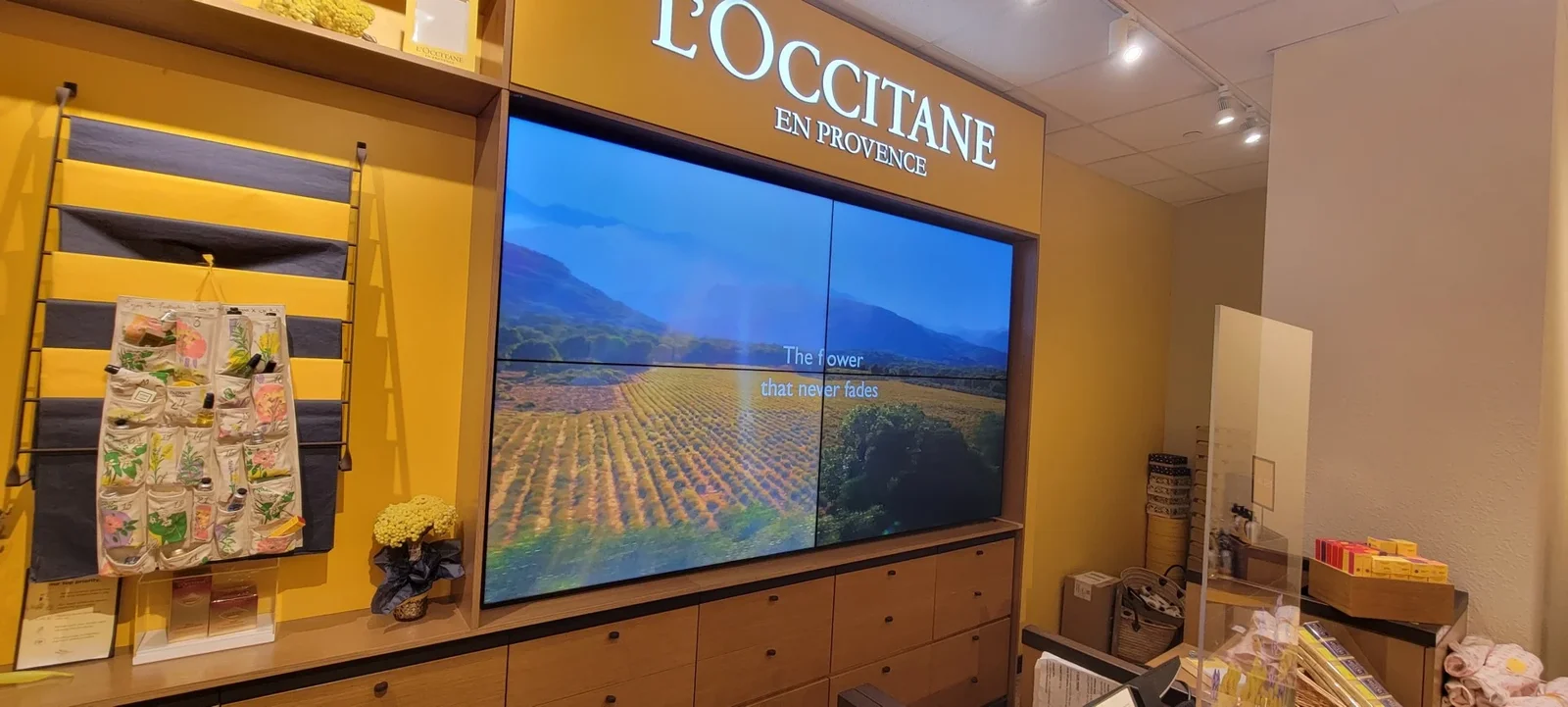
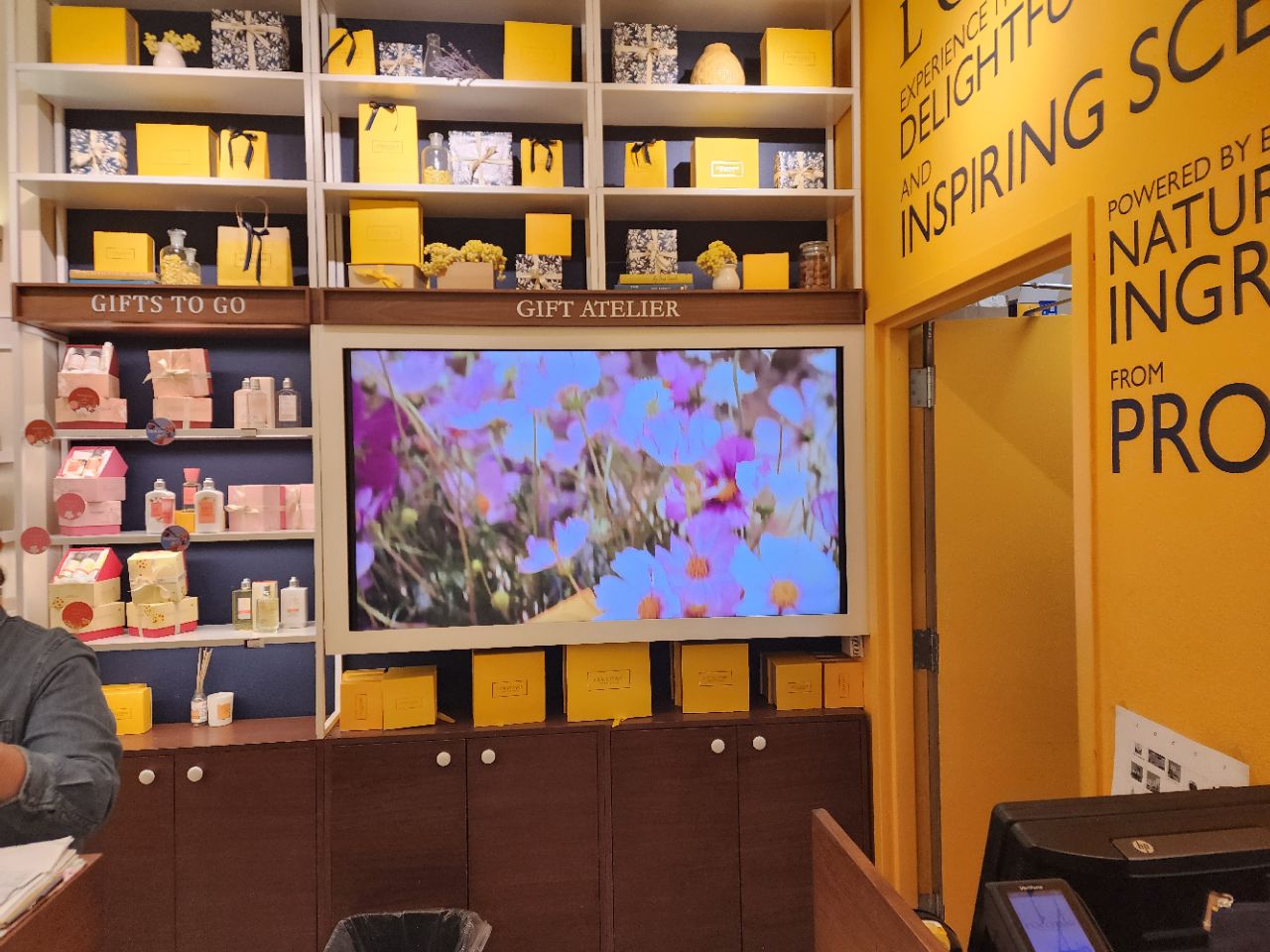
Hardware first. L'Occitane's chain runs Samsung commercial displays in three configurations chosen per store format. Flagship stores — including the Aventura Mall flagship — carry 3×3 video walls (nine 4K panels in a grid) for the hero moments at the front of the store. Standard boutiques run 2×2 video walls (four panels in a grid) at the brand wall position. Mall outlets and smaller satellite stores run single-panel installations — sometimes a portrait window-facing display, sometimes a landscape cash-wrap screen, sometimes both paired. Across the chain, 150+ boutiques run on a hardware family designed to work as one program rather than three.
The signage program is built around screen pairs in every store: a window-facing panel that anchors the storefront brand moment, and an interior cash-wrap or feature-wall panel that reinforces the same message at the point of sale. That pairing matters more than the per-store screen count. A customer who notices the window display walks in expecting continuity, and the cash-wrap screen delivers it. We co-engineered both panel positions with L'Occitane's visual merchandising team so the screens read as part of the boutique design language, not as bolted-on tech.
Permissions are where the platform earns its keep. The CrownTV Cloud Dashboard runs all 150+ stores with a three-tier model. IT has full system access — device provisioning, network configuration, security policies, audit logs. The central marketing team operates a campaign workflow — they upload seasonal creative, schedule chain-wide campaigns, and ship Instagram-feed content to specific store clusters. Store managers retain local-level customization scoped to their own boutique — they can run a flash promotion, swap creative for a local event, or adjust a schedule for a regional holiday, but they cannot push content to other stores or override the central campaign. Each tier operates independently without overstepping. The audit trail is unified.
Real-time device monitoring is part of the operational model, not a bolt-on feature. Every panel, media player, and network connection in every L'Occitane store reports status to the CrownTV operations center. We see a panel offline before the store reports it. That matters across 150+ locations where a black screen at 9am on a Saturday in a flagship is a brand failure that needs to be solved before lunch, not next week. The monitoring loop is the difference between a chain-of-150 program and a portfolio-of-150 individual installs.
After go-live
L'Occitane's marketing team ships seasonal campaigns and Instagram-feed content to 150+ stores from one place. The publishing workflow is identical regardless of whether the campaign is going to a 3×3 video wall flagship or to a single-panel mall outlet — the platform handles the format adaptation, the marketing team works at the campaign level. That is the result that matters: the platform let the brand operate at chain scale instead of at per-store scale.
The three-tier permission model has held up under load. IT runs infrastructure, marketing runs campaigns, store managers run local customization. The audit trail is clean. Tickets to our support team are about hardware faults and content questions, not about who-can-edit-what conflicts. That tells us the permission model is working — when a permission model is wrong, the support volume tells you within the first quarter.
European expansion is the next chapter — L'Occitane's roadmap has the same platform expanding across France, Luxembourg, the United Kingdom, Germany, and Belgium. We treat that as a logistics deployment, not a re-architecture. The Samsung panels are the same in Europe, the CrownTV media players ship internationally on the same kit, and the CMS does not need to be rebuilt for a different region. From the central marketing team's perspective, adding Paris is the same operation as adding Toronto.