Herman Miller Park Avenue showroom — 75-inch portrait digital display

Showroom campaign

Herman Miller · Park Avenue.

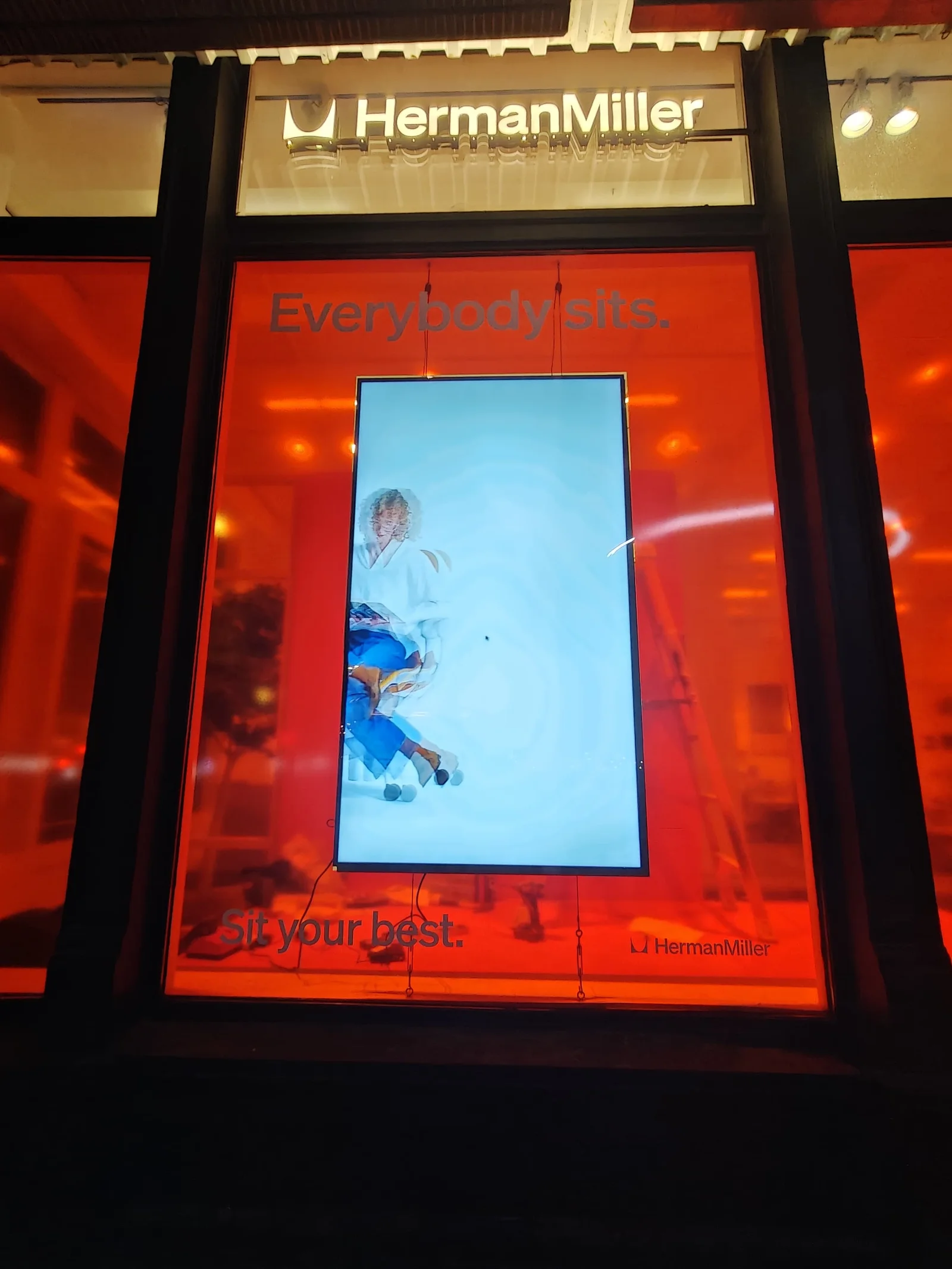
A 75″ Samsung QM75C 4K portrait display, cable-mounted and suspended against the bold red Cosm campaign backdrop, installed at the Herman Miller Park Avenue showroom — consultation to live in two weeks. Designed for Park Avenue pedestrians and the architects, interior designers, and corporate buyers who walk past.

Herman Miller — Park Avenue Park Avenue showroom · Cosm campaign
Samsung 4K portrait
QM75C 75″
Consult to live
2 weeks
NYC showroom
Park Avenue
Campaign launch
Cosm
The brief

What they needed

Herman Miller — the iconic American design firm — wanted a digital signage moment for the Park Avenue showroom to support the Cosm office chair launch. Brief: a single high-impact display, brand-true to Herman Miller's design language, suspended against a bold red campaign backdrop. Consultation to live in weeks, not months.

The work

What CrownTV shipped

CrownTV installed a Samsung QM75C 75″ 4K commercial display in portrait orientation, suspended by thin cables against the bold red campaign backdrop with the blue Cosm campaign visuals. The cable mount kept the install clean against the showroom's design-conscious architecture; no rear cabling visible, no bulky wall hardware competing with the campaign.

The result

Where it landed

Two-week timeline from consultation to live display. The Park Avenue campaign drew Park Avenue pedestrians and the architects, interior designers, and corporate buyers Herman Miller targets. Cosm launch executed against a brand-grade signage moment.

The deployment, in detail

How we built Herman Miller's install — operator to operator.

A long-form walkthrough of the brief, the hardware decisions, and the live result. The version we'd send another business owner if they asked us how this kind of program actually ships.

Inside the brief

Herman Miller called us with a brief that read as the opposite of every retail rollout we'd shipped that quarter. Not a chain. Not a multi-store program. One display, one room, one moment — the Park Avenue showroom, supporting the Cosm office chair launch. The brief was clear about what mattered: the install had to read as Herman Miller, not as 'the digital signage on top of Herman Miller.' If a passing architect or interior designer could see the technology before they saw the chair, the install had failed.

Park Avenue showrooms have an audience. Herman Miller's customer at this address is not the general public — it is the architecture firms, interior design practices, and corporate real-estate buyers who walk Park Avenue between client meetings. Brand-grade is not a marketing word for that audience. They notice the bezel of a panel, the visible cable run, the wall-mount bracket peeking from behind a frame. The brief required a display that disappeared as a piece of hardware and read entirely as part of the campaign architecture.

Timeline was the second constraint. Herman Miller wanted the install live in weeks, not months. The Cosm launch was on a marketing calendar, the showroom was active, and a long retrofit window was off the table. Two weeks from consultation to a live display became the operating target. That is a timeline that only works when the install team has done it before — which is the only reason we accepted that target on first call.

Inside the install

We specified a Samsung QM75C — 75-inch 4K commercial display — in portrait orientation. Two decisions in that spec line are doing the work. First, commercial-grade. The QM75C is designed for 16-hour daily operation in a commercial environment, with the heat management, color accuracy, and panel uniformity that a Park Avenue showroom requires. A consumer 75-inch panel would have read fine on day one and started showing burn-in patterns and color drift within months. Second, portrait orientation. A landscape 75-inch panel reads as television. Portrait orientation reads as architecture — it sizes for the human standing in front of it, and it lets the campaign creative (the blue Cosm chair against the bold red backdrop) carry the full vertical story.

The mount is where we earned the install. We used a thin-cable suspension system rather than a wall mount. The panel hangs in front of the bold red campaign backdrop with no wall hardware visible from the showroom floor. There is no rear cabling exposed — the signal and power runs are routed through the suspension cables themselves. From any approach angle in the showroom, the panel reads as a freestanding architectural element, not as a screen mounted to a wall. That choice keeps the campaign visible — the red backdrop reads continuously behind the panel, and the panel sits in front of it as a dynamic vertical surface. The blue Cosm chair imagery on the panel against the red backdrop produces the brand contrast the campaign was built around.

Day one to day fourteen is the install timeline. Day one was the consultation — site visit, brief confirmation, panel selection, mount engineering. Day four we'd locked the spec and ordered hardware. Day seven the QM75C and the cable suspension hardware were on the dock at our New York operations center. Day ten our install crew was in the showroom completing the mount. Day fourteen the panel was live, content was scheduled, and the Cosm campaign was running. That timeline only works because the install team handled every link in the chain — same team on the consultation, the spec, the mount engineering, and the ladder. No subcontractors, no handoffs, no schedule slips.

After go-live

Two weeks from consultation to a live display on Park Avenue. The Cosm launch executed against a brand-grade signage moment — the panel did the campaign work without ever announcing itself as a panel. Park Avenue pedestrians stopped. The architects, interior designers, and corporate real-estate buyers who Herman Miller specifically wants in that room engaged with the campaign in the way the brand intended.

The reference value of the install is what makes it worth publishing as a case study. Most digital signage case studies are about scale — number of stores, number of screens, number of locations. This one is about the opposite. One screen, one room, one campaign, one fortnight. It is the proof that we run the same end-to-end model for a single-display showroom moment as we do for a 150-store chain. The discipline that ships 150 stores reliably is the same discipline that ships one panel cleanly on a two-week timeline.

Herman Miller has the install as a permanent showroom asset — the Cosm campaign was the launch use case, but the panel and the suspension-mount architecture continue to serve subsequent campaigns from the same fixture. A future product launch ships new creative to the same display without any further hardware work.

Behind the brief

The decisions that shaped the install.

Not every spec line ships in a press release. Here's what we got asked about, what we picked, and why.

  1. Commercial QM75C, not consumer 75-inch

    16-hour daily operation, commercial color accuracy, panel uniformity at scale. A consumer panel would have looked fine on opening day and started failing brand-grade by spring.

  2. Portrait orientation against the red backdrop

    Landscape reads as television. Portrait reads as architecture. The campaign creative was built around vertical brand presentation, and the orientation choice committed to that framing.

  3. Thin-cable suspension mount, not wall mount

    The panel had to read as a freestanding architectural element with no visible hardware. The cable mount routes signal and power through the suspension cables themselves, leaving the red backdrop unbroken.

  4. Same team from consultation to install

    Two-week timelines fail when there is a handoff. Our consultation lead, mount engineer, and install crew were the same team across all fourteen days. That continuity is the only reason the timeline held.

  5. Permanent install, not campaign-only

    We specified the suspension architecture so the panel could carry future campaigns without further hardware work. The fixture is a permanent showroom asset, not a one-launch installation.

From the operator's seat

What worked. What we'd do differently.

What worked

The thin-cable suspension mount. We could have wall-mounted the panel against the red backdrop and called it done. The suspension mount is the reason the install reads as architecture instead of as hardware — and that is the only outcome that mattered for a Park Avenue showroom serving Herman Miller's brand-conscious clientele. Specifying that mount in the consultation cost us additional engineering time. It paid back the moment the panel went live.

What we'd do differently

We would build a sample-of-the-mount mockup at our New York operations center earlier in the spec phase. We did the engineering on paper and validated in the showroom — that worked, but a physical mockup before the install would have shortened the on-site time by half a day. On a two-week timeline, half a day is meaningful, and on a future single-display flagship moment we would do that mockup work in our shop first.

Timeline

Day 1 brief. Day 14 live.

Two weeks from consultation to a 75″ portrait display suspended on Park Avenue against the bold red Cosm campaign backdrop.

Herman Miller showroom · Park Avenue · NYC

Day 1 Brief Day 4 Spec Day 7 Hardware on dock Day 10 Mount + cabling Day 14 Live Single 75″ Samsung QM75C · portrait · cable-mounted, suspended against the Cosm campaign backdrop Conceptual day-by-day milestones — the canonical case study cites a two-week consultation-to-live timeline
Source: canonical Herman Miller Park Avenue case study

The Park Avenue campaign proved that digital signage can elevate even the most design-conscious brands.

Client Partner, Herman Miller
Spec sheet

What we shipped to Herman Miller.

Every item below came from CrownTV under one contract — Samsung commercial-grade hardware, CrownTV media players, custom mounts, and certified install crews.

Samsung QM75C — 75″ 4K commercial display
Portrait orientation · cable-mounted, suspended
Single display campaign install
Two-week consultation-to-live timeline

Source · canonical Herman Miller case study

The lookbook

Herman Miller — Park Avenue, in the field.

Real photos · real installs

Herman Miller Park Avenue showroom
Park Avenue showroom · QM75C portrait
Questions on this install

What buyers in Corporate ask us about this case study.

What hardware did Herman Miller choose for the Park Avenue showroom display?
A Samsung QM75C — 75-inch 4K commercial display — in portrait orientation, suspended by thin cables against the bold red Cosm campaign backdrop. Driven by a CrownTV media player and managed via the CrownTV Cloud Dashboard.
How long did the Herman Miller Park Avenue install take?
Two weeks from consultation to live display. Day one was the on-site consultation, day fourteen the panel was live with Cosm campaign content scheduled and running.
Why was the display mounted on a cable suspension instead of a wall mount?
The Park Avenue showroom serves an architecture and design audience — visible wall hardware would have read as 'screen mounted to wall,' not as part of the campaign architecture. A thin-cable suspension routes signal and power through the cables themselves, leaving the red campaign backdrop unbroken behind the panel.
Is the Herman Miller display a permanent install or campaign-only?
Permanent. The suspension architecture was specified so the panel can carry future campaigns from the same fixture. Future product launches ship new creative to the same display without further hardware work.
Who was the audience for the Park Avenue Cosm campaign?
The architects, interior designers, and corporate real-estate buyers who walk Park Avenue between client meetings — Herman Miller's specific B2B audience for an office-chair launch at a showroom address.
Your name here

Want a showroom rollout like Herman Miller's?

Single storefront or 500-location chain — same New York team that shipped the work above. Photos in this gallery within 90 days.