
Best High-Brightness Displays in 2026: 7 Window & Storefront Screens Ranked
The 7 best high-brightness displays of 2026, ranked by nits, warranty, price and lead time. Samsung OM55B (3,000 nits, $2,750) leads; window vs outdoor.
On this page
Reply within 2 business hours Ask a signage specialist Tap to open the quote form
Search for the best high-brightness display and Google serves you component makers, gaming monitors, and instructions for turning up Windows brightness. This guide covers the one that costs businesses real money: commercial screens that must stay readable through sunlit glass. Our #1 pick for 2026 is the Samsung OM55B — 3,000 nits, 4K, 24/7-rated, $2,750 and in stock to ship in 1 business day. Below: what "high-brightness" actually means, how we scored seven panels, and which one fits your window. Want it installed? CrownTV's window display package starts from $3,950 per window installed.
CrownTV installs high-brightness displays for a living — storefront windows, real-estate grids, drive-thru lanes — as a Samsung Authorized Reseller with 16,000+ screens live. This ranking reflects what we actually deploy and what we'd bid against; where a competitor wins a lane, we say so.
What a high-brightness display is (and what it is not)
A high-brightness display is a commercial LCD engineered to stay legible in bright ambient light or direct sun. The number that defines the category is sustained full-screen brightness, measured in nits (cd/m²): 1,500 nits is the floor, the mainstream window panels in this guide run 3,000–4,000 nits, and a consumer TV or standard signage panel sustains 250–500. Direct sunlight on glass measures around 100,000 lux; against that, a 500-nit screen is a black mirror from the sidewalk.
Brightness alone does not make the product. A true high-brightness display also carries: thermal engineering for the greenhouse heat behind glass (Samsung's OM-class is rated to 40 °C ambient and adds overheating mitigation); an ambient-light sensor so 3,000 nits at noon becomes a few hundred at night instead of a glare complaint; a 24/7 duty rating, because a window sign never gets switched off; IP5X dust validation for the sealed cabinet; and a low-haze, anti-reflective surface so the glass in front of it doesn't undo the brightness.
What it is not: a consumer "HDR 1,500-nit" TV (that figure is a small-window peak, not sustained output, and the warranty excludes commercial use); a 700-nit "high-bright" indoor panel (fine for an atrium, hopeless behind sun-facing glass); and an outdoor display. That last distinction matters most. In-window panels are rated 0–40 °C with dust protection only. Fully outdoor panels (Samsung OH-class) add an IP56-sealed cabinet, IK10 impact glass and a −30 to 50 °C range — a different, costlier product, covered in our outdoor digital signage guide. This article ranks both kinds side by side so you can see exactly where the line falls.
How we ranked these displays
Every model is scored on four numbers you can verify yourself, each from a manufacturer datasheet or a live retail page (checked 2026-10-14):
- Brightness (nits, typical). The manufacturer's typical full-screen figure, not peak. 3,000 nits scores 3 of 5; 3,500 scores 4; 4,000 scores 5. Below 2,500 does not make the list.
- Warranty (years). Commercial parts-and-labor coverage. 3 years is the category standard and scores 3; shorter or parts-only terms lose a point.
- Price (DisplayDetails, today). The live price on DisplayDetails, CrownTV's Samsung-authorized store, so it stays current as the catalog reprices. Scored per inch of screen against the group: cheapest per inch scores 5. Models we don't stock are quoted per project and scored on list-price parity.
- Lead time (business days). Days from cleared payment to the carrier. 1 business day scores 5, 5–7 business days scores 3, quote-to-order scores 2.
Scores are summed with equal weight; ties go to the panel that fits more placements (a 4K in-window unit beats an FHD one at the same score). Fully outdoor units are scored on the same four numbers but ranked within their own lane, since nobody choosing between them is also choosing an OM55B. The result is a ranking by value for a storefront, not a ranking by raw nits — which is why the 4,000-nit OM46B sits at #2 behind the 3,000-nit OM55B that costs less, ships faster and runs 4K.
The 7 best high-brightness displays in 2026
1. Samsung OM55B, best for a sun-facing storefront window
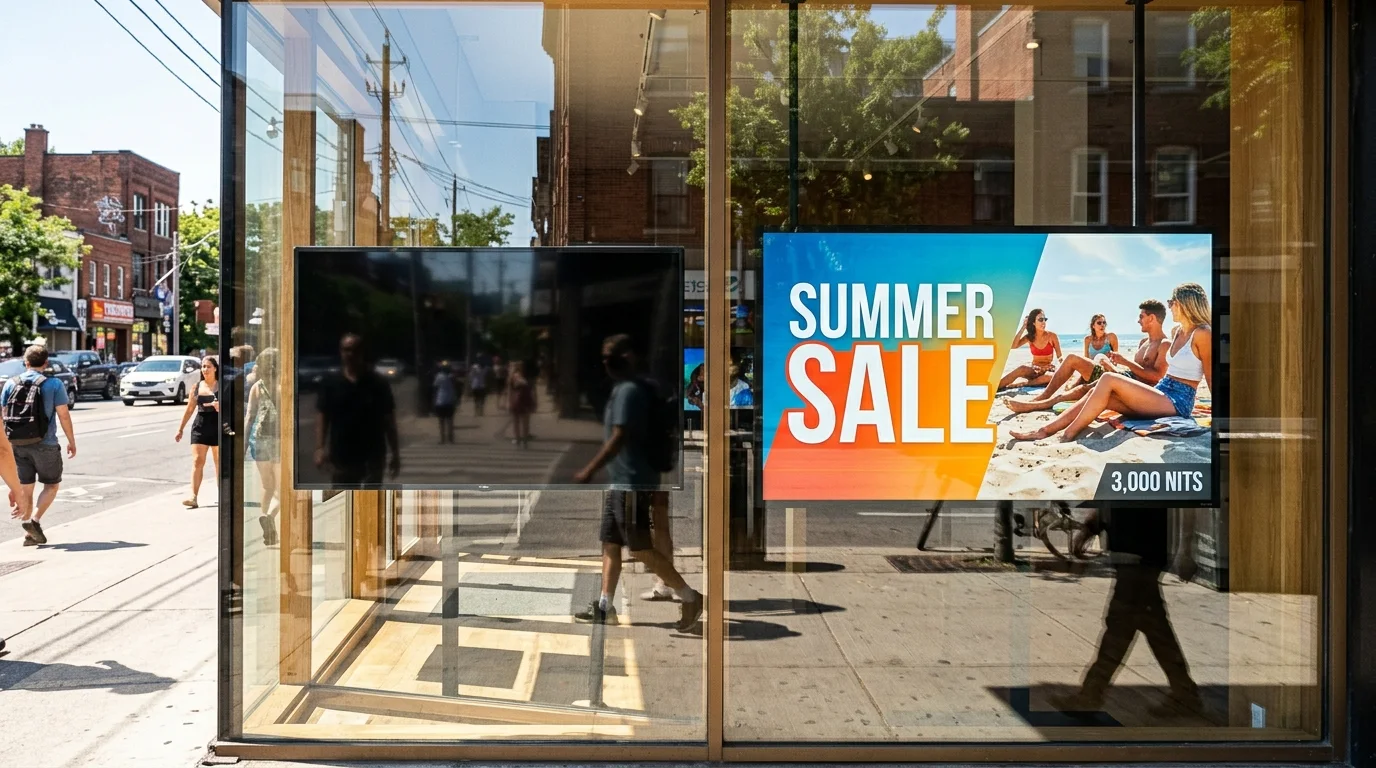
The default answer for storefront glass. Samsung's 55-inch OMB window display runs 3,000 nits typical on a 3,840 × 2,160 ADS panel, rated for 24/7 operation and 0–40 °C ambient, with IP5X-validated dust protection and an ambient sensor for auto-brightness. It is the only 4K panel under $7,900 on this list and the only one in stock at DisplayDetails today — $2,750, ships in 1 business day from New York, free insured freight in the contiguous US, 3-year Samsung commercial warranty, purchase orders accepted. Portrait or landscape; mounts ceiling-hung or on a floor stand behind the glass. Full review: Samsung OM55B.
Best suited for: a single- or multi-screen retail, salon, real-estate or restaurant window that takes direct sun for part of the day and needs sharp 4K text at sidewalk distance. It is the panel inside CrownTV's installed window package, from $3,950 per window.
2. Samsung OM46B, best for narrow glazing and mullion grids
The 46-inch sibling is actually brighter — 4,000 nits typical — on a 1,920 × 1,080 panel, with the same 24/7 rating, 0–40 °C range, IP5X dust validation and auto-brightness sensor. Why it ranks second rather than first: it is FHD rather than 4K, and at $2,799 it costs slightly more than the OM55B for less screen. Where it wins is physical fit: a 46-inch panel drops between the mullions of a typical storefront bay where a 55 won't, and the extra 1,000 nits is insurance for west-facing glass. Ships in 5–7 business days from DisplayDetails; 3-year Samsung commercial warranty; freight-free in the contiguous US.
Best suited for: real-estate listing grids, pharmacy and bank windows with narrow glass sections, and any west- or south-facing window where you want headroom above 3,000 nits. Pair in rows of three or four for a listing wall.
3. Samsung OM75A, best for large-format glazing
When the window is big enough that a 55 looks like an afterthought, the 75-inch OM75A keeps the brightness at a size that owns the elevation: 4,000 nits typical, 3,840 × 2,160, 24/7-rated, 0–40 °C, IP5X dust protection, Tizen media player built in. It is the most expensive in-window panel here at $7,900 and the heaviest to mount, so it is a flagship-window purchase rather than a chain-wide one. Ships in 5–7 business days from DisplayDetails (Samsung backorders on the 75-inch class can run 2–4 weeks — we confirm in writing before you pay); 3-year commercial warranty. Review: Samsung OM75A.
Best suited for: flagship retail, auto showrooms, lobbies with floor-to-ceiling glass, and hospitality entrances where one screen has to read from across the street. CrownTV installs it display-only or as part of a window package quoted per site.
4. Samsung OM55N-DS, best double-sided window display
Two faces in one ceiling-hung unit: 3,000 nits outward to the sidewalk and 1,000 nits inward to the store, each 55-inch 1,920 × 1,080, with IP5X dust protection and a 0–40 °C rating. One mounting point, one power drop, one LAN cable — the best value per installed dollar in window signage when both sides of the glass have an audience. At $4,599 it costs less than two OM55Bs plus a second mount, which is the honest comparison. Ships in 5–7 business days from DisplayDetails; 3-year Samsung commercial warranty. Review: Samsung OM55N-DS.
Best suited for: real-estate offices, salons, banks and quick-service restaurants where the window faces foot traffic and the same glass backs onto a waiting area or queue. Not for direct-sun interiors — the 1,000-nit inward face is sized for a lit store, not a second sunlit side.
5. Samsung OH46B, best fully outdoor display under 50 inches
Different category, same mission. The 46-inch OHB-S is an all-in-one outdoor unit: 3,500 nits typical (4,000 peak), 1,920 × 1,080, IP56-sealed cabinet against rain, snow and pressure-washing, IK10 tempered protection glass, −30 to 50 °C operating range, 24/7-rated, with an auto-brightness sensor. That envelope is why it costs $4,499 — roughly 60% more than the in-window OM46B — and why you should not buy it for a window. Ships in 5–7 business days from DisplayDetails; 3-year Samsung commercial outdoor warranty (parts and labor, sealed cabinet must remain intact).
Best suited for: drive-thru order confirmation and pre-sell boards, gas-station pump islands, outdoor menu boards and courtyard wayfinding where the screen is exposed to weather but space is tight. Environment and enclosure planning lives in the outdoor signage guide.
6. Samsung OH55A-S, best fully outdoor display at 55 inches
The exterior-wall workhorse: 3,500 nits typical (4,000 peak), UL-verified for outdoor use, 55-inch 1,920 × 1,080, IP56 cabinet, IK10 Magic Protection Glass, −30 to 50 °C, 24/7-rated, auto-brightness. At $5,499 it is the most expensive panel in this guide bar the 75-inch OM75A, and it earns that only when the screen genuinely lives outside. Ships in 5–7 business days from DisplayDetails; 3-year Samsung commercial outdoor warranty. Review: Samsung OH55A-S.
Best suited for: building exteriors, transit shelters, stadium concourses, outdoor dining and any drive-thru lane that needs 55 inches of menu. If the screen can sit behind glass instead, buy the OM55B and bank the difference.
7. LG 55XS4P, best non-Samsung in-window alternative
LG's current window-facing panel is the honest bid we put next to the OM-class: 4,000 nits typical, 3,200 minimum, 55-inch 1,920 × 1,080 IPS, 24/7-rated, 3% haze surface, webOS 6.0 with a built-in quad-core player, a "quiet mode" that holds 2,500 nits with the fans down, and conformal-coated boards. LG rates it 0–40 °C without direct sun but only 0–30 °C in direct sunlight, which is a tighter window than Samsung's and matters in a south-facing bay in July. Warranty: 3-year limited per LG's US spec sheet. CrownTV is not an LG stockist, so this one is quote only — expect a lead time measured in weeks rather than days.
Best suited for: a fleet that is already on LG webOS and SuperSign and wants one management stack, or a window where 4,000 nits is non-negotiable and the 46-inch OM46B is too small. For everyone else, the OM55B at $2,750 and in stock is the better total package; the wider rivalry lives in Samsung vs LG.
Side-by-side comparison
| Model | Nits (typ.) | Size / res. | Placement | Duty | Price | Warranty | Lead time |
|---|---|---|---|---|---|---|---|
| Samsung OM55B | 3,000 | 55″ · 4K | In-window | 24/7 | $2,750 | 3 yr commercial | 1 business day (in stock) |
| Samsung OM46B | 4,000 | 46″ · FHD | In-window | 24/7 | $2,799 | 3 yr commercial | 5–7 business days |
| Samsung OM75A | 4,000 | 75″ · 4K | In-window | 24/7 | $7,900 | 3 yr commercial | 5–7 business days |
| Samsung OM55N-DS | 3,000 out / 1,000 in | 55″ ×2 · FHD | In-window, double-sided | 24/7 | $4,599 | 3 yr commercial | 5–7 business days |
| Samsung OH46B | 3,500 (4,000 peak) | 46″ · FHD | Fully outdoor, IP56 / IK10 | 24/7 | $4,499 | 3 yr commercial outdoor | 5–7 business days |
| Samsung OH55A-S | 3,500 (4,000 peak) | 55″ · FHD | Fully outdoor, IP56 / IK10 | 24/7 | $5,499 | 3 yr commercial outdoor | 5–7 business days |
| LG 55XS4P | 4,000 (3,200 min.) | 55″ · FHD | In-window | 24/7 | Quote | 3 yr limited | Quote |
Checked 2026-10-14. Nits, duty and temperature ratings from Samsung and LG datasheets; prices and lead times from DisplayDetails (Samsung-authorized, ships from New York). Free insured freight in the contiguous US; purchase orders accepted.
Which high-brightness display fits your use case
| Placement | Pick | Why |
|---|---|---|
| Storefront window, sun-facing | Samsung OM55B ($2,750) | 3,000 nits typical clears direct sun on most glass; 4K for text at sidewalk distance; in stock, ships in 1 business day. Step up to the 4,000-nit OM46B for narrow bays or all-afternoon west sun. |
| Lobby or showroom near glass | Samsung OM75A ($7,900) | Floor-to-ceiling glazing wants a screen that reads from the street; 75″ at 4,000 nits does it without a video wall. If the spot never takes direct sun, a 700-nit QM-class panel is enough — ask us before over-buying. |
| Drive-thru lane | Samsung OH46B ($4,499) | Weather-exposed, often low to the ground, frequently hit — IP56 sealing and IK10 glass are the requirement, not the upgrade. 46″ fits the lane pole and pre-sell position. |
| Fully outdoor wall or patio | Samsung OH55A-S ($5,499) | UL-verified 3,500 nits, −30 to 50 °C, sealed against rain and pressure-washing. Enclosure, power and mounting are covered in the outdoor signage guide. |
| Transit, bank or office window with two audiences | Samsung OM55N-DS ($4,599) | 3,000 nits to the street, 1,000 to the interior, one ceiling mount and one power drop. Cheaper than two single-sided panels and the second mount. |
| LG webOS fleet, window | LG 55XS4P (quote) | 4,000 nits and the same management stack as the rest of an LG estate; watch the 0–30 °C direct-sun rating and the longer lead time. |
Checked 2026-10-14. Picks assume a single screen per position; multi-screen grids and video walls are quoted per project.
Buying rules that outrank any spec sheet
- Sustained beats peak. Consumer "1,500-nit" TVs hit that number on a small HDR window; full-screen sustained output is what a sign needs, and it is typically a third of the marketing figure. Every panel above is rated on typical full-screen brightness.
- Spec the worst-case orientation. East glass gets blasted at breakfast, west at dinner. Buy for the hour the sun is worst, not the daily average — and check the direct-sun temperature rating, not just the ambient one.
- Heat is the silent killer. A window bay is a greenhouse; panels without window-rated thermal engineering cook in year one, and the warranty excludes it.
- Auto-dimming is mandatory. 3,000 nits at 10 p.m. is a glare complaint. Every panel above runs an ambient sensor; make sure your installer leaves it enabled.
- In-window is not outdoor. OM-class and XS-class panels are rated 0–40 °C with dust protection only. If rain can reach the screen, it needs the OH-class IP56 cabinet — see the outdoor signage guide.
- Budget 2–3× a standard panel. The 55″ Samsung OM55B is $2,750 for the panel and from $3,950 per window installed as a package (mount, media player, install, first-year software). Full installed ranges on our digital window displays page and in the digital signage cost guide.
How CrownTV Helps
- Samsung Authorized Reseller — OM window, OM double-sided and OH outdoor lines sold with the 3-year commercial warranty intact, via DisplayDetails: free insured freight in the contiguous US, purchase orders accepted, OM55B in stock today.
- Glass-first scoping: send window dimensions, orientation and a photo — we spec the honest nits level, including talking you down when 700 is enough.
- Licensed, insured installation in all 50 states: ceiling-hung or floor-stand window mounting, power to the bay, heat management, from $3,950 per window installed.
- One dashboard for window, outdoor and indoor screens together.
Get a high-brightness display quote in two business hours →
Frequently asked questions
What is a high-brightness display?
A commercial screen engineered to stay readable in bright ambient light or direct sun — typically 1,500 nits and up, versus 250–500 nits for consumer TVs and standard signage panels. Beyond raw brightness, true high-brightness displays add thermal management for the heat load behind glass, anti-reflective surface treatments, 24/7 duty ratings, and ambient-light sensors that dim the panel at night.
How many nits do I need?
Match brightness to exposure: 500–700 nits for bright interiors and atriums, 1,500–2,500 for windows with indirect light, 2,500–3,000+ for glass in direct sun, and 3,500–4,000+ for fully outdoor placements. Direct sunlight measures around 100,000 lux — against that, a 500-nit panel reads as a black mirror from the sidewalk. Spec for the worst-case sun orientation, not the average.
What nits do I need for a sun-facing window?
Plan on 3,000 nits typical for south- or west-facing glass that takes direct sun for part of the day, and 4,000 nits if the sun sits on the glass most of the afternoon or the window is tinted. That is why the Samsung OM55B (3,000 nits) is the default and the OM46B, OM75A and LG 55XS4P (4,000 nits) are the step-up picks. Below 2,500 nits a sun-facing window will wash out at the exact hour foot traffic peaks.
Is a high-brightness display the same as an outdoor display?
No. A high-brightness window display (Samsung OM-class, LG XS-class) is rated for 0–40 °C behind glass with IP5X dust protection only — it must stay indoors. A fully outdoor display (Samsung OH-class) adds an IP56-sealed cabinet, IK10 impact glass and a −30 to 50 °C operating range so it survives rain, snow and pressure-washing. Outdoor units cost roughly 60–100% more at the same size, so buy the window version unless the screen will genuinely be exposed to weather.
What's the best high-brightness display for a store window?
The Samsung OM55B is our default recommendation: 3,000 nits, 4K, 24/7-rated, portrait or landscape, with an ambient sensor for auto-brightness, at $2,750 and in stock. If the window serves foot traffic on both sides, the double-sided OM55N-DS ($4,599) shows 3,000 nits to the sidewalk and 1,000 nits to the store interior from a single ceiling-hung unit. Larger glazing steps up to the 75-inch, 4,000-nit OM75A.
Can I use a regular TV as a high-brightness display?
No. Consumer TVs advertise peak HDR brightness measured on a small window of the screen — sustained full-screen output is typically 300–600 nits, which vanishes behind sunlit glass. They also aren't rated for the greenhouse heat load of a window bay or 24/7 duty, and every major manufacturer's consumer warranty excludes commercial use. The panel that looks cheaper becomes the expensive one when it fails in the first year.
How much do high-brightness displays cost?
Roughly 2–3× a standard commercial panel of the same size. At DisplayDetails pricing today: Samsung OM55B $2,750, OM46B $2,799, double-sided OM55N-DS $4,599, 75-inch OM75A $7,900; fully outdoor OH46B $4,499 and OH55A-S $5,499. All ship freight-free in the contiguous US with a 3-year Samsung commercial warranty; purchase orders accepted. CrownTV's installed window package — panel, ceiling or floor mount, media player, install and first-year software — starts from $3,950 per window.
Read Next
What results look like
Retail
L'Occitane en Provence
150+boutiques
L'Occitane needed one content platform across its entire North American footprint — 150+ boutiques in the United States and Canada — with control split between IT, central marketing, and…
Read the case study →Retail
Victoria's Secret & PINK — Fifth Avenue
15screens
For the 24,000 sq ft Victoria's Secret + PINK flagship at 640 Fifth Avenue, CrownTV designed and installed 15 Samsung commercial displays — 98-inch QM98 panels paired with 85-inch QM85C…
Read the case study →DISPLAYDETAILS · BY CROWNTV · SHIPS NATIONWIDE
High-brightness displays, direct from CrownTV
3,000-nit storefront display — beats midday glare.
Samsung OM55B
55-inchSamsung Authorized Reseller — direct allocation, full warranty
- Price-match guarantee — find it cheaper, we'll match it.
- 3-year Samsung commercial warranty — RMAs handled by us.
- Free nationwide shipping — every panel, every order.
- Purchase orders, tax-exempt orders accepted.
Browse the full Samsung OM series lineup at DisplayDetails →
Keep reading
More guides like this
Operator-grade playbooks, weekly.
Proof, not pitches
See real installs
Live deployments across hospitality, retail, and offices.
Ready to deploy?
Get a quote in 2 business hours
Reply within two business hours. No call required.