Pressed Juicery digital menu board installation in retail location

QSR menu rollout

Pressed Juicery menu boards.

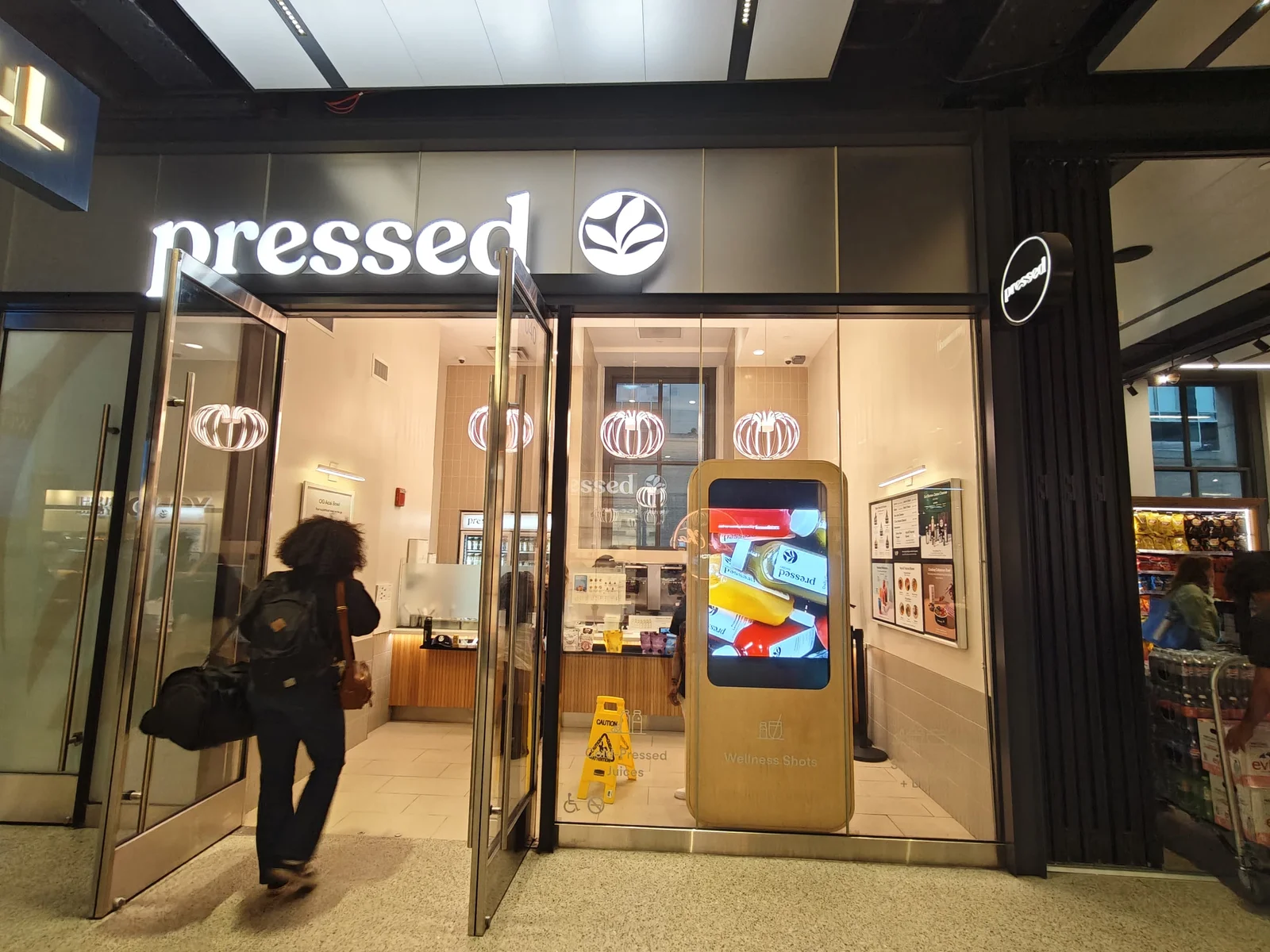
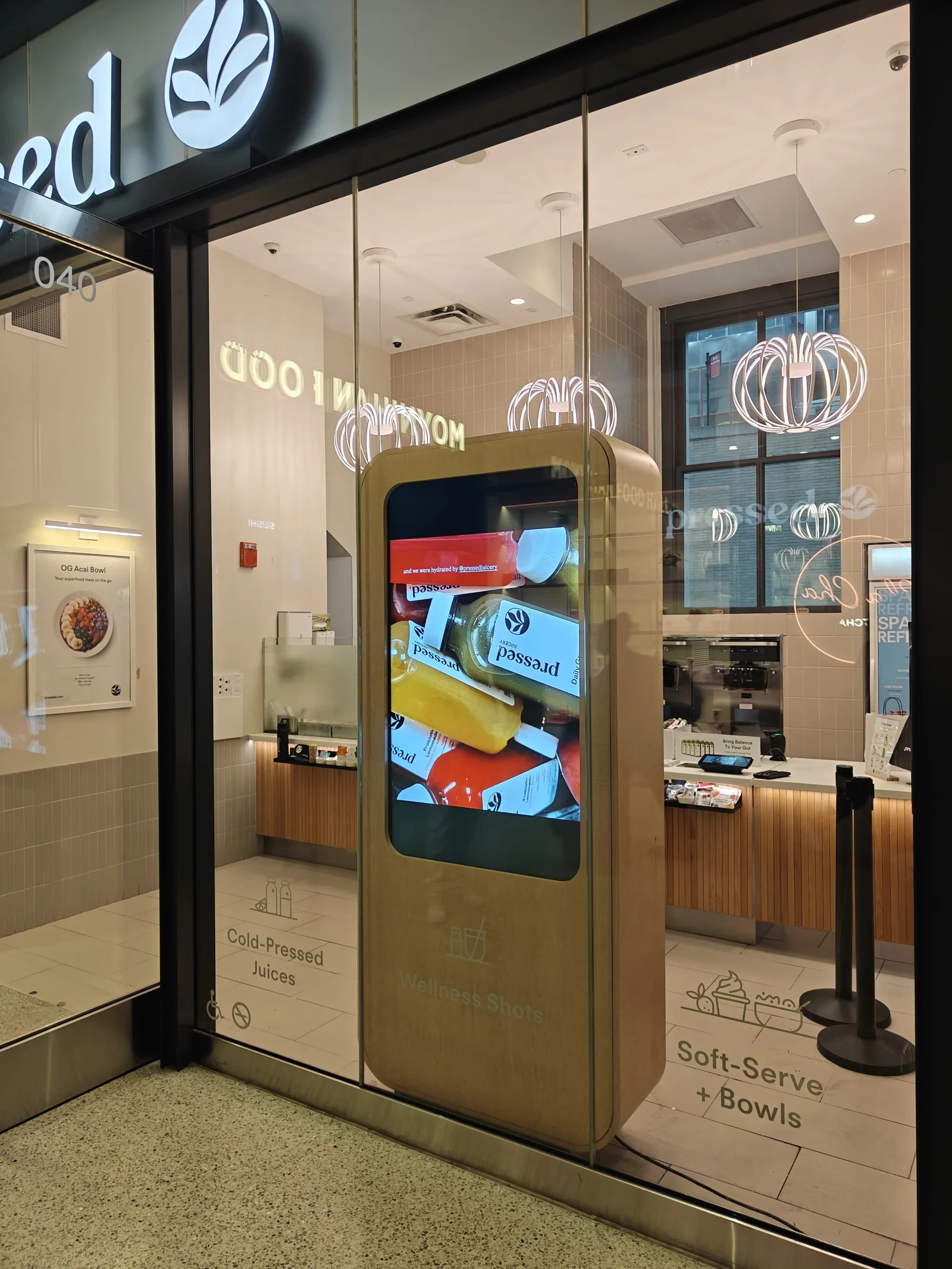
Five Samsung QMC 43″ menu boards per store across Pressed Juicery's nationwide footprint, plus a featured double-sided 55″ kiosk in a custom birch wood enclosure at Moynihan Train Hall / Penn Station — individually zoned content per screen, fleet-wide updates in seconds.

Pressed Juicery Penn Station Moynihan · 5×43″ menu boards
Menu boards per store
5× QMC 43″
Moynihan flagship
Penn Station
Double-sided kiosk
OM55B 3,500 nits
Enclosure
Custom birch
The brief

What they needed

Pressed Juicery — founded 2010, with 2M+ social followers and 7B media impressions across categories including juices, smoothies, bowls, Freeze (dairy-free soft serve), and wellness shots — needed digital menu boards across the chain plus a high-traffic flagship moment at Penn Station's Moynihan Train Hall. The brief: a uniform menu-board hardware spec at every store and a custom-enclosure double-sided kiosk for the Penn Station concourse.

The work

What CrownTV shipped

Per store, CrownTV installed five Samsung QMC 43″ 4K landscape panels mounted in a horizontal row above the counter. The Penn Station kiosk uses a single Samsung OM55B 55″ 3,500-nit panel installed double-sided (one face to the train concourse, one face into the store) inside a custom birch wood enclosure with rounded corners. Each screen runs individually-zoned content from the CrownTV cloud, and fleet-wide updates publish to all stores simultaneously.

The result

Where it landed

Menu items, prices, and seasonal LTOs publish across every store from one dashboard. The Penn Station flagship draws train-concourse foot traffic into the store via the bright, double-sided kiosk. Operations stopped printing physical menus.

The deployment, in detail

How we built Pressed Juicery's install — operator to operator.

A long-form walkthrough of the brief, the hardware decisions, and the live result. The version we'd send another business owner if they asked us how this kind of program actually ships.

Inside the brief

Pressed Juicery is a QSR brand operating in a category that does not behave like burgers or pizza. The product mix is wide — cold-pressed juices, smoothies, bowls, Freeze (dairy-free soft serve), wellness shots — and the menu rotates with seasonality and promotional cycles in ways that broke a printed-menu workflow well before the brief reached us. Adding a new SKU meant reprinting menu boards across every store and waiting for the print run to land. A seasonal LTO had to ship to every location simultaneously or the customer experience broke at the locations that were behind. The brief came from operations and from marketing in equal measure: get the menu boards on a content management system, and ship a flagship moment in the highest-foot-traffic transit hub in New York.

Penn Station's Moynihan Train Hall flagship was the second half of the brief. Moynihan opened in 2021 as the Amtrak / Long Island Rail Road expansion of Penn Station and immediately became one of the highest-density commuter foot-traffic hubs in the country. Pressed Juicery's location there sits at the edge of the train concourse — the traffic pattern is thousands of commuters walking past per hour during peak windows. A standard menu board behind the counter would address the customer who already chose to step into the store. The Moynihan brief was different: capture the commuter in the concourse first, then convert them into a customer at the counter. That meant a kiosk in the concourse itself, double-sided, with one face that read at full brightness against transit-hub lighting.

The chain rollout had a third constraint baked in: hardware uniformity. Every Pressed Juicery store had to ship with the same menu-board hardware kit so the operations team could train one install playbook, the support team could stock one parts inventory, and the brand team could template content against one screen format. Bespoke per-store hardware was off the table — the chain had to feel uniform from a guest's perspective, and that started with the screen estate behind every counter being identical.

Inside the install

Per-store: five Samsung QMC 43-inch 4K landscape commercial panels mounted in a horizontal row above the counter. We chose 43-inch deliberately. A larger panel like a 55-inch row would have over-delivered for the average Pressed Juicery counter footprint and crowded the architecture; a smaller 32-inch row would have made the menu unreadable from the back of a crowded queue. 43-inch is the sweet spot for most QSR menu-board installations, and the QMC 4K panels render dense menu typography with the clarity the product photography deserves. Mounting is a horizontal row: five panels spanning the menu width, each one running an individually-zoned content slot from the CrownTV cloud. The brand team pushes new menu items, price changes, and seasonal LTOs to specific zones without having to re-render the entire menu screen.

Penn Station Moynihan was a custom build. The kiosk is a single Samsung OM55B 55-inch panel installed double-sided — one face to the concourse, one face into the Pressed Juicery store. The OM55B is a 3,500-nit high-brightness commercial panel; that brightness rating is what lets the concourse-facing side stay readable against Moynihan's substantial overhead lighting and large skylight. We worked with a millwork partner to build a custom birch wood enclosure with rounded corners that holds both faces of the kiosk and integrates with the architectural language of the train hall. The kiosk is not a screen on a stand — it is a piece of the store that happens to be sited fifteen feet outside the storefront.

Content topology runs on the CrownTV Cloud Dashboard. Each of the five per-store menu boards is an individually-zoned content target — different content can run on each of the five panels simultaneously, scheduled to the minute or to the hour. The Penn Station kiosk runs as two zones (concourse face and store face) on the same enclosure. Fleet-wide content updates publish to every store at the same moment the brand team hits publish — a price change, a new LTO, a wellness-shot campaign — propagates across the chain instantly. Per-store zones can also receive store-specific content (a local promotion, a regional product mix) without affecting the chain-wide menu schedule.

Operations got the result they specced for: physical menu printing stopped. New menu items, price changes, and seasonal LTOs ship through the dashboard, not through a print vendor. The chain also got a content production model that scales — the brand team templates each menu zone once, then schedules content into those zones for the rest of the year.

After go-live

Menu items, prices, and seasonal LTOs publish across every store from one dashboard, simultaneously, in seconds. That is the headline operational result. The cost of a menu change dropped from a print-vendor invoice plus a per-store rollout window to a publish action in the CMS. Time-from-decision-to-customer dropped from days to seconds. Seasonal LTOs ship the moment the marketing calendar says they ship, and end the moment the calendar says they end — without a per-store cleanup process.

The Penn Station Moynihan kiosk is doing the conversion work the flagship brief specced. The concourse face captures commuter attention against the transit-hub lighting environment that would wash out a lower-brightness panel. The store face reinforces the menu inside. The kiosk is now a brand fixture in the concourse — pedestrians who would never have noticed the storefront at the concourse edge see the bright double-sided kiosk and convert to the counter.

Every per-store menu-board run on the chain is on the same hardware kit, the same CMS, the same content templates. Operations has a single playbook for every store. The brand team ships once and reaches every customer at every counter simultaneously. That is what the chain wanted out of the system — not a digital signage program, a menu-board operating system that runs the way the chain runs.

Behind the brief

The decisions that shaped the install.

Not every spec line ships in a press release. Here's what we got asked about, what we picked, and why.

  1. 43-inch panels in a five-screen row

    Sized for typical QSR counter footprints and queue sightlines. Larger panels would have over-delivered; smaller would have made the menu unreadable from the back of the queue.

  2. Individually-zoned content per panel

    Each of the five menu boards is its own content target. Updates to a single zone do not require re-rendering the whole menu, which is the difference between a two-second update and a two-minute one.

  3. Custom birch enclosure for the Penn Station kiosk

    Stock kiosk hardware would have read as kiosk-in-a-train-hall. The custom enclosure reads as part of the train hall's architectural program. That difference is what made the kiosk earn its sightline.

  4. OM55B 3,500-nit panel for the concourse face

    Moynihan Train Hall has a glass roof and substantial overhead lighting. A standard-brightness panel would have washed out at peak daytime traffic. 3,500 nits stays readable.

  5. Same hardware kit at every store

    One install playbook, one parts inventory, one content template. Hardware uniformity is what made the chain rollout operationally tractable.

From the operator's seat

What worked. What we'd do differently.

What worked

Going custom on the Penn Station kiosk enclosure. We could have specified a stock double-sided kiosk frame and finished it on site. The custom birch wood enclosure with rounded corners reads as part of Moynihan Train Hall's architectural language — and that architectural fit is what made the kiosk earn its sightline in the concourse. A stock enclosure would have read as 'kiosk' in a setting where the surrounding architecture deserved better.

What we'd do differently

We would standardize the per-zone content templates with the brand team before the rollout, not during it. We shipped the chain on the dashboard with a templating workflow that the brand team converged on over the first quarter. Locking the templates earlier would have made the first-quarter content production faster — and the lessons we learned in that process now feed every QSR menu-board project we ship.

Two formats

5×43″ counter row. Plus a double-sided kiosk.

Every store gets the same five-screen menu-board row above the counter. Penn Station Moynihan adds a custom-birch double-sided 55″ kiosk on the train concourse.

  • QMC 43″ · 4K landscape
  • OM55B 3,500 nits · double-sided
PER-STORE · 5× QMC 43″ MENU BOARD ROW QMC 43″ QMC 43″ QMC 43″ QMC 43″ QMC 43″ counter individually-zoned content · fleet-wide updates in seconds PENN STATION · MOYNIHAN TRAIN HALL FLAGSHIP TRAIN CONCOURSE — foot traffic flow KIOSK PRESSED JUICERY storefront ↔ double-sided · 1 face concourse · 1 face store Samsung OM55B 55″ · 3,500 nits · custom birch wood enclosure with rounded corners
Source: canonical Pressed Juicery case study

Our menu boards update instantly across every location — no more printing, no more delays.

Client Partner, Pressed Juicery
Spec sheet

What we shipped to Pressed Juicery.

Every item below came from CrownTV under one contract — Samsung commercial-grade hardware, CrownTV media players, custom mounts, and certified install crews.

Samsung QMC 43″ — 4K commercial landscape (5× per store, wall-mounted row)
Samsung OM55B — 55″ high-brightness 3,500 nits (Penn Station kiosk)
Custom birch wood enclosure with rounded corners (double-sided kiosk)
Individually zoned content per screen · fleet-wide simultaneous updates

Source · canonical Pressed Juicery case study

The lookbook

Pressed Juicery, in the field.

Real photos · real installs

Pressed Juicery menu board
Per-store menu board · 5× QMC 43″
Pressed Juicery promotional display
Promotional display
Questions on this install

What buyers in QSR ask us about this case study.

How many menu boards does Pressed Juicery run per store?
Five Samsung QMC 43-inch 4K commercial landscape panels in a horizontal row above the counter, with each panel running an individually-zoned content slot from the CrownTV Cloud Dashboard.
What is special about the Penn Station Moynihan Pressed Juicery install?
A double-sided kiosk in a custom birch wood enclosure — single Samsung OM55B 55-inch 3,500-nit high-brightness panel with one face to the train concourse, one face into the store, sized for the architectural language of Moynihan Train Hall.
How are menu updates published across the Pressed Juicery chain?
From the CrownTV Cloud Dashboard. Menu items, price changes, and seasonal LTOs publish to every store simultaneously — chain-wide propagation in seconds, replacing the previous print-vendor menu workflow.
Why a custom kiosk enclosure for Moynihan Train Hall?
Stock kiosk hardware would have read as a generic kiosk in a high-design transit hub. The custom birch wood enclosure with rounded corners reads as part of the train hall's architectural program — which is what makes the kiosk earn its sightline against the surrounding millwork.
Can different content run on each of the five menu boards at the same time?
Yes. Each panel is an individually-zoned content target. The brand team can run different content per panel — for example, the wellness-shot promotion on one zone while the smoothie menu runs on the other four — scheduled to the minute.
Your name here

Want a QSR menu-board rollout like Pressed Juicery's?

Single storefront or 500-location chain — same New York team that shipped the work above. Photos in this gallery within 90 days.