
Multi-location dispensary storefronts
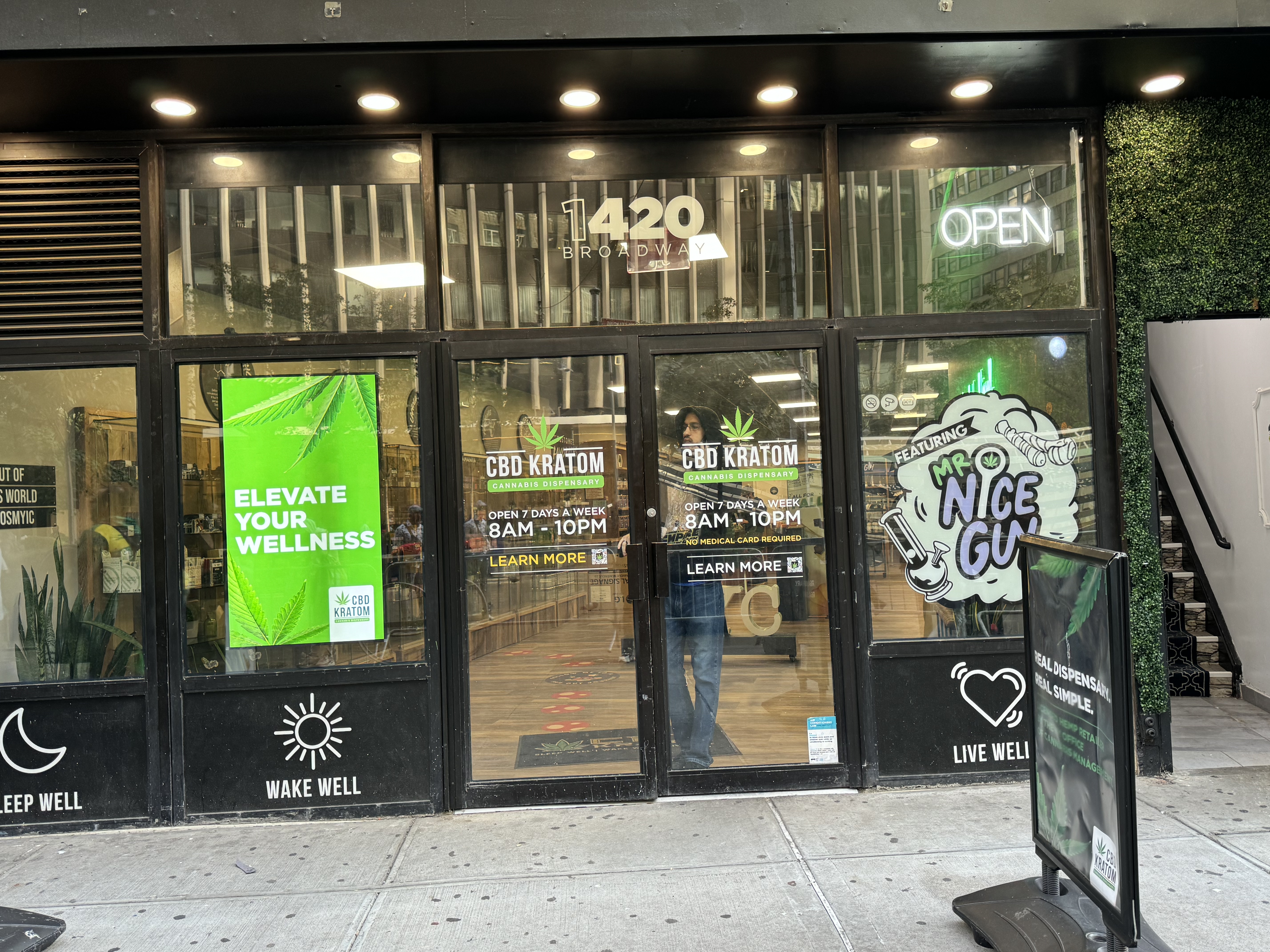
CBD Kratom and similar dispensary chains run high-brightness window displays as dynamic street-level advertising — daypart promotions, daily specials, and brand campaigns visible from across the street.
Window displays
high-brightness window-facing and outdoor IP56-sealed digital window signage at 2,500–3,500 nits — bright enough to compete with daylight that can exceed 10,000 lux. Turnkey: hardware, mount, install, and content management software.
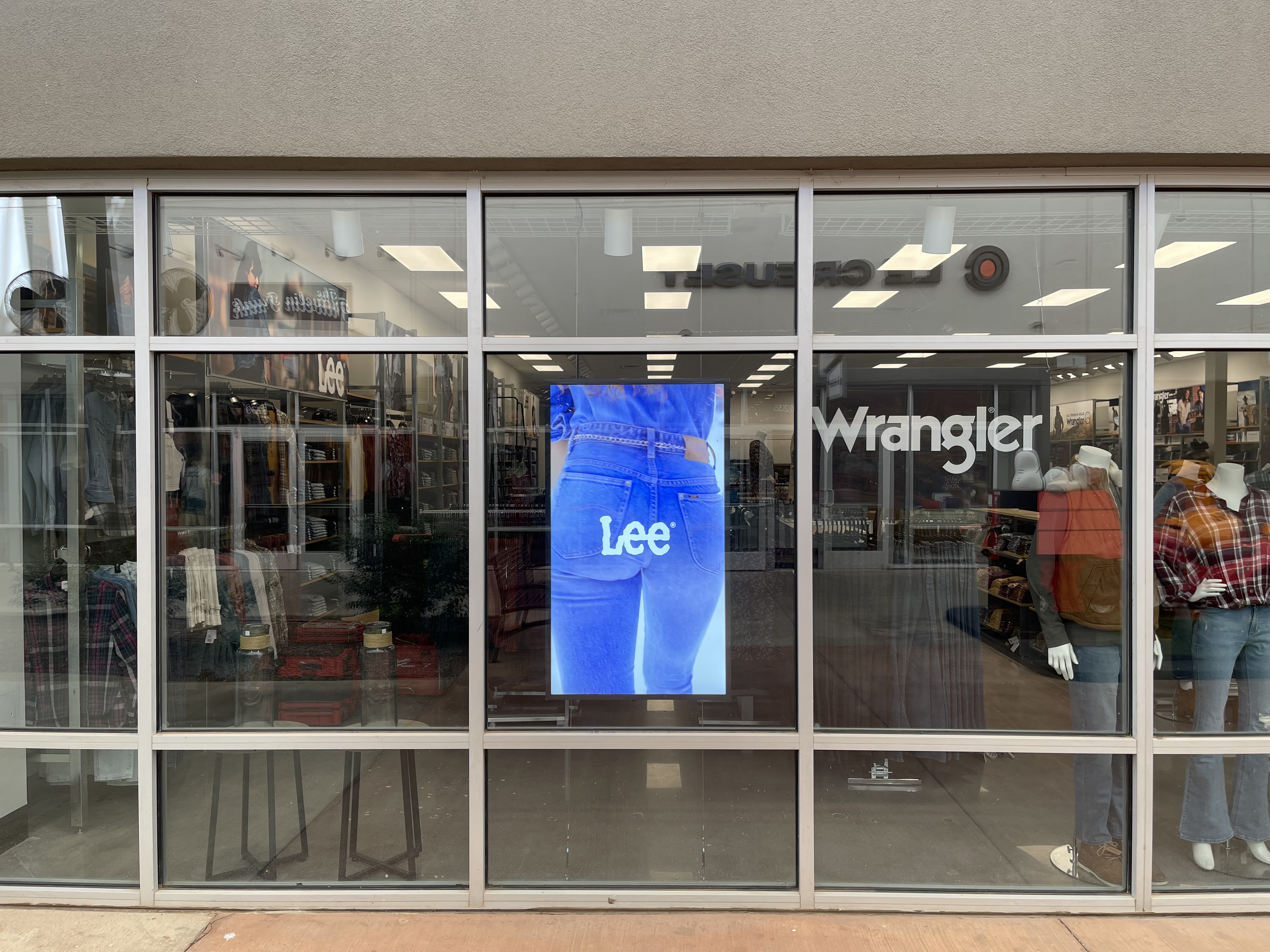
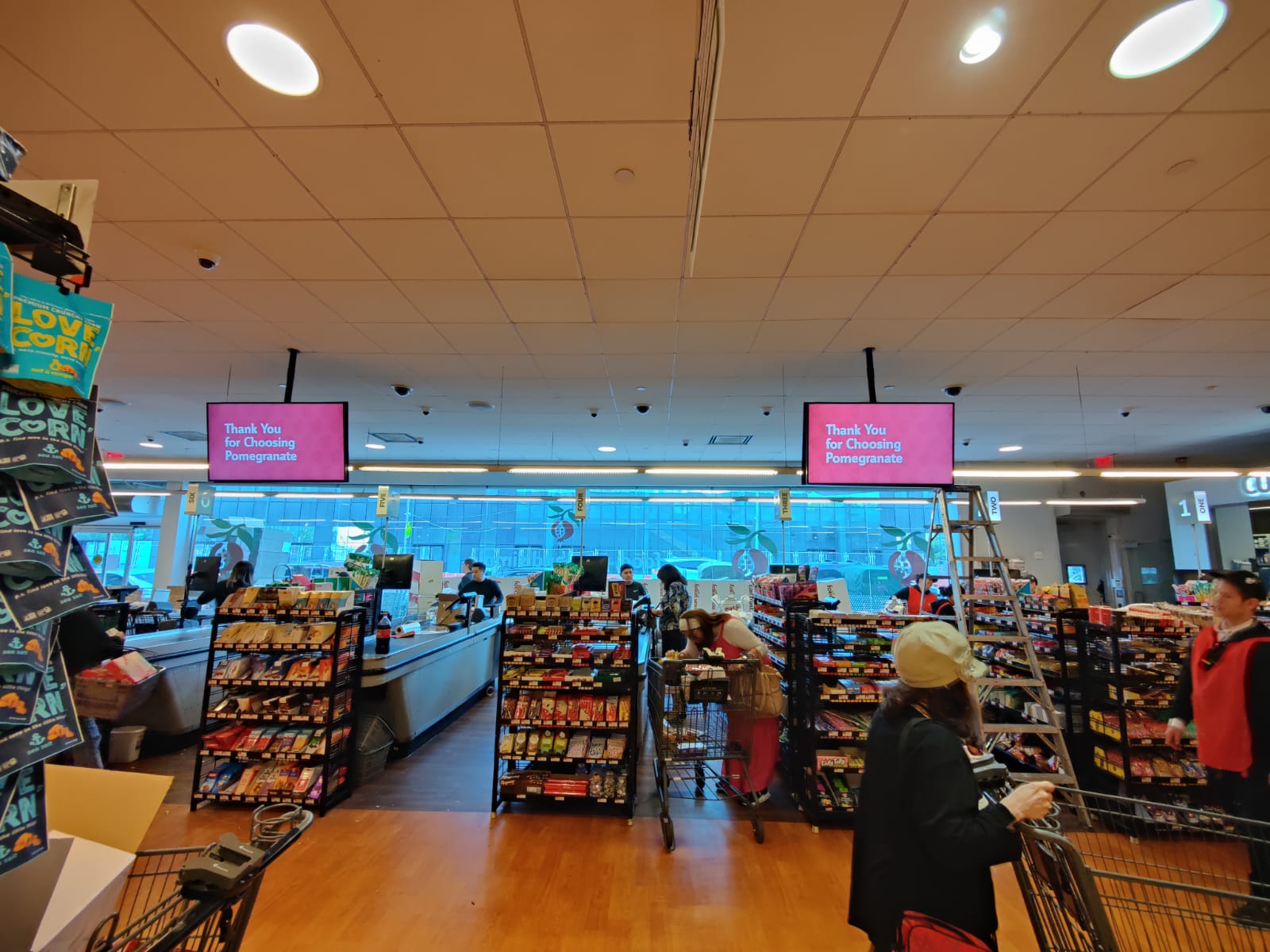
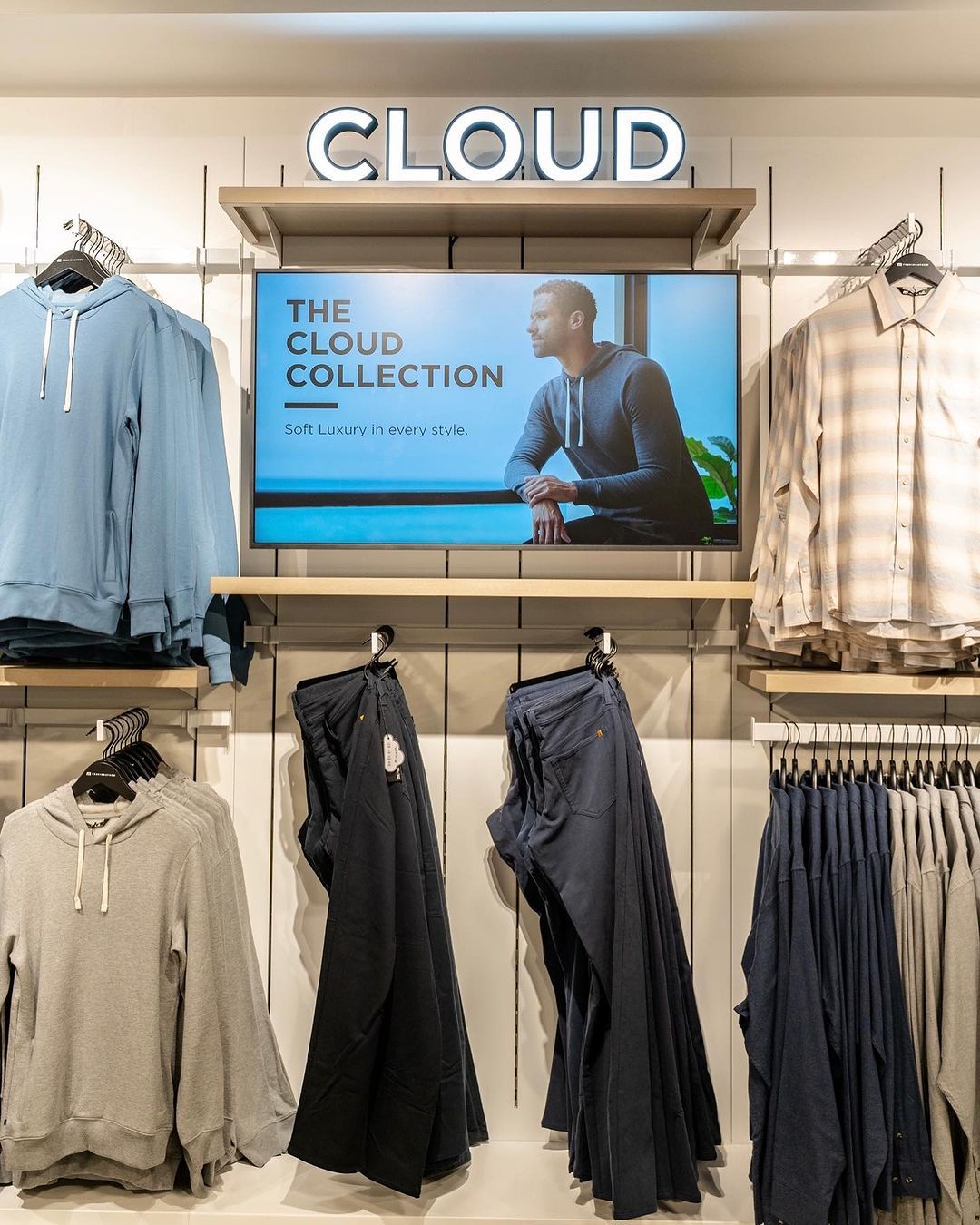
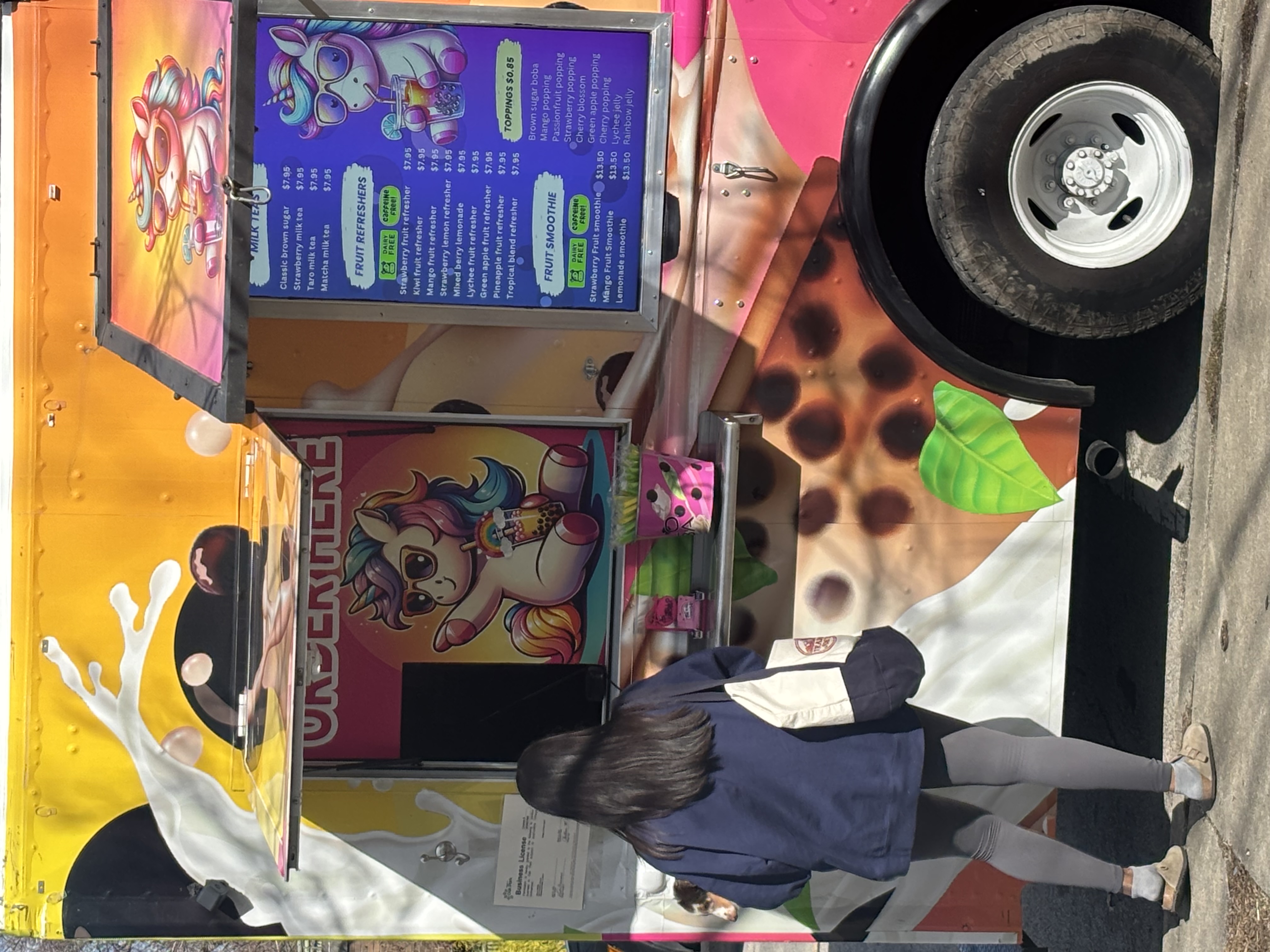
1,000+ storefront window installs across the U.S. — sun-readable, 24/7, weather-rated.
Trusted by leading brands since 2012




Regular displays fail in storefront windows. A consumer TV runs 250–400 nits and washes out the moment direct sunlight hits the glass; the heat trapped behind the window (often above 120°F in summer) kills the panel in months and voids the warranty. CrownTV's window-facing signage is purpose-built for the job: high-brightness window-facing and outdoor IP56-sealed commercial panels at 2,500–3,500 nits, anti-glare coatings, industrial-grade cooling, and ambient-light sensors that adjust output automatically. We supply the screen, the mount, the media player, the installation, and the cloud content management software in one package — no third-party installers, no surprise add-ons.
How bright is bright?
Direct midday sun on a storefront window can exceed 10,000 lux. A consumer TV at 350 nits washes out instantly. Mid-tier commercial panels at 500 nits are still fighting glare. high-brightness, indoor-commercial, and outdoor commercial at 3,000 nits punches through — your message lands whether it's noon in July or 8pm in November.
Washed out at noon
Visible glare remains
Punches through direct sun
high-brightness window-facing and outdoor IP56-sealed high-brightness commercial displays, sized 43" to 75". 2,500–3,500 nits, anti-glare, automatic brightness sensors, industrial-grade cooling, rated for 24/7 commercial operation. Pair with a CrownTV media player and floor-to-ceiling cable, pylon, or kiosk mounts as the install demands.
See High-brightness window displays →CBD Kratom and similar dispensary chains run high-brightness window displays as dynamic street-level advertising — daypart promotions, daily specials, and brand campaigns visible from across the street.
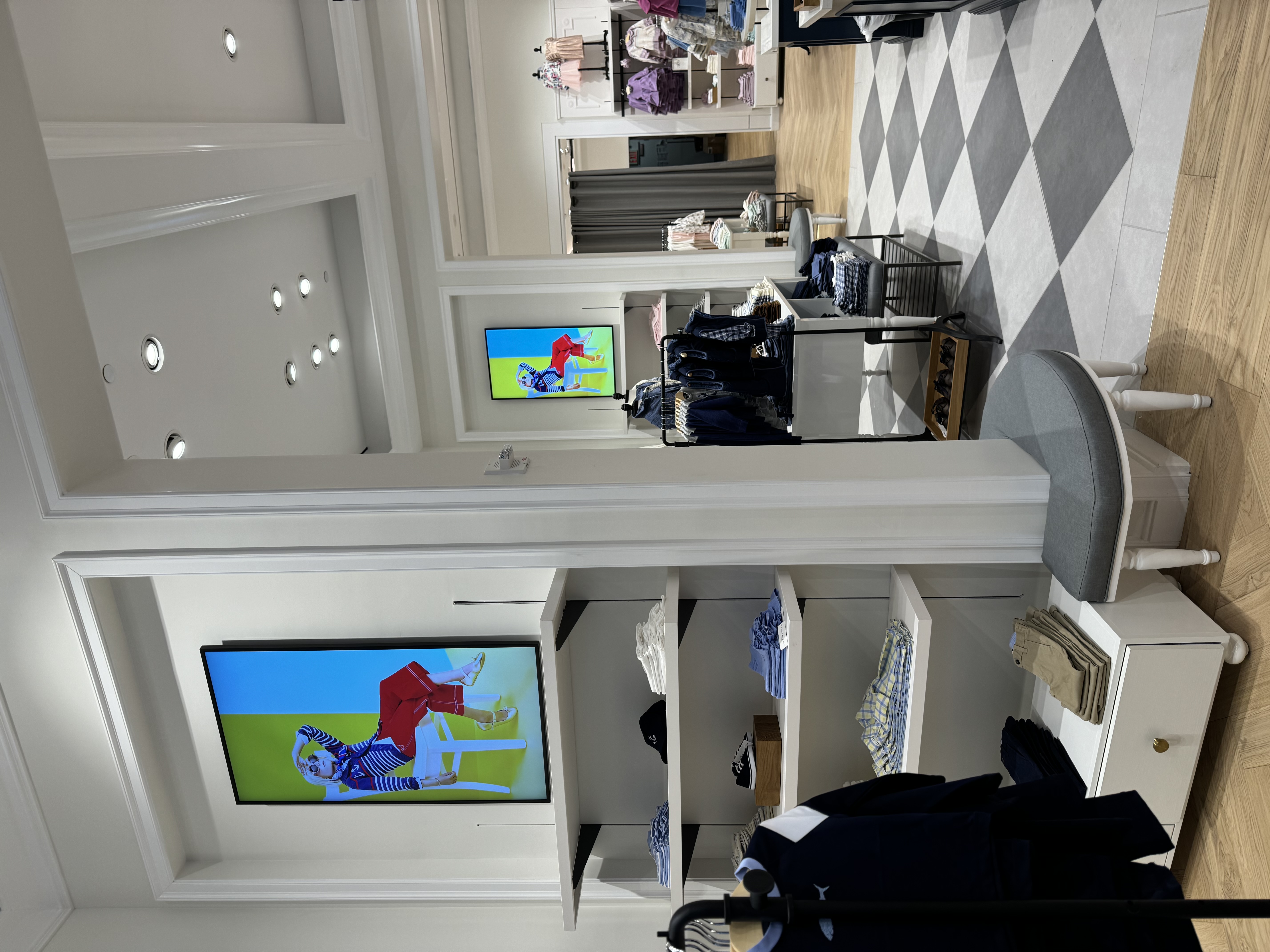
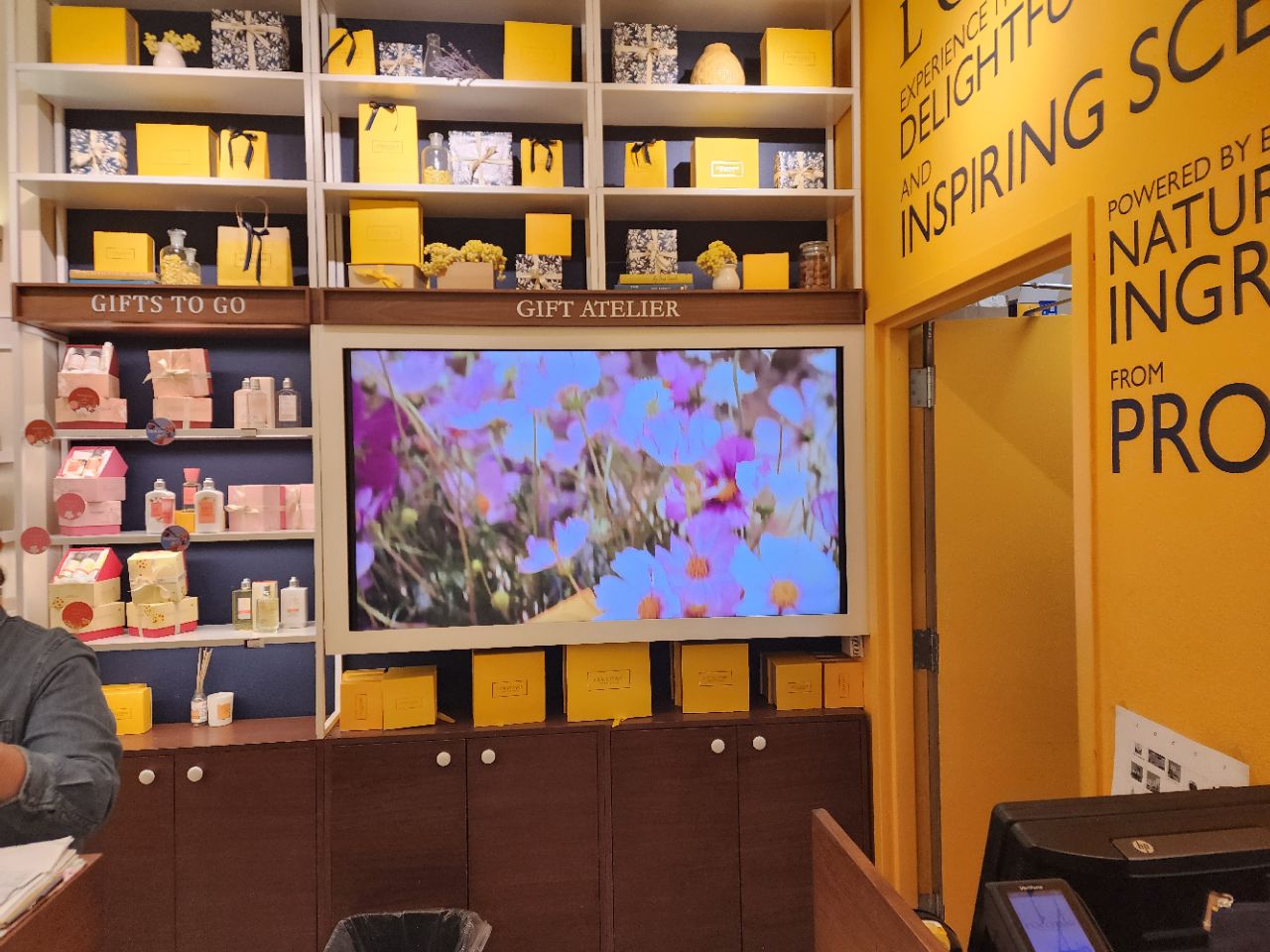
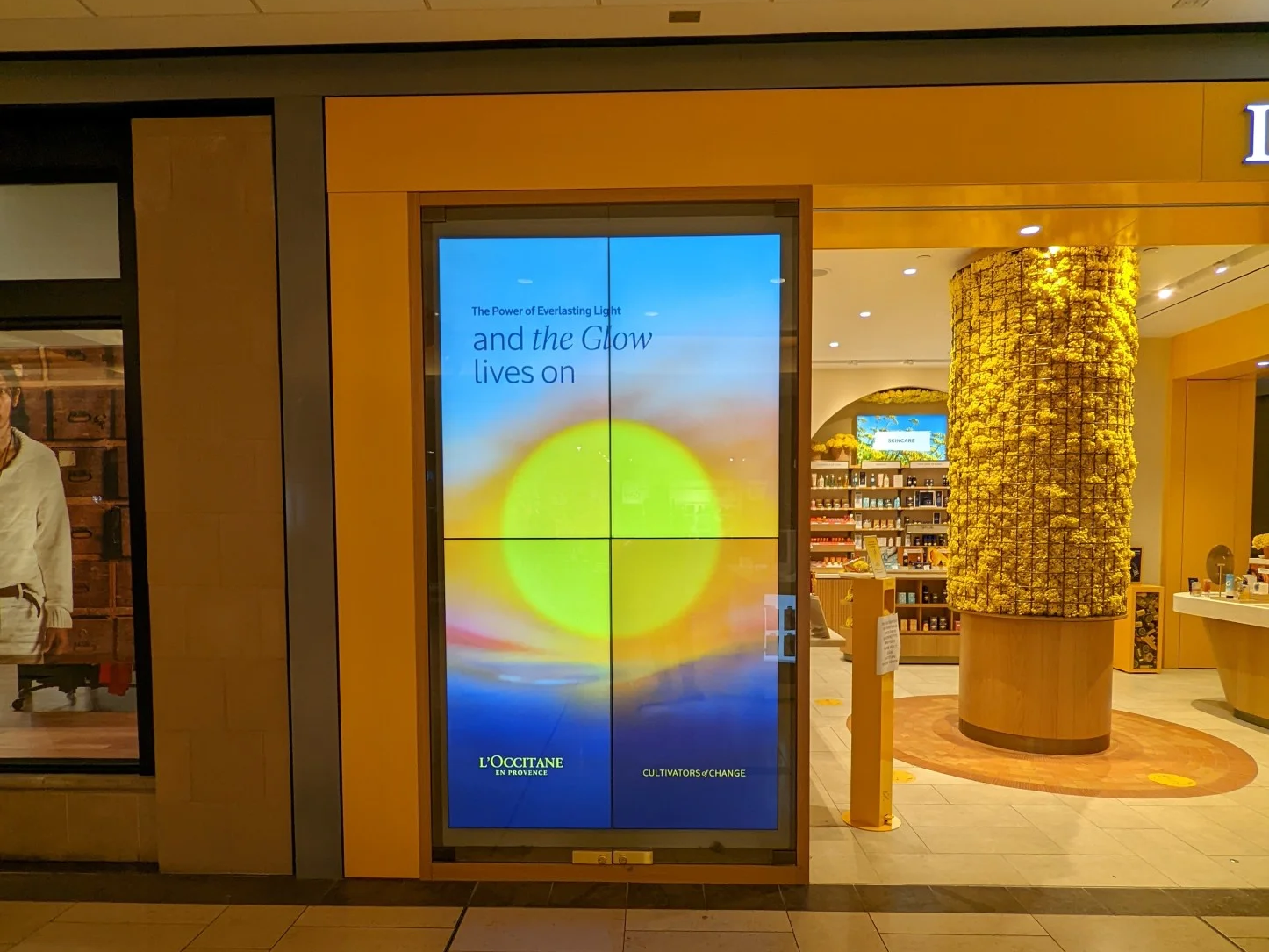
A 75" L'Occitane window install on Robson Street paired storefront video with in-store signage for a coordinated brand experience. Bonobos, Janie and Jack, and Victoria's Secret run similar storefront programs.
Restaurants pair window displays with their digital menu boards to draw foot traffic with appetizing visuals and daily specials before customers even reach the door.
Agencies use window displays to showcase property listings around the clock — generating leads after hours, with no extra staffing required.
C-store and fuel chains run outdoor-rated panels at the pump and drive-thru order point with weather-sealed enclosures.
How a window install actually goes in
Where the glazing meets the frame is where most cheap window installs fail. The panel sees 120°F+ trapped air from above and 10,000+ lux of incident light from outside. We ship the panel that's rated for both and we route the cable inside the storefront frame, not exposed across the window.
Patterns that work in production — built and shipped on real CrownTV deployments.
Schedule morning coffee and breakfast 7–11am, lunch combo 11–2, afternoon refresher 2–5, happy hour 4–6, dinner reservations 5–9. Cycle once, runs every day. Day-parting alone moves featured-item sales 15–30%.
QR codes only work on a window display when the panel is bright enough to render the contrast that a phone camera can read. At 3,000 nits the QR scans on the first try; at 500 nits the customer gives up and walks past.
POS marks a SKU live, the playlist drops the countdown card and rotates the new-arrival hero. Streetwear and limited-edition retail run this pattern. The window does the marketing the second the SKU is sellable.
Listings agency runs a six-property loop with photos, pricing, and a QR code per listing. Walk-by traffic at 11pm becomes a Saturday showing. No staff required.
Pair a window display with a Square or Toast integration so the menu shows live availability — sold out items grey out, ETA badges update. Hello Boba runs this on a mobile QSR build.
If it's over 85°F outside, the smoothie banner lifts; if it's under 40°F, the hot soup of the day takes the slot. The dashboard polls a weather API and switches the layer per zip code.
A dispensary chain like CBD Kratom runs the same brand framework with neighborhood-specific imagery and pricing. Brooklyn store gets Brooklyn imagery, Manhattan store gets Manhattan.
After hours, the window dims to 30%, drops to a slow loop of brand video and tomorrow's hours. No one wants to walk past a screaming neon sale at 2am.
L'Occitane's Robson Street install runs a 75″ window paired with interior wall signage — the same campaign film bleeds from window to interior in a synchronized cut.
Outdoor-rated outdoor IP56-sealed with a weather-sealed enclosure at the menu, plus a confirmation screen at the speaker. The order shows back to the customer in real time, cutting reorders by ~25%.
Field-tested specs from thousands of CrownTV installs. The rules that keep the screens running and the content readable.
If the storefront has an awning or recessed entry, high-brightness window-facing at 3,000 nits is the right call. If the window faces direct south or west sun without shade, step up to OH at 4,000 nits or you'll see hours per day where the screen is unreadable.
Mount the panel a few inches off the glazing so trapped air can convect out. We field stock-rated mounts that include a thermal gap; consumer mounts that flush the panel against the glass cause heat soak that kills the panel in months.
Power and data go through the frame to a junction box behind the wall. No coiled HDMI cable visible from the sidewalk. This is a code requirement in most municipalities for new installs and it looks better.
high-brightness window-facing and outdoor commercial ship with anti-glare coatings front-laminated at the factory. Aftermarket films field-applied to the panel introduce bubbles, peel in 6–18 months, and void the warranty. We don't do them.
Window panels swing from 10,000-lux midday to a few hundred lux at dusk. The ambient sensor steps brightness in 10% increments so the panel isn't blasting 3,000 nits into the sidewalk at 9pm. Saves backlight life and reduces visual disturbance.
A 75″ OH at 4,000 nits draws ~700W peak. Two of them on the same 15-amp circuit with the rest of the storefront load is a tripped breaker waiting to happen. We spec dedicated circuits in the install scope, no exceptions.
Window displays are the highest-stakes scope in commercial signage. The panel is the customer-facing face of the brand from the sidewalk, the install is exposed to direct sun and sidewalk weather, and the consequences of getting hardware wrong are months of an unreadable storefront. CrownTV ships every window install with the same four pillars.
high-brightness window-facing at 3,000 nits for in-window installs behind glazing. outdoor IP56-sealed at 4,000 nits for true-outdoor pylons, drive-thru, and direct south/west exposure. Anti-glare front-laminated, automatic ambient-light sensors, industrial-grade cooling rated for 24/7 commercial duty in environments up to 110°F. The CrownTV media player on every panel — never a USB stick, never a Chromecast.
Site survey including a sun-angle and lux read (we measure at 11am and 4pm at the storefront). Mount the panel 50–75mm off the glass with a stock-rated bracket. Cable run through the storefront frame to a junction box. Dedicated 20-amp circuit, J-box add where required. Network: Cat6 to a managed switch, LTE failover available. Permitting and COIs filed with property management before the crew arrives.
Storefront-specific templates: time-of-day cycling, inventory-drop reveals, weather-aware layers, real-estate loops, dispensary daypart programs. Vertical-format motion graphics designed for portrait orientation. QR codes sized so they scan from the sidewalk in direct sun. Custom motion at flat hourly rate.
Proactive offline alerts in under five minutes. Brightness/health checks via the dashboard nightly. Hardware swap under warranty in 5 business days. 24/7 phone and email support from a CrownTV operator. Quarterly install QA — panel cleaning, mount torque check, cable inspection — at a flat fee on managed-service contracts.
A window display is the only piece of digital signage where the screen is fighting daylight to be read. Direct midday sun on a south-facing storefront can hit the glass at over 10,000 lux. A consumer TV runs 250–400 nits and washes out instantly under that load. Even mid-tier commercial panels at 500–700 nits leave the customer squinting through glare. The high-brightness window-facing at 3,000 nits and the outdoor IP56-sealed at 4,000 nits are what actually punch through.
The brightness number is the easy part. The install scope is where most window programs fall apart.
The trapped-air zone behind a storefront window in summer regularly exceeds 120°F. Consumer TVs are warrantied for an ambient operating range that tops out around 95°F and a 16-hour duty cycle. Inside a sun-baked window, the panel runs at 100% brightness for 14 hours per day in an environment 25 degrees over its rated max. The backlights fail in 4–8 months and the warranty is void on day one because the manufacturer treats commercial use as a violation of the residential terms. We've replaced consumer TVs with high-brightness window-facing after the customer learned this the expensive way more times than we can count.
A window display has roughly two seconds to capture a passerby. Studies of digital storefront signage have shown walk-in traffic lifts of up to 33% versus static printed posters. The lift comes from motion, brightness, and currency — a digital screen that updates with today's specials reads as a live store; a faded poster taped to the inside of the glass reads as out of business. Pair the window panel with a content rotation cadence — morning promo, lunch promo, afternoon, evening, late-night ambient — and the storefront is always live without anyone touching it after the schedule is built.
CBD Kratom runs sun-readable window displays as dynamic street-level advertising across multiple dispensary storefronts — daypart promotions, daily specials, and brand campaigns visible from across the street. L'Occitane's Robson Street install paired a 75″ window panel with in-store signage for a coordinated brand experience. Bonobos, Janie and Jack, TravisMathew, Wrangler & Lee, and Pomegranate run storefront window programs at multi-location scale. Hello Boba runs a mobile QSR window display on its food truck, demonstrating that the high-brightness window-facing is rated for the worst environments — direct sun, rain spray, ambient-temperature swings, vibration — without an outdoor enclosure.
high-brightness window-facing 43″ runs roughly $1,800; 55″ around $2,800; 75″ around $5,500. outdoor IP56-sealed for true-outdoor exposure prices roughly 30% above OM. Add the CrownTV media player at flat per-screen pricing, software at flat monthly per-screen, and turnkey install at flat per-screen. The install fee is higher on window programs than on indoor — we're running power, mounting on a stock-rated bracket, routing cables inside the frame, and pulling permits where municipalities require. Multi-location pricing is published on the pricing page; quotes return inside four business hours.
Single-location standard turnkey: order Monday, site survey Tuesday or Wednesday, install Thursday or Friday, content live the next morning. Multi-store window rollouts run a wave per region — the CBD Kratom multi-state rollout runs a wave per state every two weeks. We don't subcontract install to a national-account broker; every install is handled by CrownTV-direct technicians or a vetted CrownTV-trained partner with a Samsung commercial signage cert.
The three Samsung commercial lines we ship for window-facing scope each have a specific job. indoor commercial at 500 nits is the default indoor signage panel — never ship it into a window unless the window has substantial awning shade and you've measured ambient lux below 1,500. high-brightness window-facing at 3,000 nits is the workhorse for in-window installs behind storefront glass — sized 43″ to 75″, anti-glare front-laminated, ambient-light sensor included. outdoor IP56-sealed at 4,000 nits is true-outdoor: drive-thru menu boards, plaza pylons, gas-station forecourts, fuel-island displays, food-truck rigs. OH ships in IP56 enclosures rated for direct rain, snow, and ambient temperature swings from -10°F to 110°F.
The cost ladder matches the brightness ladder. indoor commercial 55″ runs roughly $1,200; OM 55″ runs roughly $2,800; OH 55″ runs roughly $5,500 with the enclosure. The wrong-panel decision usually goes one of two ways: a customer puts indoor commercial in a south-facing window and it's unreadable from 11am to 4pm every day, or a customer puts OH in a covered-awning window and pays a 2× premium they didn't need. We measure ambient lux at 11am and 4pm during the site survey and recommend the right panel for the actual environment, not a worst-case spec sheet.
Anti-reflective treatment on a window-facing panel is non-negotiable. Without it, the customer sees a perfect mirror of the sidewalk and a faint impression of the menu underneath. The question is how the AR is applied. Front-laminated AR is bonded to the panel's protective glass at the factory under controlled conditions — no bubbles, no peeling, no warranty implications. high-brightness window-facing and outdoor commercial ship with front-laminated AR by default. Field-applied AR films are installed in the store after the fact by a technician with a squeegee. They look fine on day one, develop bubbles by month six, peel by month eighteen, and void the panel's warranty because the manufacturer treats the lamination as an unauthorized modification. CrownTV doesn't field-apply AR. We ship the panel that has it built in.
Tell us what you're building — all inquiries responded to within 4 business hours.
Quote in 4 business hours
Single café or a 200-store QSR rollout — every quote includes hardware, mount, dedicated-circuit electrical, content commissioning, and one year of CrownTV Dashboard. Same project manager from quote to commissioning. Standard turnkey deployment is under one week.
All inquiries responded to within 4 business hours.
No commitment. No hard sell.