
Sports Bar TV Setup for World Cup 2026: The Complete Screen Playbook
World Cup 2026 is live through July 19. The sports bar TV setup playbook: how many TVs you need, commercial vs consumer panels, layout, signage, and cost.
On this page
Reply within 2 business hours Ask a signage specialist Tap to open the quote form
The biggest soccer tournament ever staged in the United States kicked off today. From June 11 through the final on July 19 — played across the river from Manhattan at MetLife Stadium — there are 104 matches landing on American screens, most of them during business hours for a bar.
That’s six weeks where the deciding factor between a packed room and an empty one is embarrassingly simple: whose screens are better.
This is the playbook we’d hand any bar, restaurant, or taproom owner asking how to get their sports bar TV setup right — not just for this tournament, but for every NFL Sunday, March Madness weekend, and Premier League morning after it. It covers how many TVs you actually need, why commercial panels beat consumer TVs in a bar, where each screen goes, what the signage layer around the game is worth, and what the whole system costs installed.
(CrownTV designs and installs sports bar TV systems end-to-end — displays, video walls, mounting, and the signage software layer. That’s the lens this guide is written from, and we’ll be clear about the parts of the system that aren’t ours.)
The five layers of a real sports bar TV setup
Walk into any bar that gets game day right and you’ll find the same five layers, whether the owner planned it that way or arrived by instinct:
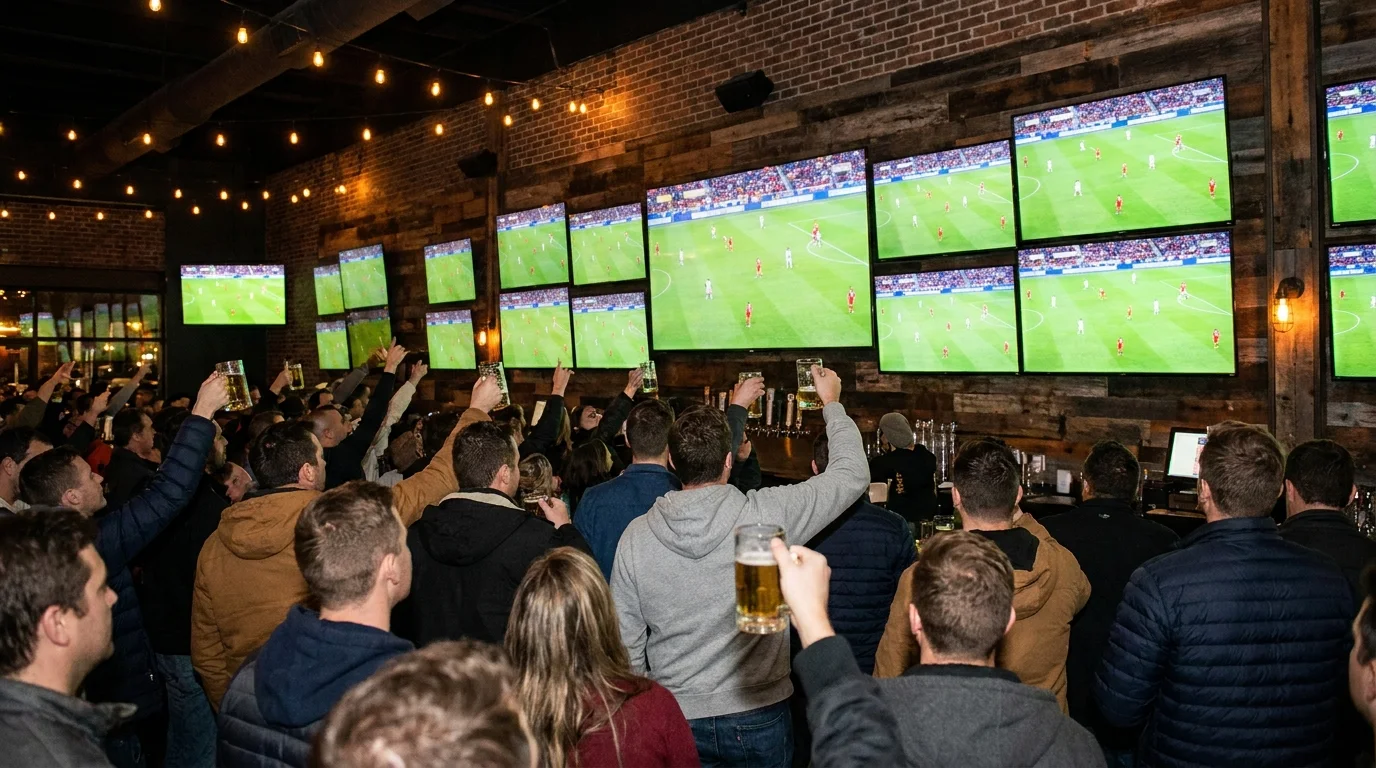
1. The hero wall. One oversized moment the whole room can read — a 2×2 or 3×3 video wall, or a single large-format panel like a 98″ commercial display. This is the screen that decides whether your bar is the place for the big match or just a place showing it.
2. Perimeter viewing TVs. 55″–65″ panels placed by sightline so every seat sees a screen — including the awkward corner two-top and the seats facing away from the main wall.
3. The back-bar signage layer. Screens behind the taps doing money work between whistles: drink menus, tap lists, happy-hour pricing that flips on schedule. This is bar digital signage, and it’s the layer most bars skip — then keep paying for in chalk and printer ink.
4. The window screen. A high-brightness display facing the street, running tonight’s fixture list. On a sunny afternoon, a normal TV in a window is a black mirror; a 3,000-nit window-series panel is readable from across the street.
5. Patio and rooftop screens. Weather-rated commercial outdoor displays — IP56-sealed, 3,500+ nits — because summer tournaments are patio tournaments, and a consumer TV in a plastic enclosure rarely survives a season outside.
Most bars have layer 2 and nothing else. The gap between that and the full system is the gap customers can see from the sidewalk.
How many TVs does a sports bar need?
The honest answer: plan by sightline, not by square footage.
The working rule we use on site surveys: every seat should see at least one screen without turning more than about 45 degrees. Count your seating zones — bar rail, booths, tables, patio — and make sure each zone has a natural screen. Then add the hero moment.
| Venue | Typical screen count | What that covers |
|---|---|---|
| Neighborhood bar / taproom | 4–6 screens | Perimeter TVs covering the rail and tables, one back-bar menu board |
| Full sports bar | 8–14 screens + hero wall | Every seating zone covered, back-bar signage, window screen, specials loop |
| Large venue / eatertainment | 20+ screens, zoned | Multi-zone control — different fixtures in different rooms, patio program |
Two mistakes show up constantly:
- Buying screens before mapping seats. The count comes from the floor plan. A 1,800 sq ft bar with smart sightlines beats a 4,000 sq ft barn with screens clustered over the bar.
- Forgetting the standing crowd. On a capacity night, half your audience is standing between tables. Mounting height and tilt have to work for them too — which is one of the reasons professional commercial TV installation maps sightlines standing and seated.
Commercial displays vs consumer TVs: the part nobody wants to hear
Every bar owner has done the math at a big-box store: a 65″ consumer TV costs a third of a commercial panel. Here’s what that math leaves out.
| Consumer TV | Commercial display | |
|---|---|---|
| Duty cycle | Rated ~4–6 hrs/day, living room | 16/7 — built for 16-hour days, 7 days a week |
| Brightness | ~250–350 nits, dim-room tuned | 500 nits non-glare (indoor) · 3,000+ (window) · 3,500+ (outdoor) |
| Glare handling | Glossy panel, mirrors every window | Non-glare commercial panel |
| Warranty in a bar | Typically void on commercial use | Commercial warranty, business use covered |
| Inputs & control | One remote per TV, consumer OS | Centrally managed, signage-ready |
| Lifespan on bar duty | Visibly degraded in 1–2 years | Specced for years of full-time duty |
That warranty line is the one that stings. Most consumer manufacturers explicitly exclude business use — the day a $700 TV dies over your bar rail mid-season, it’s a $700 paperweight.
Bars run screens harder than almost any other business: long hours, bright rooms, sun through storefront glass, fryer grease in the air. It’s the exact environment commercial panels exist for. (For the panel-level detail, see the commercial displays line — and for storefront glass specifically, high-brightness window displays.)
The hero moment: video wall, or one huge screen?
The room’s focal point does the marketing. Three honest options:
2×2 video wall (≈110″ canvas). Four 55″ narrow-bezel tiles, 1.7mm bezel-to-bezel, calibrated as one canvas. The sweet spot for most full bars — flagship presence without flagship construction.
3×3 video wall (≈165″ canvas). Nine tiles for big rooms and venues that want the wall visible from the door. This is destination-bar territory.
A single 98″ large-format display. No seams, simpler engineering, one panel to mount. When the room is right, one big screen beats a tiled wall — it’s the same panel class we used as the floor anchor at the LeSportsac SoHo flagship, and it reads from the back of a deep room.
Rule of thumb: under ~25 ft of viewing distance, the 98″ usually wins on simplicity. Past that, the wall earns its keep. (Full configuration and pricing breakdown on the video walls page.)
And the part owners forget: the wall doesn’t go dark at the final whistle. From the dashboard, it flips to the specials board, the next fixture promo, or the private-hire card — the most valuable advertising surface in your room, already paid for.
The signage layer is where the system pays rent
The game feeds fill the match window. The signage layer sells everything around it — and it’s what separates a TV setup from a screen system.
What runs on it, scheduled once and flipped automatically by daypart:
- Back-bar menu boards — drink lists and tap rotations with live pricing. A keg kicks, the board updates from a laptop in seconds. No chalk ladder at 4pm.
- Happy-hour boards that appear at 4:00 sharp and disappear at 7:00 sharp. The screens keep the schedule even when the floor is slammed.
- The fixture board — this week’s matches and kickoff times by the door and in the window. During a six-week tournament with games most days, this is the single highest-leverage promo surface you own.
- Halftime food pushes — fifteen minutes when the kitchen is quiet and 80 people are looking for a reason to order. A wings promo on every perimeter screen at halftime is the cheapest sales rep you’ll ever hire.
- Late-night and event cards after the match — next watch party, trivia night, private hire.
This layer is standard restaurant tech applied to a bar — the same digital menu board system running QSR and restaurant programs for multi-location chains. If your kitchen side needs the full treatment too, that’s the digital menu boards scope.
Patios, rooftops, and the summer problem
A June–July tournament means patio season, and the patio screen is where good intentions go to die. Consumer TVs — even “outdoor-ish” ones in enclosures — fail against the actual spec sheet of a patio: direct sun (a normal panel is unreadable at 350 nits outdoors), rain and humidity, 40-degree temperature swings, and the occasional end-of-night hose-down.
Commercial outdoor panels are built against exactly that: 46″–75″, 3,500+ nits, IP56-rated sealing, on structure-rated mounts. They cost real money, and they’re the only version of a patio screen that’s still working next summer.
Who provides what (read this before you call anyone)
Worth being precise about, because the sports bar AV market is confusing on purpose:
Your TV provider (cable, satellite, or streaming) supplies the game feeds and the commercial sports licensing. Venue licensing for live sports is between you and your provider — any installer who hand-waves this is doing you no favors.
Your screen partner — that’s us — supplies everything those feeds land on: the commercial displays, the video wall, mounting and in-wall cable routing, the media players, the signage software, and the install itself. CrownTV configures the system so each screen switches cleanly between the match feed and the signage loop, and coordinates with your TV or AV provider on the input side.
Audio is its own trade, and worth doing right — we’ll coordinate placement and conduit with your audio installer rather than pretend it’s our scope.
That division of labor is the honest version of what “sports bar TV system” companies sell. One vendor owns the screens and the signage layer end-to-end; the feeds stay on the account you already have.
The install: after-hours or it didn’t happen
A bar can’t close for a week of construction — especially not mid-tournament. The install discipline that matters:
- Site survey first. Sightline map, wall construction, power and cable paths, glare audit against the windows. The quote comes from the floor plan, not a formula.
- After-hours installation. Mounts, in-wall cabling, panel hanging, wall calibration, and system configuration between close and open. The bar never loses a service night. (Same discipline we use on flagship retail installs.)
- One to two sessions, then live. A typical single-bar program goes from survey to live screens in under a week.
- Training on the way out. Your managers learn the dashboard — flipping a screen, updating a price, scheduling next week’s fixtures — before the crew leaves.
What it costs, installed
Real ranges, consistent with comparable CrownTV screen programs — hardware, mounts, media players, install labor, and signage software setup included:
| Program | Installed range |
|---|---|
| Neighborhood bar · 4–6 screens | $9,500 – $18,000 |
| Full bar program · 8–14 screens | $22,000 – $45,000 |
| Game wall add-on · 2×2 to 3×3 | $16,000 – $36,000 |
| Multi-location group | Custom-quoted, standardized kit per site |
Every real quote is site-scoped — screen count, wall construction, and cable paths move the number. The full breakdown of placements, hardware specs, and pricing tiers lives on the sports bar TV systems page.
Six weeks of World Cup, then everything after
If you’re reading this mid-tournament: it is not too late. The knockout rounds are still ahead, the final lands July 19 at MetLife — the biggest single bar night this market has seen in decades — and an after-hours install means a bar that books a survey this week is watching the quarterfinals on its new system.
Once the screens are up, the next question is what to run on them — we wrote the promo side up separately: 15 World Cup promotion ideas for bars and restaurants, from fixture boards to halftime flash promos to selling the final like New Year’s Eve.
And then the calendar keeps going. Premier League mornings start in August. NFL Sundays in September. College football Saturdays, NBA winter, March Madness. A screen system installed for this tournament isn’t a World Cup expense — it’s the bar’s most-used asset, bought during the one summer when it pays for itself fastest.
Ready to map your room? Get a quote — site survey, sightline map, and a fixed installed price, with a 2-business-hour response — or start with the sports bar TV systems page to see placements, hardware, and pricing in detail.
Frequently Asked Questions
What is the best TV for a sports bar?
A commercial display, not a consumer TV. Bars run screens 12–16 hours a day under bright ambient light — consumer panels are rated for a few hours in a dim living room, wash out under bar lighting, and their warranties typically exclude commercial use. Commercial 4K panels run 500-nit non-glare screens on a 16/7 duty cycle with warranties that actually cover a bar.
Can I just use regular consumer TVs in my bar?
You can, and many bars do — that is why so many bar screens look washed out by year two. Consumer TVs aren't built for 12–16 hour daily duty, struggle against window glare, and most manufacturers void the warranty the moment the TV is used in a business. Commercial displays cost more upfront and beat consumer panels on total cost within a couple of years of bar duty.
How much does a sports bar TV system cost?
Representative installed ranges: a 4–6 screen neighborhood-bar program runs about $9,500–$18,000; a full 8–14 screen bar program runs $22,000–$45,000; a 2×2 to 3×3 video-wall hero moment adds $16,000–$36,000. Installed pricing includes hardware, mounts, media players, install labor, and signage software setup.
Do TV installers provide the cable or streaming packages for the games?
No — game programming and commercial sports licensing stay between the venue and its TV provider (cable, satellite, or streaming). A digital signage company like CrownTV installs the displays, routes the inputs cleanly, and runs the signage layer — menus, specials, schedules — around the game feeds you already pay for.
Is it too late to upgrade my bar's screens during World Cup 2026?
No. The tournament runs through the July 19 final, and a single-bar screen program typically goes live in under a week from site survey, with physical installation done in one or two after-hours sessions — no lost service nights. Bars that upgrade mid-tournament still catch the knockout rounds, the final, and every season that follows.
Keep reading
More guides like this
Operator-grade playbooks, weekly.
Proof, not pitches
See real installs
Live deployments across hospitality, retail, and offices.
Ready to deploy?
Get a quote in 2 business hours
Reply within two business hours. No call required.