
Digital Window Displays: The 2026 Buyer's Guide (Nits, Double-Sided, Real Costs)
Digital window displays that stay visible in sunlight: the nits ladder, double-sided screens, sizing to your glass, real estate window grids, and honest all-in costs.
On this page
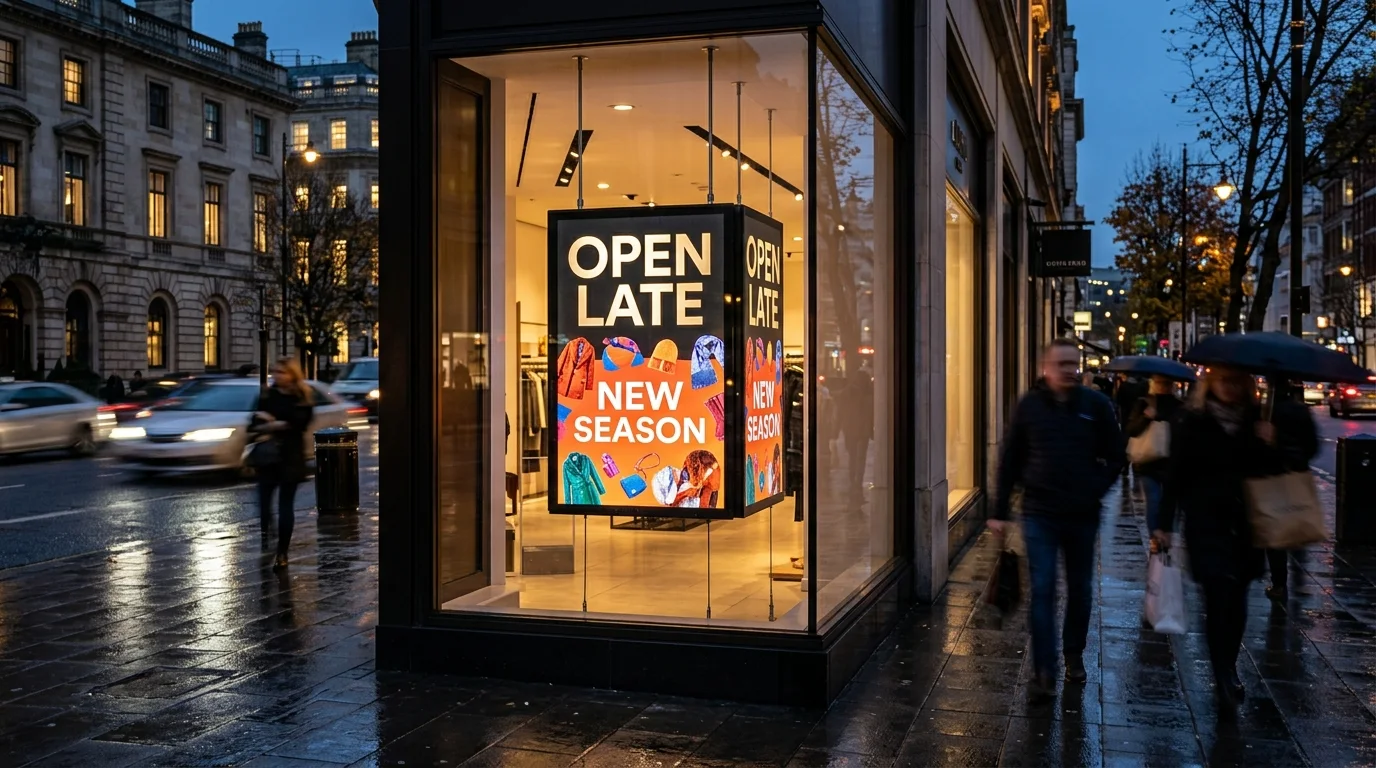
Here's the shortest hardware lesson in signage: a regular TV in a window dies in sunlight — 2,500 nits is the entry ticket. The window is the only screen position you own that markets to people who never came inside, and it's also the harshest: direct sun, glass reflections, and greenhouse heat. That combination makes digital window displays their own hardware category, not an indoor panel pointed outward.
CrownTV has installed window-facing displays for 13+ years across retail, real estate, banking, and restaurants. Two of the most common quote requests we get are exactly the two problems this guide solves: "we want a double-sided screen bright enough for the sidewalk" and "we want to fill our window, not hang a TV in the middle of it."
What is a digital window display?
A digital window display is a high-brightness commercial screen (2,500–3,000+ nits) mounted in or behind storefront glass, facing the sidewalk — readable against direct sunlight. Formats: single-sided panels, double-sided units serving street and interior at once, portrait grids (the real-estate listing wall), and ceiling-hung banks that fill large glazing.
The nits ladder (and why the window is different)
| Position | Required brightness | Hardware class |
|---|---|---|
| Indoor wall | 350–500 nits | Standard commercial (QMC) |
| Bright atrium / near glass | 500–700 nits | High-bright indoor |
| In-window, indirect light | 2,000–2,500 nits | Window-rated (OM class) |
| In-window, direct sun | 3,000+ nits | OM-series high-brightness |
| Fully outdoor | 3,000–4,000+ nits, IP-rated | OH-series — see the outdoor guide |
Two window-specific realities beyond brightness. Heat: glass turns a window bay into a greenhouse; window-rated panels are engineered for that thermal load, consumer TVs are not. Reflections: brightness is the only real weapon — films and angling help at the margins, nits win the war. Auto-brightness matters at night too: a 3,000-nit panel at full power at 10 p.m. is a glare complaint from across the street.
The four window formats
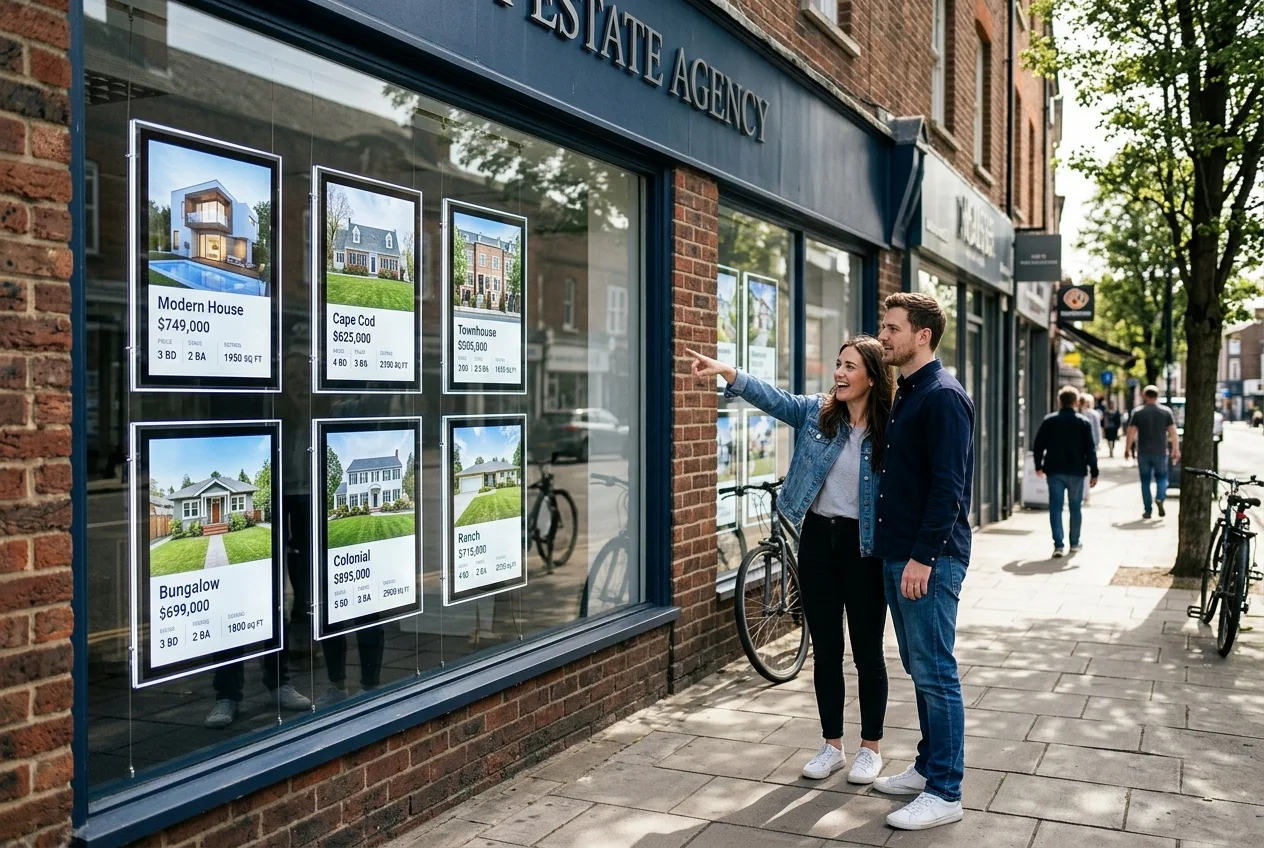
1. Single-sided panel, facing out. The standard storefront promo screen — portrait orientation usually beats landscape in vertical glazing. Smaller bays run the 46-inch Samsung OM46B ($2,799) at the same brightness class. 2. Double-sided units. Panels like the Samsung OM55N-DS show the sidewalk one loop and the store interior another, from one ceiling-hung mounting point in the glass — the highest-value format per mounting dollar. 3. The window grid. Multiple portrait panels in a bank — the real-estate standard (4–8 listing screens), also used by banks for rates and salons for services. 4. Fill-the-glass installations. For large glazing where a single panel looks lost: ceiling-hung banks of portrait panels sized to the mullions, or fine-pitch LED sized to the opening (priced in our LED wall guide). The sizing rule that governs all four: fill the glass or frame it deliberately — a 55″ panel floating in a 6-foot window reads as an afterthought from the sidewalk.
Retail window displays: high-brightness LCD vs LED vs transparent LED
Retail buyers comparing window technology are really choosing between three builds. High-brightness LCD (the OM-class panels above) is the default for 95% of retail windows: crisp at close range where sidewalk traffic stands, portrait-native, and the most affordable path to 3,000 nits — buy direct: Samsung OM55B single-sided or the OM55N-DS double-sided. LED window displays (fine-pitch panels sized to the glazing) win when the "window" is really a wall of glass — seamless at any size, brighter still, priced per square foot in our LED wall cost guide. Transparent LED film is the emerging third option — a see-through mesh bonded to the glass so the window stays a window — striking for flagships, but budget specialist pricing, glass-measurement surveys, and controller work; it's a project, not a purchase. If a vendor quotes transparent LED for a standard promo window, get an OM-class bid next to it before signing.
What digital window displays cost
Window-grade hardware is 3–5× standard indoor panels — that's the brightness and thermal engineering, not margin. Working anchors: roughly $3,500–$5,000 for a single-sided 55″ high-brightness panel (more for double-sided), plus mount, media player, install, and software; a professionally installed single window display typically lands around $6,000–$10,000 all-in. Grids and fill-the-glass projects are quoted per site — mounting structure, power runs to the window bay, and heat management drive the number more than panel count. Every window project we quote starts with glass dimensions, orientation (which way does it face?), and a photo — our window displays page covers the intake. Indoor screens elsewhere in the store follow the standard package pricing.
Common window display mistakes
- An indoor panel pointed at the street. The most common wasted spend in storefront signage — invisible by mid-morning, cooked by summer.
- Landscape in vertical glass. Portrait fills the sightline; landscape leaves the window mostly empty.
- Ignoring the night state. Full brightness after dark is glare; auto-dimming is a spec, not a nicety.
- No power planning for the bay. Window bays rarely have outlets where you need them; the electrical run is part of the project, not a surprise.
- Static content in a moving medium. The sidewalk audience changes every 8 seconds; the loop should too.
How CrownTV Helps
- Samsung Authorized Reseller — OM-series high-brightness panels, double-sided OM55N-DS units, window grids, and LED fills
- Glass-first scoping: send dimensions and a photo, get a format recommendation and line-item quote
- Licensed, insured installation including ceiling-hung window mounting, power runs, and heat management — all 50 states
- CrownTV Dashboard with dayparted loops and night dimming — window content managed with the rest of your screens
Get a window display quote in two business hours →
Frequently asked questions
What is a digital window display?
A high-brightness commercial screen (2,500–3,000+ nits) mounted in or behind storefront glass facing the sidewalk — single-sided, double-sided, in grids, or sized to fill the glazing — bright enough to stay readable against sunlight and reflections.
How bright does a window display need to be?
2,500 nits minimum for daylight glass; 3,000 nits for direct sun. Standard 350–500-nit panels read as black mirrors from the sidewalk.
Can I use a regular TV as a window display?
No — consumer panels lack sustained brightness and aren't rated for the greenhouse heat load behind glass; they fail early and their warranties exclude commercial use.
How much does a digital window display cost?
Roughly $3,500–$5,000 for single-sided 55″ high-brightness hardware (more double-sided); a professionally installed single window display typically lands around $6,000–$10,000 all-in. Grids and fill-the-glass projects are quoted per site.
What do real estate offices use in windows?
Grids of 4–8 portrait high-brightness screens cycling listing cards fed from the listing system, or double-sided 3,000+ nit panels per bay — serving foot traffic on both sides of the glass.
Read Next
DISPLAYDETAILS · BY CROWNTV · SHIPS NATIONWIDE
Window-grade high-brightness displays, direct from CrownTV
Double-sided 3,000-nit window display — readable from inside and out.
Samsung OM55N-DS
55-inchSamsung Authorized Reseller — direct allocation, full warranty
- Price-match guarantee — find it cheaper, we'll match it.
- 3-year Samsung commercial warranty — RMAs handled by us.
- Free nationwide shipping — every panel, every order.
- FREE: 1 month CrownTV CMS + 1 media player per screen (then $29.99/mo).
Keep reading
More guides like this
Operator-grade playbooks, weekly.
Proof, not pitches
See real installs
Live deployments across hospitality, retail, and offices.
Ready to deploy?
Get a quote in 4 hours
Reply within two business hours. No call required.