
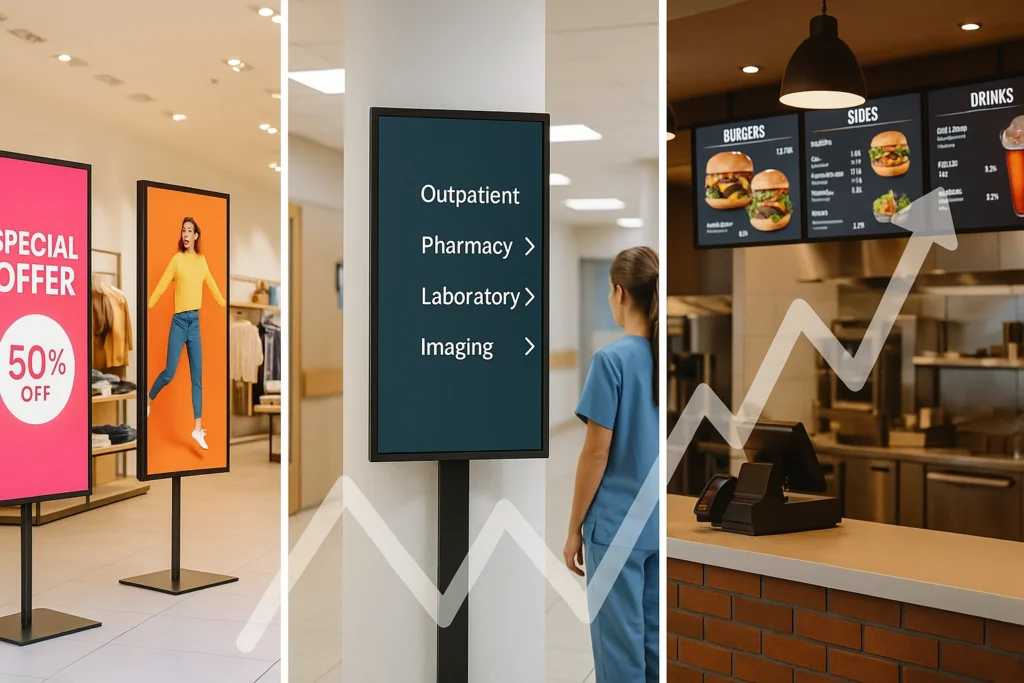
Here’s the thing about digital signage: everyone talks about what it costs, but the real conversation should be about what it returns. And when you dig into the numbers, the returns are hard to ignore.
Whether you’re running a retail chain, a hospital network, a quick-serve restaurant, or a university campus, digital signage solutions deliver measurable business outcomes that go far beyond “looking modern.” Across the signage industry, the benefits digital sign networks provide are well documented: sales increases of 30% or more, reduced operational drag, higher employee productivity, and improved customer satisfaction. From restaurants digital menu boards to corporate communication digital displays, signage software and digital channels are turning passive screens into active revenue tools — all backed by real industry data.
But digital signage ROI by industry isn’t a one-size-fits-all story. In the age of data-driven decision-making, every market vertical uses its deployed digital sign networks differently. A restaurant measures success through purchases digital kiosks influence, while a corporate office tracks engagement across channels digital signage powers. A hospital cares about patient experience metrics that a retailer never thinks about. That’s why we’ve broken down the return on investment signage digital displays deliver across six major sectors, complete with real statistics, practical formulas, and the context you need to build a business case that gets approved.
Key Takeaways
- Digital signage ROI by industry varies significantly — retailers see an average 32% sales increase, while restaurants report gains of 8% to 37% depending on upselling and daypart strategies.
- Healthcare facilities use digital signage to reduce perceived wait times by up to 35%, directly improving patient satisfaction scores tied to Medicare reimbursement.
- Corporate digital signage boosts employee productivity by 25% by replacing buried emails with high-visibility internal communications in common areas.
- Education institutions cut printing costs by 50% or more while improving campus safety through instant emergency notifications.
- The typical payback period for a digital signage deployment is 12 to 24 months, with returns compounding over time as content strategies mature.
- To accurately measure digital signage ROI, baseline your key metrics before deployment and track both hard returns like revenue lifts and soft returns like brand recall and employee engagement.
What Is Digital Signage ROI and Why It Matters
At its core, digital signage ROI measures the financial and operational returns your screens generate relative to what you’ve invested. Simple enough in concept, but in practice, it encompasses a surprisingly wide range of outcomes.
Some returns are direct and easy to quantify: increased sales, higher average order values, reduced printing costs. Others are indirect but equally valuable: stronger brand recall, faster patient throughput, fewer workplace safety incidents. The best ROI calculations capture both.
So why does this matter right now? The global digital signage market is projected to reach $35.94 billion by 2030, according to Grand View Research. That kind of growth doesn’t happen unless businesses are seeing real returns. And they are, the typical payback period for a digital signage deployment sits between 12 and 24 months, with many organizations reporting positive ROI well before that window closes.
Here’s what makes digital signage ROI statistics particularly compelling for decision-makers: the returns compound over time. Unlike a one-time marketing campaign, a well-managed digital signage network keeps delivering value month after month. Content updates are instant, targeting improves with data, and operational efficiencies only deepen as teams get more comfortable with the technology.
The key is understanding which metrics matter most for your industry. Let’s break that down.
Retail Digital Signage ROI: Sales Increases and Customer Engagement
Retail is where digital signage ROI data is most abundant, and most dramatic. If you’re a retailer still relying exclusively on static displays, you’re leaving significant revenue on the table.
The headline number: retailers using digital signage see an average sales increase of 32%. That’s not a projection or a best-case scenario. It’s a documented average across multiple studies and deployments.
But it doesn’t stop at the register. Here’s a fuller picture of what retail digital signage delivers:
| Metric | Impact |
|---|---|
| Sales increase | 32% average |
| Foot traffic increase | 24% |
| Views vs. static displays | 400% more |
| Brand recall rate | 83% |
| Customers influenced at point of sale | 74% |
That 400% figure is worth sitting with for a moment. Digital displays don’t just look better than paper posters, they fundamentally change how customers interact with your space. Motion captures attention. Dynamic content holds it. And when 74% of shoppers say in-store signage influences their purchasing decisions, you’re looking at a direct line between screen content and checkout totals.
The digital signage sales increase retail brands experience comes from several mechanisms working together. Promotional displays drive impulse purchases. Wayfinding screens reduce friction and keep customers browsing longer. Real-time inventory highlights prevent lost sales when popular items are available but hard to find.
An 83% brand recall rate also means your messaging sticks long after the customer leaves the store. Compare that to traditional print signage, where recall rates typically hover around 50-60%, and the gap becomes clear.
For multi-location retailers, the compounding effect is massive. A 32% sales lift across 50 stores isn’t just 50 times the impact of one store, it’s a fundamental shift in how the brand performs at scale.
Restaurant and QSR Digital Signage ROI: Menu Boards and Upselling
If retail makes the broadest case for digital signage, restaurants and QSRs make arguably the most focused one. The ROI story here centers on a single, high-impact application: the digital menu board.
Restaurant digital signage drives sales increases ranging from 8% to 37%, depending on how strategically it’s deployed. That’s a wide range, and the difference largely comes down to how well operators use the technology for upselling and daypart optimization.
Here’s how the returns break down:
Upselling and Average Order Value. This is the big one. Digital menu boards make it easy to highlight combo meals, premium upgrades, and add-ons with appetizing imagery and strategic placement. When a customer sees a beautifully photographed dessert right after selecting their entrée, that “why not” moment happens more often. Restaurants consistently report meaningful increases in average order value, and unlike staff-driven upselling, the digital board never forgets, never gets tired, and never feels awkward about suggesting the large.
Daypart Flexibility. Breakfast items at 7 AM, lunch combos at noon, happy hour specials at 4 PM, all without someone climbing a ladder to swap out panels. This isn’t just convenient: it directly impacts revenue by ensuring the most profitable items are always front and center when demand peaks.
Speed and Throughput. Clearer menu presentation means faster ordering, which means shorter lines. For QSR digital signage operations where throughput is everything, reduced wait times translate directly into more transactions per hour during peak periods.
Menu Testing Without Waste. Want to test a new item or price point? With digital boards, you can run A/B tests across locations in real time and measure the impact before committing to a full rollout. That kind of agility used to require expensive market research, now it’s built into the signage system.
As Precedence Research notes, the restaurant and hospitality segment continues to be one of the fastest-growing verticals for digital signage adoption. The math is straightforward: even an 8% sales increase on a high-volume QSR operation pays for the entire signage system within months.
Healthcare Digital Signage ROI: Patient Experience and Operational Savings
Healthcare ROI looks different from retail or restaurants because the returns are less about direct revenue and more about operational efficiency, patient satisfaction, and regulatory compliance. But make no mistake, those outcomes carry enormous financial weight.
The adoption numbers tell part of the story: 78% of hospitals now use digital signage in some capacity. That’s not a trend, it’s a standard of care.
Healthcare digital signage delivers returns across several critical areas:
Perceived Wait Time Reduction. Waiting rooms are where patient satisfaction goes to die. Digital signage reduces perceived wait times by up to 35%, without actually changing how long patients wait. Informational content, health tips, and queue status updates keep patients engaged and less frustrated. And since patient satisfaction scores directly impact reimbursement rates under value-based care models, this isn’t a soft metric. It’s financial.
Automated Communications. Think about how many hours nursing staff spend answering the same directional questions, or how much time administrators spend updating paper-based notices across a hospital campus. Digital signage automates wayfinding, visitor instructions, department updates, and safety protocols, freeing up staff to focus on actual patient care. The operational cost savings from reduced manual communications add up quickly in facilities running 24/7.
Improved Patient Satisfaction Scores. Hospitals deploying digital signage in patient rooms, waiting areas, and corridors consistently report improved HCAHPS scores. Better-informed patients are calmer patients, and calmer patients rate their experience higher. Given that Medicare reimbursement is partially tied to these scores, the ROI has a direct dollar figure attached.
Safety and Compliance. Digital signage enables real-time emergency notifications, infection control reminders, and compliance messaging. The return on safety signage specifically is well-documented: $4 to $6 returned for every $1 invested. In a healthcare environment where a single compliance failure can cost millions, that ratio is extremely compelling.
For hospital administrators and healthcare operations managers building a business case, the digital signage benefits by sector are perhaps most multifaceted in healthcare, touching everything from staff efficiency to patient outcomes to financial performance.
Corporate Office Digital Signage ROI: Employee Communication and Productivity
Corporate digital signage ROI is often underestimated because it’s harder to photograph for a case study. There’s no flashy menu board or in-store promotion to point at. But the numbers tell a compelling story.
The standout statistic: corporate digital signage drives a 25% increase in employee productivity when used for internal communications. That figure comes from replacing, or at least supplementing, the endless stream of internal emails that most employees ignore.
Here’s the reality of internal communications in 2026: the average office worker receives well over 100 emails per day. Important company updates, safety reminders, HR announcements, and performance dashboards get buried under meeting invites and reply-all chains. Digital signage cuts through that noise by placing critical information where people naturally look, break rooms, lobbies, elevator banks, common areas.
Improved Communications Reach. Email open rates for internal communications typically hover around 20-30%. Digital signage in high-traffic areas achieves near-100% visibility among on-site employees. That’s not a marginal improvement, it’s a category change.
Meeting Room and Resource Management. Interactive displays outside conference rooms reduce scheduling conflicts, eliminate ghost bookings, and keep meetings running on time. It sounds small, but multiply those saved minutes across an entire organization and the productivity gains become significant.
Culture and Engagement. Recognizing employee achievements, celebrating milestones, and sharing company performance data on screens builds a sense of transparency and belonging. Engaged employees are more productive, stay longer, and contribute more. According to Gallup, highly engaged teams show 21% greater profitability.
Visitor and Lobby Experience. For companies that host clients, partners, or recruits, a professional digital signage setup in the lobby immediately communicates competence and modernity. It’s a soft ROI, but anyone who’s lost a deal partly due to a bad first impression knows it matters.
For manufacturing digital signage environments specifically, the returns include real-time production dashboards, safety compliance tracking, and shift communication, all of which reduce downtime and workplace incidents.
Education Digital Signage ROI: Campus Communication and Wayfinding
Education currently represents about 9% of the digital signage market, a share that’s growing as schools and universities recognize the technology’s unique value proposition in academic environments.
Education digital signage delivers ROI through several channels that traditional educational institutions have historically struggled with:
Campus Wayfinding. Large university campuses are notoriously difficult to navigate, especially for new students, visiting parents, and guest speakers. Interactive wayfinding displays reduce confusion, cut down on late arrivals to classes and events, and decrease the burden on front desk and administrative staff who’d otherwise spend significant time giving directions.
Emergency Notifications. This one’s non-negotiable. Digital signage provides instant campus-wide emergency alerts, weather events, lockdowns, safety incidents, that reach everyone in the building simultaneously. The ROI here isn’t measured in dollars but in safety outcomes. Still, when you consider the liability exposure of inadequate emergency communication, the financial case writes itself.
Reduced Printing Costs. Universities are printing machines. Course schedules, event promotions, cafeteria menus, club announcements, policy updates, the paper never stops. Digital signage replaces a massive portion of that print volume. Schools deploying campus-wide signage networks routinely report printing budget reductions of 50% or more, with some departments eliminating paper notices entirely.
Student Engagement and Information Access. Screens in student unions, libraries, and department hallways keep students informed about deadlines, events, and resources without requiring them to check email or a portal. For institutions that struggle with student engagement, and most do, this is a practical, proven tool.
Revenue Generation. Interestingly, some universities have turned their signage networks into revenue streams by displaying sponsored content from local businesses, campus vendors, and event partners. It’s a model that offsets the signage investment while providing genuinely useful information to students.
The digital signage ROI by industry conversation in education isn’t always about direct revenue. It’s about operational efficiency, safety, and creating an environment where students and staff can focus on what actually matters.
How to Measure Digital Signage ROI: Key Metrics and Formulas
Having the data is one thing. Knowing how to measure and present it to stakeholders is another. Here’s a practical framework for calculating return on investment digital signage delivers for your specific deployment.
The Basic ROI Formula
Start with the standard calculation:
ROI (%) = [(Net Returns – Total Investment) / Total Investment] × 100
For example, if your digital signage network generates $50,000 in additional revenue and measurable savings over 12 months and your total investment was $20,000, your ROI is:
[(50,000 – 20,000) / 20,000] × 100 = 150% ROI
Simple enough. The challenge is accurately capturing all the returns.
Key Metrics to Track by Industry
| Industry | Primary ROI Metrics | How to Measure |
|---|---|---|
| Retail | Sales lift, foot traffic, basket size | POS data comparison (pre/post deployment) |
| Restaurant/QSR | Average order value, throughput, upsell rate | POS analytics, order volume per hour |
| Healthcare | Patient satisfaction scores, wait time perception, staff hours saved | HCAHPS surveys, patient feedback, time studies |
| Corporate | Employee engagement, email reduction, meeting efficiency | Pulse surveys, communication analytics, scheduling data |
| Education | Printing cost reduction, emergency response times, event attendance | Budget comparisons, drill performance data, attendance tracking |
Tips for Building Your Business Case
Baseline everything first. You can’t prove improvement without a starting point. Before deployment, document your current sales numbers, printing costs, satisfaction scores, or whatever metrics you plan to track. We’ve seen too many organizations deploy signage without establishing baselines, then struggle to quantify the impact later.
Track both hard and soft returns. Hard returns (revenue increases, cost savings) get approvals. Soft returns (brand perception, employee morale, patient comfort) keep the program funded long-term. Include both in your reporting.
Use a 12-month evaluation window. Digital signage ROI statistics look best over time because the technology improves as you optimize content strategy. A 90-day snapshot might not capture the full picture, especially if your team is still learning the system during that period.
Account for cumulative savings. Printing costs you eliminate in month one don’t come back in month two. Staff hours freed up compound. Content that’s already created can be reused and remixed. The longer the signage runs, the better the returns look, and that’s not creative accounting, it’s just how the math works.
How CrownTV Maximizes ROI Across Every Industry
Understanding digital signage ROI by industry is the first step. The second, and arguably more important, step is choosing a platform that’s actually designed to deliver those returns consistently.
That’s where we come in. CrownTV provides a complete turnkey solution built to maximize ROI from day one, regardless of your industry or scale.
A Purpose-Built Media Player. Our digital signage media player is engineered specifically for commercial signage, not repurposed consumer hardware. That means reliable performance, remote management capabilities, and the processing power to handle dynamic content without hiccups. Reliable hardware means less downtime, and less downtime means your screens are always working for you.
A Centralized Cloud Dashboard. Our cloud-based dashboard lets you manage content across every screen in your network from a single interface. Schedule dayparted content for your restaurants, push emergency alerts across a campus, update promotions in real time across 200 retail locations, all without touching a single screen physically. The operational efficiency alone accelerates ROI.
Industry-Specific Expertise. We don’t just sell screens and software. We work with businesses across retail, restaurants, healthcare, corporate, and education to develop content strategies that drive the specific outcomes each industry cares about. Whether you need help setting up digital signage for the first time or optimizing an existing network, our team brings the playbook.
Nationwide Installation. Our licensed technicians handle installation across the entire country, which means you get professional deployment without sourcing local contractors or managing the project yourself. Faster deployment means you start seeing returns sooner.
The digital signage benefits by sector we’ve outlined in this text aren’t theoretical, they’re the outcomes our clients experience every day. And with a typical payback period of 12 to 24 months, the question isn’t really whether digital signage delivers ROI. It’s how much ROI you’re leaving on the table by waiting.
Ready to see what digital signage can return for your specific business? Explore our industry solutions or check out CrownTV pricing to start building your business case today.
Frequently Asked Questions
What is the average ROI of digital signage in retail?
Retailers using digital signage see an average sales increase of 32%, a 24% boost in foot traffic, and 400% more views than static displays. With an 83% brand recall rate and 74% of shoppers influenced at point of sale, the return on investment compounds significantly across multi-location operations.
How does digital signage ROI differ by industry?
Digital signage ROI by industry varies based on sector-specific goals. Retail measures sales lift and foot traffic, restaurants track average order value and upsell rates, healthcare focuses on patient satisfaction and wait time reduction, corporate offices prioritize employee productivity, and education targets printing cost savings and campus safety.
How long does it take for digital signage to pay for itself?
The typical payback period for a digital signage deployment is between 12 and 24 months, with many organizations reporting positive ROI even sooner. Returns compound over time as content strategies improve, operational efficiencies deepen, and cumulative savings from eliminated printing and manual processes continue to grow.
Can digital signage increase restaurant sales and average order value?
Yes. Restaurant digital signage drives sales increases of 8% to 37%, largely through strategic upselling on digital menu boards. Highlighting combo meals, premium upgrades, and add-ons with dynamic imagery consistently raises average order value, while daypart scheduling ensures the most profitable items are promoted at peak times.
How do you calculate digital signage ROI?
Use the formula: ROI (%) = [(Net Returns – Total Investment) / Total Investment] × 100. Track industry-specific metrics like sales lift, patient satisfaction scores, or printing cost reductions. Baseline your data before deployment, evaluate over a 12-month window, and account for both hard returns and cumulative operational savings.
Is digital signage worth the investment for hospitals and healthcare facilities?
Absolutely. With 78% of hospitals already using digital signage, healthcare facilities report up to 35% reduction in perceived wait times, improved HCAHPS patient satisfaction scores, and $4 to $6 returned for every $1 spent on safety signage. These outcomes directly impact Medicare reimbursement rates and operational efficiency.