
Retail Digital Signage: 16 In-Store Screen Ideas That Actually Sell (2026)
Retail digital signage that earns its wall space: 16 in-store screen placements ranked by sales impact, hardware picks, all-in costs, and the multi-store governance playbook.
On this page
Reply within 2 business hours Ask a signage specialist Tap to open the quote form
Retail digital signage has a dirty secret: most of it is wallpaper. A screen looping a brand video in a corner nobody faces earns nothing. Here's the opinion this guide is built on, from 13+ years installing in stores like L'Occitane, Victoria's Secret Fifth Avenue, and TravisMathew: a retail screen only earns its wall space when it sits at a decision point — the window, the register, the endcap, the queue. Everything else is decoration.
CrownTV runs 16,000+ screens across 1,800+ businesses, retail chains among them. This guide is the placement playbook we walk retail buyers through — 16 placements ranked by what they sell, the hardware for each, and the governance that keeps a 40-store chain on-brand.
What is retail digital signage?
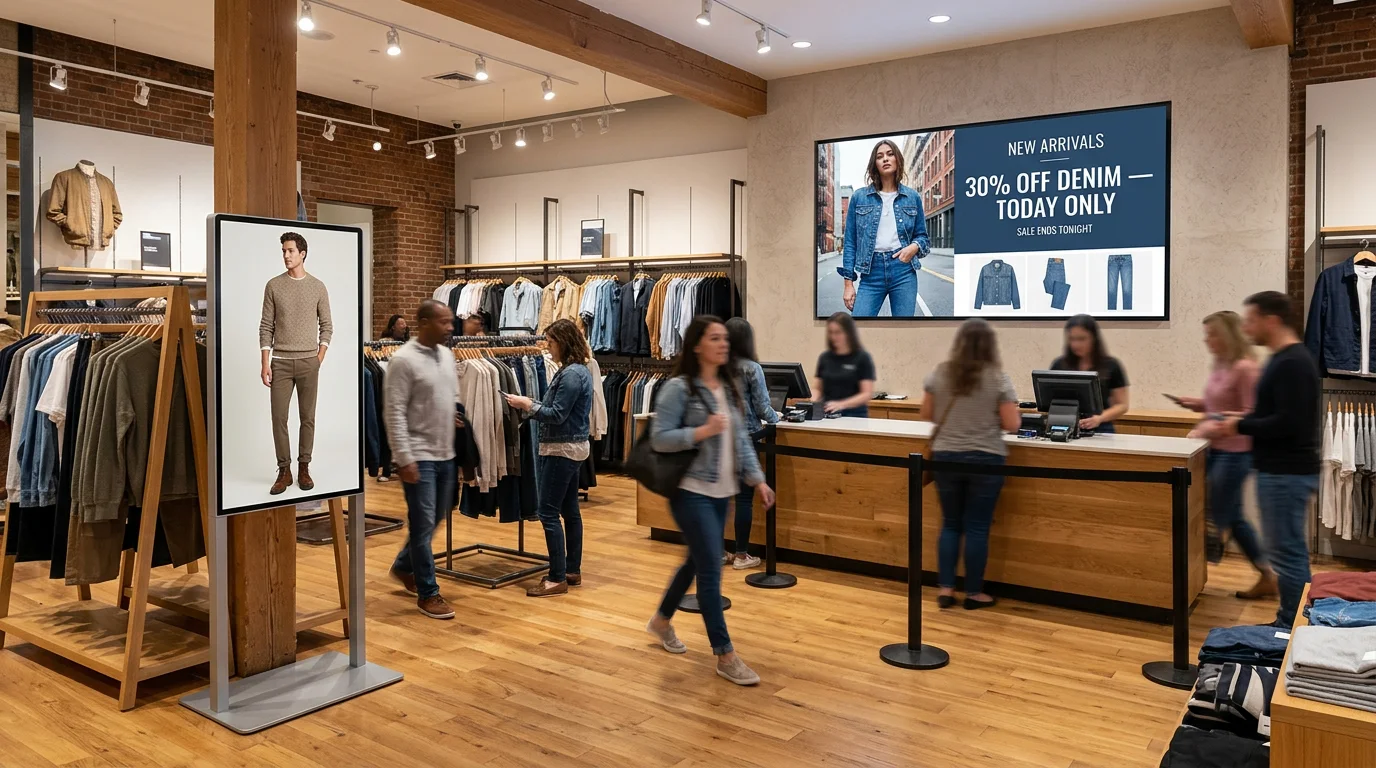
Retail digital signage is a network of commercial displays across a store — window screens, register and queue promos, endcaps, campaign walls, lookbooks — managed from a single content platform. Publish once; every screen (and every store) updates in seconds. Retailers use it to promote, to reprice without reprinting, and to keep selling through the glass after close.
The 16 placements, ranked by sales impact
Front of store
1. Window displays. The only screens that sell 24 hours a day — if they're bright enough. Behind glass means 2,500–3,000 nits (Samsung OM series) or the screen is a black mirror by 10 a.m. Full hardware treatment in our digital window displays guide. 2. Entrance threshold screen. Today's promotion at the point of maximum footfall. 3. Storefront LED (flagships). Seamless walls visible from the street — see LED video wall costs.
Path to purchase
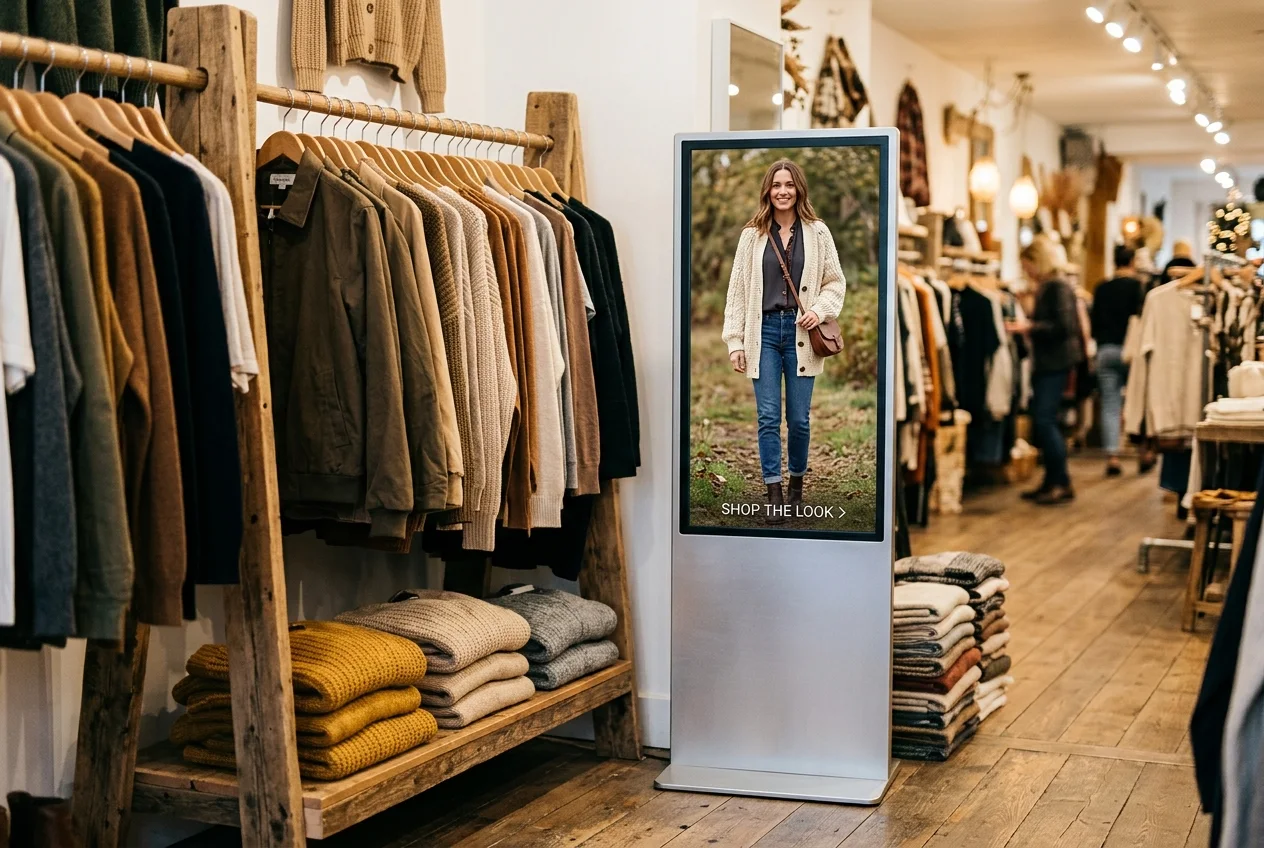
4. Endcap screens. The decision point retail already fights over; a screen there dayparts, plays motion, and swaps campaigns instantly. 5. Shelf-edge and counter screens. Small-format panels beside the product — specs, reviews, bundle pricing. 6. Aisle/freestanding portrait units. Lookbooks and category promos where wall space doesn't exist. 7. Campaign wall. One large panel keyed to the seasonal push, refreshed centrally the morning each campaign launches. 8. Fitting-room-adjacent screens. Styling suggestions and cross-sells at the try-on moment.
Register and exit
9. Register back-wall screen. The captive queue audience: impulse items, loyalty signup, gift cards. 10. Queue-line screens. Longer queues (holidays, drops) get sequential promo content — the retail version of the drive-thru upsell. 11. Exit screen. Returns policy, next event, app download — the last impression, automated.
Experience and proof
12. Social-proof wall. UGC, reviews, press on loop — proof at the point of sale. See social media digital signage. 13. Interactive lookup screens. Endless-aisle browsing and stock checks; kiosk formats covered in the kiosk guide. 14. Events and workshop boards. Retailtainment programming — classes, launches, appearances — promoted where the foot traffic is. 15. Visual-merchandising accents. Screens inside displays and vitrines as motion accents; ideas in visual merchandising ideas. 16. Back-of-house staff screens. Shift notes, targets, and shrink alerts in the stockroom — the workplace signage playbook, retail edition.
Planning screens for your store or chain?
Send us a floor plan or store count — we'll map the placements worth paying for and quote hardware, install, and software in one number.
Get a retail signage quote in 2 business hours →Hardware by placement
| Placement | Display | Why |
|---|---|---|
| Window-facing | Samsung OM55B / OM55N-DS (double-sided) | 3,000 nits beats sunlight; double-sided works the sidewalk and the store |
| Campaign walls / register | Samsung QM55C–QM75C | 500-nit 4K, 24/7-rated, slim |
| Endcaps / shelf edge | QM32C–QM43C | Compact, portrait-capable |
| Aisles / lookbooks | QMC portrait on freestanding mounts | Screens where walls aren't |
| Flagship feature | dvLED wall or The Wall all-in-one | Seamless at scale — priced in the LED wall guide |
Every screen runs a dedicated media player — retail Wi-Fi during a Saturday rush is not a content-delivery strategy. Panel comparisons in best digital signage displays.
Multi-store governance (the chain question)
The chain problem isn't hardware; it's forty stores interpreting a campaign forty ways. The structure that works mirrors every other multi-site vertical we deploy: corporate locks campaign templates, brand assets, and price displays; stores publish local hours, events, and clearance inside those rails; approval workflows catch the rest. Campaign launches become a single publish — every store, the same morning, no shipping tubes of posters. Retail buyers evaluating platforms should demand fleet visibility (what's playing where, which screen is dark) before comparing template libraries — dark screens are the silent killer of chain deployments. Platform landscape in best digital signage software. The same split applies one level up at a shopping center: the landlord runs common-area directories and ad screens, tenants run their own storefronts — how that network gets built is in our shopping mall digital signage guide.
How much does retail digital signage cost?
All-in and one-time per screen — display, mount, media player, licensed-insured install, setup, first-year software:
| Screen size | All-in price | Typical retail placement |
|---|---|---|
| 32″ | $2,950 | Shelf edge, register, exit |
| 43″ | $3,150 | Endcaps, aisles, lookbooks |
| 55″ | $3,450 | Campaign walls, register back-wall |
| 65″–75″ | $4,550–$4,950 | Feature walls, large-format promo |
A window + register + campaign-wall starter lands around $10,500–$15,000 (window hardware quoted with high-brightness panels); chains get volume pricing. Wider math in digital signage cost; retail industry context in our digital signage statistics (NRF and OAAA data among the sources).
Common retail deployment mistakes
- Screens as decoration. If it's not at a decision point, it's wallpaper. Placement first, screen second.
- Standard panels in windows. The #1 wasted spend in retail signage. Windows mean 3,000 nits.
- Campaigns on a print schedule. If screen content changes monthly, you bought expensive posters. Daypart, test, and swap weekly.
- Consumer TVs on 12-hour retail duty. Burn-in, voided warranties, visible failure at the worst time.
- No fleet visibility. A dark campaign screen in store #23 stays dark until someone from head office happens to visit.
How CrownTV Helps
- Samsung Authorized Reseller — QMC in-store panels, OM window displays (incl. double-sided), dvLED for flagships
- All-in per-screen packages with 3-year commercial warranty; volume pricing and wave installs for chains
- CrownTV Dashboard: locked campaign templates, per-store publishing, approval workflows, fleet visibility
- Retail track record: L'Occitane, Victoria's Secret Fifth Avenue, TravisMathew, Pressed Juicery, Janie and Jack
Get a retail signage quote in two business hours →
Frequently asked questions
What is retail digital signage?
The network of commercial screens a store manages from one platform: windows, register and queue promos, endcaps, campaign walls, lookbooks, and social-proof screens — published centrally across one store or the chain.
How much does retail digital signage cost?
All-in per screen: $2,950 (32″) through $4,950 (75″) including display, mount, player, install, and first-year software. A window + register + campaign-wall starter runs about $10,500–$15,000; chains get volume pricing.
Does digital signage increase retail sales?
Promoted items get front-of-eye placement at decision points, campaigns launch chain-wide instantly, and windows sell after close. Measure promoted-SKU lift against control stores and let results drive expansion.
What screens do retail stores use?
Commercial QMC-series panels in-store, 3,000-nit OM-series (incl. double-sided) in windows, portrait freestanding units in aisles, and dvLED walls in flagships — all on dedicated media players.
How do chains manage signage across stores?
Corporate-locked templates and pricing, per-store publishing rights, approval workflows, and fleet visibility — one publish reaches every store the same morning.
How do retail chains manage signage across stores?
Corporate locks campaign templates, brand assets, and pricing rules; each store publishes local hours, events, and clearance inside those rails. Role-based permissions, approval workflows, and fleet visibility (which store's screen is offline, what's playing where) are the features that separate chain-grade platforms from single-store tools. One publish, every store, same morning.
Read Next
DISPLAYDETAILS · BY CROWNTV · SHIPS NATIONWIDE
Retail-grade displays, direct from CrownTV
Most-deployed 4K commercial display in the QM lineup.
Samsung QM55C
55-inchSamsung Authorized Reseller — direct allocation, full warranty
- Price-match guarantee — find it cheaper, we'll match it.
- 3-year Samsung commercial warranty — RMAs handled by us.
- Free nationwide shipping — every panel, every order.
- Purchase orders, tax-exempt orders accepted.
Browse the full Samsung QMC series lineup at DisplayDetails →
Keep reading
More guides like this
Operator-grade playbooks, weekly.
Proof, not pitches
See real installs
Live deployments across hospitality, retail, and offices.
Ready to deploy?
Get a quote in 2 business hours
Reply within two business hours. No call required.