
👉 Need A Samsung The Wall All‑in‑One 146”?
🚚 Fast Shipping. Competitive Pricing. All Inquiries Answered Within 1 Business Hour
We Supply Commercial-Grade Digital Displays And Can Handle Everything — Screen Sourcing, Mounting, And Professional Installation
👉 Request A Quote For The Samsung The Wall All‑in‑One 146”
When we look at flagship commercial displays, Samsung The Wall All‑in‑One 146″ (IA Series, model IA008B) sits in a very specific niche: a fully integrated 4K MicroLED wall designed for premium business environments, not general-purpose signage.
In this review, we focus only on this 146″ All‑in‑One configuration, how it performs, what it demands from a space, and whether it makes business sense for lobbies, boardrooms, control rooms, and high-end retail. We’ll walk through image quality, installation, integration, and long‑term ownership so you can decide if this particular model aligns with your project requirements.
At A Glance
Samsung The Wall All‑in‑One 146″ is a 146‑inch 4K UHD MicroLED display with a 0.94 mm pixel pitch and an all‑in‑one design that includes the controller, Tizen 6.5 smart platform, and integrated speakers.
Key characteristics in plain terms:
- 146″ diagonal, native 3840 x 2160 (4K UHD)
- MicroLED with flip‑chip RGB and very fine 0.94 mm pixel pitch
- Peak brightness up to 1600 nits, typical max around 500 nits
- Rated contrast ratio of 24,000:1 with HDR10/10+ and LED HDR
- Built‑in controller and scaler, no external video processor required
- Tizen 6.5 OS with MagicINFO content management support
- Onboard 10 W speakers (basic but usable for many corporate applications)
- Integrated Wi‑Fi and Bluetooth
- Front serviceability for modules, designed for wall mounting
- Display weight about 353 lbs (533 lbs packaged)
In short, we’re looking at a turnkey dvLED video wall system aimed at professional environments that want the impact of The Wall without assembling a custom LED array from scratch.[1][2][5]
Key Specs And Configurations
From an AV planning perspective, the core specifications of Samsung The Wall All‑in‑One 146″ (IA008B) are:
- Resolution: 3840 x 2160 (4K UHD)[1][2]
- Pixel pitch: 0.94 mm MicroLED
- Brightness: 1600 nit peak, 500 nit max typical[2][5]
- Contrast: 24,000:1: HDR10, HDR10+, LED HDR: AI Picture processing[2][4]
- Refresh: 3840 Hz driving: 60 Hz input with frame rate conversion to 120 Hz in MICRO Motion modes[2]
- Inputs: 3 × HDMI 2.0, 1 × DisplayPort 1.2, 2 × USB 2.0
- Control: RS‑232C and RJ45 (LAN), plus network control over IP[2][4]
- Power consumption: 1240 W max, about 860 W typical per screen[2]
- Operating conditions: 32°F to 104°F (0–40°C), IP20 rating[2]
- Lifetime: Rated LED lifetime of approximately 150,000 hours[2]
Available configurations
This specific model is offered as:
- Single 146″ All‑in‑One unit (the focus of this guide)
- Side‑by‑side or tiled multi‑screen arrays, up to four 146″ units in a row for extremely wide installations[5]
For most corporate and retail environments, we see this 146″ version used as a standalone hero display, large enough to dominate a lobby or boardroom without moving into arena‑scale wall territory.
How We Evaluate This Display
Since Samsung The Wall All‑in‑One 146″ is a specialized commercial product, our assessment is built around real‑world business use rather than consumer TV criteria.
We base our evaluation on:
- Image quality
We look at brightness, perceived contrast, color accuracy, uniformity, HDR handling, and motion behavior, using Samsung’s published specifications and integrator feedback.[1][2][4]
- Usability and system design
We assess the all‑in‑one architecture, input options, smart features (Tizen, MagicINFO), and daily operational workflows, how easily IT and AV teams can manage the display.[2][4]
- Installation and physical requirements
Weight, dimensions, serviceability, mounting, and environmental considerations that affect feasibility in typical commercial spaces.[1][4][7]
- Reliability and total cost of ownership (TCO)
Lifetime ratings, servicing approach, power draw, and likely long‑term operating implications, especially for always‑on signage or control‑room scenarios.[2][5]
Our goal is to answer a narrow but important question: does this specific 146″ MicroLED execution justify its footprint, complexity, and operating costs in a professional setting?
Image Quality And Viewing Experience
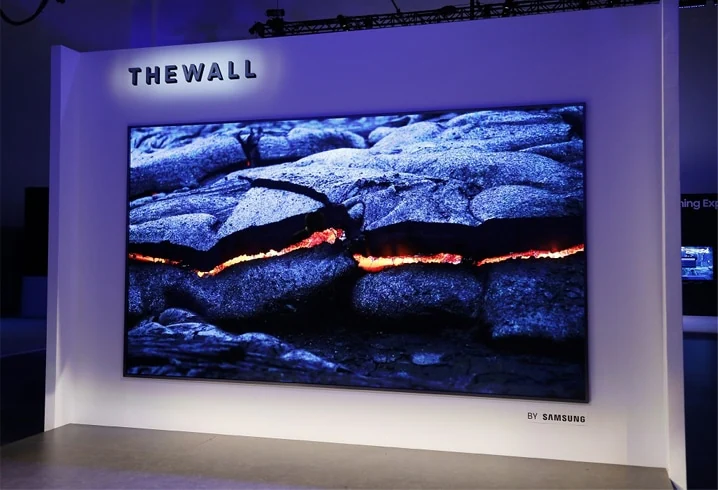
Samsung positions The Wall line as a reference‑grade option, and on the 146″ All‑in‑One we see that intent in the core imaging technologies.
The display uses flip‑chip RGB MicroLEDs with a 0.94 mm pixel pitch, which allows true 4K detail at 146″ without visible pixel structure at typical viewing distances. The rated 20‑bit color depth supports fine gradations in shadows and highlights, important for brand visuals, medical‑adjacent viewing modes, and data‑dense content.[1][4][5]
Samsung’s Neural Quantum Processor 4K applies AI‑based upscaling and picture optimization. For real deployments, that means lower‑quality feeds (1080p signage players, legacy meeting room sources) can still look clean on a 4K wall, though native 4K content unsurprisingly looks best.
The viewing experience is helped by wide 170° horizontal and vertical viewing angles, so content remains readable and color‑stable when viewers are off‑axis, relevant for open lobbies or wide boardrooms.
Brightness, HDR, And Color Performance
In bright commercial spaces, raw brightness and contrast make or break a display. Samsung The Wall All‑in‑One 146″ is specified at:
- 1600 nits peak brightness for HDR highlights[2][5]
- Around 500 nits max for sustained brightness in typical operation[2]
- 24,000:1 contrast with LED HDR and support for HDR10 and HDR10+[2][4]
What this translates to in practice:
- The display has enough peak output to remain impactful under strong ambient light, such as glass‑heavy lobbies or retail spaces with downlighting.
- Dark content, night scenes in brand videos, deep gray UI elements on dashboards, retains good separation instead of washing out.
- HDR titles and promotional pieces with specular highlights (e.g., chrome products, city lights, high‑end automotive content) benefit from the combination of high peak brightness and strong contrast.
Samsung also cites a wider color volume compared with conventional LED LCDs, with claims around roughly double the linear color gamut in some materials.[1][2][4] While the exact numbers depend on calibration, we’d expect this model to comfortably meet or exceed standard commercial color spaces like Rec.709 and cover a significant portion of wider gamuts, which is more than adequate for corporate and retail applications.
Clarity, Motion Handling, And Viewing Angles
With a 0.94 mm pixel pitch, The Wall All‑in‑One 146″ can deliver:
- Crisp text for dashboards and financial tickers
- Detailed product imagery at close viewing distances
- Smooth edges on vector graphics and UI elements
The LED driving frequency is listed at 3840 Hz, and motion features include MICRO Motion which effectively upconverts 60 Hz input to 120 Hz‑like output. In practice, that means:
- Reduced judder on camera pans and transitions
- Cleaner motion on sports, fast‑moving brand videos, or surveillance feeds
We don’t see this as a high‑frame‑rate gaming display, but for commercial video, live feeds, and motion‑rich corporate content, motion handling should be more than sufficient.[1][2][4]
The 170° viewing angles help ensure that color and contrast hold up for viewers walking across a lobby or seated at the far edges of a large conference table, minimizing the traditional “washed‑out from the side” look of many LCDs.
👉 Need A Samsung The Wall All‑in‑One 146”?
🚚 Fast Shipping. Competitive Pricing. All Inquiries Answered Within 1 Business Hour
We Supply Commercial-Grade Digital Displays And Can Handle Everything — Screen Sourcing, Mounting, And Professional Installation
👉 Request A Quote For The Samsung The Wall All‑in‑One 146”
Installation, Physical Requirements, And Setup
From an integrator’s standpoint, one of the main appeals of Samsung The Wall All‑in‑One 146″ is that it avoids the complexity of a fully custom LED wall.
The display is composed of preset MicroLED modules that dock onto background plates. Samsung’s system uses alignment mechanisms to help keep seams invisible and maintain a uniform plane.
Physical characteristics:[1][4][7]
- Approximate dimensions: 3256 × 1864 × 95 mm (W × H × D)
- Display weight: around 353 lbs (160 kg)
- Packaged weight: about 533 lbs (242 kg)
Samsung recommends a four‑person installation team, which aligns with the weight and size. The package typically includes:
- Frame kit and wall brackets
- Décor bezels or trim elements to finish edges
- Front‑service access tools
Once mounted, the built‑in controller auto‑configures the LED modules into a single 4K canvas, significantly simplifying commissioning compared with assembling and mapping a discrete LED cabinet wall.
Mounting, Power, And Room Constraints
While the all‑in‑one approach reduces system complexity, this is still a physically demanding display.
Mounting and structure
- Designed primarily for wall mounting, with brackets included.[2][5]
- The wall must support not only the 353‑lb display but also meet safety and structural codes for commercial facilities.
- Because the unit is front‑serviceable, clearance requirements behind the display are modest, but we still need enough space for cable routing and ventilation.
Power and heat
- Input power: 100–240 V AC, 50/60 Hz
- Max power draw: 1240 W, typical around 860 W[2]
- Heat output up to roughly 5800 BTU/h at maximum load[2][5]
Those numbers mean we need:
- Appropriately rated power circuits (often dedicated)
- Consideration of HVAC capacity, especially in enclosed boardrooms or smaller control rooms
If a room is already thermally marginal, adding a 5000+ BTU heat source can make occupant comfort an issue unless cooling is adjusted.
System Integration And Commissioning
Samsung The Wall All‑in‑One 146″ integrates the controller and scaling hardware in the display itself, which simplifies signal flow.
Key integration points:[2][4]
- Inputs: 3 × HDMI 2.0, 1 × DP 1.2, 2 × USB 2.0 cover most corporate sources (PCs, media players, video conferencing codecs).
- Control: RS‑232C and RJ45 enable integration with control systems (Crestron, Extron, others) as well as network monitoring.
- Workspace features: Samsung Workspace supports Microsoft 365 access and Remote Desktop (RDP), allowing direct connection to cloud services without a dedicated PC.
- SmartView+ and Auto Source Switching: Useful in multi‑user meeting spaces where different presenters or sources connect through the day.
Once the wall is physically installed and powered, the auto‑configuration wizards detect and map the LED modules. For AV teams used to stitching together traditional LED cabinets and external processors, this is a meaningful reduction in setup time and risk.
Smart Features, Control, And Content Management
Because Samsung The Wall All‑in‑One 146″ runs Tizen 6.5, it behaves much like Samsung’s higher‑end commercial smart displays, but on a far larger canvas.
Key capabilities:[2][5]
- MagicINFO support for content management, scheduling, and remote monitoring
- Built‑in media player for signage playlists and local content
- Eco and temperature sensors that can adjust brightness or behavior to extend component life and reduce unnecessary power usage
- DICOM simulation mode for more consistent grayscale in medical‑adjacent environments (not for primary diagnosis)
Control and management options include:
- Local control via supplied remote and on‑screen menus
- Network control over LAN for IT and AV teams
- Integration into existing digital signage ecosystems through MagicINFO or third‑party CMS players feeding HDMI/DP
For multi‑site retailers or corporate campuses, having The Wall behave like other Samsung smart signage displays simplifies fleet management: the same dashboards and practices often apply across the board.
Reliability, Service, And Total Cost Of Ownership
On paper, Samsung The Wall All‑in‑One 146″ is engineered for long‑term, always‑on use.
Reliability and serviceability
- LED lifetime is rated at approximately 150,000 hours, which, in theory, supports many years of operation even in 24/7 environments.[2]
- The unit is front‑serviceable, so modules can be accessed and serviced from the room side without tearing out the wall structure, important in built‑in architectural installs.
- The display carries TÜV Eye Comfort‑related credentials, indicating attention to blue‑light management and flicker characteristics.[2][5]
Total cost of ownership (TCO)
There are a few clear TCO drivers:
- Power consumption: At up to 1240 W, energy use will be a noticeable line item for always‑on deployments, especially in regions with higher electricity costs.
- Cooling: The 5800 BTU/h heat output can influence HVAC sizing and operating costs.
- Longevity: The long lifetime and modular serviceability help offset those operating costs by reducing replacement frequency and downtime.
- All‑in‑one integration: Because the controller and many smart signage functions are integrated, we don’t have to budget for separate processors or external players in all scenarios.
We’d characterize the TCO profile as suitable for mission‑critical or brand‑critical applications where the visual impact and reliability justify the ongoing energy and infrastructure costs, not for deployments where the primary metric is minimal power use.
Pros And Cons
To put Samsung The Wall All‑in‑One 146″ in perspective, we can summarize its main strengths and weaknesses for commercial buyers.
| Aspect | Pros | Cons |
|---|---|---|
| Image quality | True 4K MicroLED with 0.94 mm pitch: very high contrast: strong HDR support: wide color and viewing angles | Requires high‑quality content and proper calibration to realize full potential |
| System design | All‑in‑one controller: Tizen 6.5: MagicINFO support: front serviceability | Less modular than fully custom LED solutions if unusual aspect ratios are needed |
| Installation | Pre‑engineered frame and modules: auto‑configuration: wall brackets included | Heavy unit (353 lbs) demands robust structure and careful logistics |
| Operation | Smart features, built‑in media player, integrated Wi‑Fi/BT: supports Microsoft 365/RDP workflows | Higher power draw and heat output than LCD signage alternatives |
| Business fit | Extremely impactful for premium spaces: long LED lifetime | Overkill for smaller rooms, budget installations, or casual viewing[1][2][4] |
Overall, we see the pros aligning strongly with high‑end, curated environments where the wall becomes part of the space’s identity.
👉 Need A Samsung The Wall All‑in‑One 146”?
🚚 Fast Shipping. Competitive Pricing. All Inquiries Answered Within 1 Business Hour
We Supply Commercial-Grade Digital Displays And Can Handle Everything — Screen Sourcing, Mounting, And Professional Installation
👉 Request A Quote For The Samsung The Wall All‑in‑One 146”
How It Compares To Alternatives
Samsung The Wall All‑in‑One 146″ sits at the intersection of dvLED video walls and high‑end professional LCDs.
Versus large commercial LCD displays
- Contrast and black levels: MicroLED delivers much deeper perceived blacks than typical edge‑lit or even direct‑lit LCDs.
- Brightness: The 1600‑nit peak output exceeds what most large LCDs can sustain.
- Viewing angles: Better consistency off‑axis, with less color and contrast shift.
- Seamlessness: No bezels, unlike tiled LCD video walls.
In return, LCDs generally offer:
- Lower power consumption per square foot
- Lighter weight and simpler structural requirements
- Lower acquisition and operating costs
Versus other The Wall configurations
Within Samsung’s own The Wall portfolio:
- The 146″ 4K All‑in‑One offers higher resolution and a larger canvas than smaller or lower‑resolution variants, such as earlier 110″ 2K implementations.[2][3][4]
- That extra size and pixel density come with higher power draw and greater weight, which may rule out some smaller rooms or lighter‑duty walls.
So for projects where the brief calls for a single, attention‑grabbing wall that’s large but still manageable as a single unit, the 146″ model can hit a sweet spot, assuming the space is prepared for its structural and electrical requirements.
Best Use Cases And ROI Considerations
Samsung The Wall All‑in‑One 146″ is not a general‑purpose display. We see it delivering the best value in scenarios where the display directly supports brand perception, mission‑critical operations, or premium client experiences.
High‑impact environments where it fits well[1][4]
- Corporate lobbies and reception areas where the display acts as a digital centerpiece for visitors.
- Executive boardrooms and briefing centers that need a large, seamless canvas for presentations, data visualization, and video conferencing backgrounds.
- Control rooms and operations centers leveraging the 4K resolution for multi‑window dashboards and situational awareness.
- Flagship retail stores and showrooms seeking a visually striking stage for product launches, seasonal campaigns, and immersive branded content.
In terms of ROI, the value case typically hinges on:
- The display’s role in customer perception and brand equity, for instance, a luxury auto showroom or financial institution lobby.
- Reduced ancillary hardware costs thanks to the all‑in‑one architecture and smart platform.
- Long lifetime and modular servicing, which reduce replacement cycles and downtime, especially in 24/7 or extended‑hour operations.
If the display is simply replacing a standard meeting room screen without contributing meaningfully to client‑facing experience or critical visualization, the ROI will be harder to justify.
Who Should Buy The Wall All‑in‑One 146” (And Who Shouldn’t)
Based on the capabilities and constraints of Samsung The Wall All‑in‑One 146″, here’s who we think it suits, and who is better served by other platforms.
Well‑suited buyers
- Enterprises with flagship spaces (HQ lobbies, innovation centers, executive briefing rooms) where the display is a core design element.
- Retailers and hospitality brands running premium locations that rely heavily on visual storytelling.
- Control rooms, broadcast, and command centers that benefit from the 4K canvas, high contrast, and reliability.
- AV integrators looking for an all‑in‑one MicroLED solution that reduces custom processor and mapping work compared with fully modular LED walls.
Less suitable buyers
- Home users: The size, installation demands, and operating profile are misaligned with typical residential environments.
- Cost‑sensitive projects: Where the primary requirement is “big screen at low operating cost,” large LCD or projection can be more practical.
- Small rooms or weak structures: Spaces that can’t comfortably support the weight, power, and heat footprint.
If your main goal is simply to show slides in a mid‑size meeting room, this display is likely excessive. If your goal is to anchor a flagship space with a visually dominant, long‑life digital wall, it becomes far more compelling.
Final Verdict
Samsung The Wall All‑in‑One 146″ is a purpose‑built 4K MicroLED display engineered for high-end commercial environments where image quality, reliability, and visual impact are non-negotiable. At 146 inches with seamless MicroLED technology, it delivers what no LCD video wall can: zero bezels, true blacks, and 1,600+ nit peak brightness in a single self-contained unit. For corporate lobbies, luxury retail flagships, broadcast studios, and premium event spaces, this display commands attention in ways traditional signage simply cannot match.
We’d consider it a strong candidate when:
- The space can handle its structural, power, and cooling demands.
- The display plays a direct role in brand presentation or mission‑critical visualization.
- Long‑term reliability and seamless appearance matter more than minimizing energy use.
For organizations that meet those conditions, Samsung The Wall All‑in‑One 146″ offers a well‑engineered, all‑in‑one path into MicroLED walls without the complexity of a fully custom LED installation.
👉 Need A Samsung The Wall All‑in‑One 146”?
🚚 Fast Shipping. Competitive Pricing. All Inquiries Answered Within 1 Business Hour
CrownTV supplies Samsung The Wall All‑in‑One 146″ with full turnkey service: competitive pricing, fast shipping, professional installation by licensed technicians, and ongoing support. With 13+ years deploying commercial displays and 13,500+ active screens nationwide, CrownTV handles every detail from site survey to final calibration. Request a free consultation to get pricing and lead times for your project.
Explore More: Compare this with other video wall solutions, see 31 digital signage examples from real installations, or learn about CrownTV’s full indoor display lineup including commercial-grade Samsung screens at every price point.
Frequently Asked Questions
What is Samsung The Wall All-in-One 146” and who is it designed for?
Samsung The Wall All-in-One 146” (IA008B) is a 146-inch 4K MicroLED commercial display with a 0.94 mm pixel pitch, built-in controller, Tizen 6.5 smart platform, and speakers. It’s engineered for premium business environments such as corporate lobbies, executive boardrooms, control rooms, and flagship retail spaces.
What are the key specs of Samsung The Wall All-in-One 146”?
Core specs include 3840 × 2160 (4K UHD) resolution, 0.94 mm MicroLED pixel pitch, 1600 nits peak and about 500 nits typical brightness, 24,000:1 contrast with HDR10/HDR10+, 3840 Hz LED driving, three HDMI 2.0 inputs, DisplayPort 1.2, USB, RS-232C and LAN control, and a rated 150,000-hour LED lifetime.
How difficult is it to install Samsung The Wall All-in-One 146” in a commercial space?
Installation is easier than a fully custom LED wall but still demanding. The pre-engineered frame, wall brackets, and auto-configuration simplify setup, yet the unit weighs around 353 lbs, typically needs a four-person team, robust wall structure, dedicated power, and HVAC consideration due to up to roughly 5800 BTU/h heat output.
What is the recommended viewing distance for a 146” 4K MicroLED wall?
For a 146-inch 4K MicroLED display with a 0.94 mm pixel pitch, a practical viewing distance is roughly 6–15 feet (about 2–5 meters). Closer than that, viewers may start noticing pixel structure; farther away, they’ll still perceive sharp 4K detail, which suits lobbies, boardrooms, and control rooms.
How does Samsung The Wall All-in-One 146” compare to a high-end projector for large rooms?
Compared with a projector, Samsung The Wall All-in-One 146” delivers much higher contrast, deeper blacks, higher sustained brightness, and no shadows or lamp changes. Projectors generally cost less and draw less power for similar image sizes but rely heavily on room darkening and ongoing lamp/laser maintenance to maintain image quality.
If you’re comparing different Samsung commercial display options, you may also find these guides useful:
Samsung OH55A-S
Samsung QM85C
Samsung QM43C
Samsung QM75C
Samsung QM50C
Samsung QM65C
Samsung QM55C
Samsung OM55B
Samsung OM75A,
Samsung The Wall All-in-One 146″