
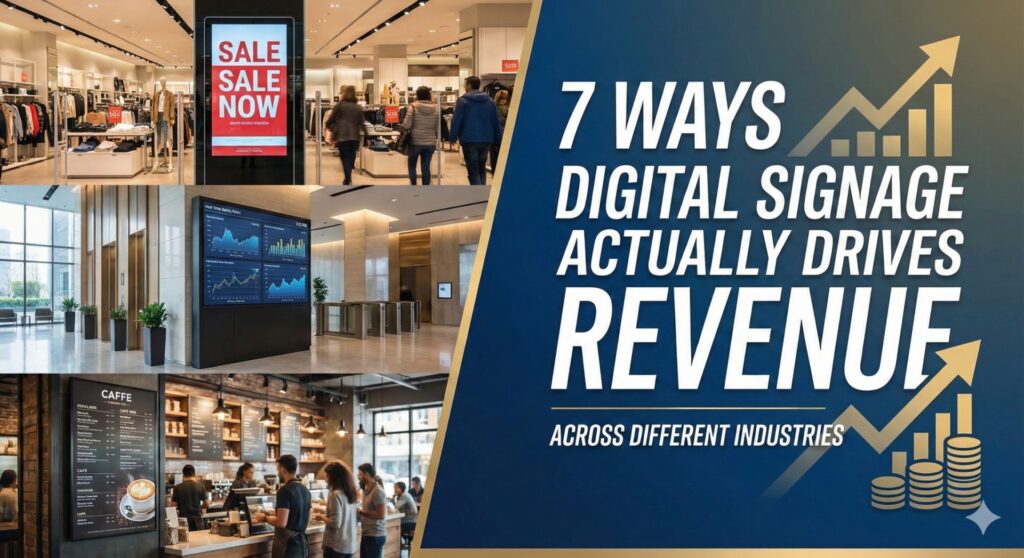
We’re long past the point where screens on the wall are just “nice to have.” When they’re done right, digital signage becomes a revenue engine that touches marketing, operations, and customer experience at the same time.
Across industries, businesses see 7–33% sales lifts, 24% more foot traffic, and even 124% profit increases when they replace static signs with dynamic displays. That’s not hype, that’s what happens when content, timing, and context finally work together instead of fighting each other.
In this guide, we’ll break down the most important digital signage benefits for businesses, how the technology actually works, and where it creates measurable revenue gains in retail, restaurants, healthcare, education, fitness, real estate, hospitality, offices, and more.
Key Takeaways
- Digital signage benefits for businesses include measurable sales lifts of 7–33%, more foot traffic, and higher profits by replacing static signs with dynamic, targeted content.
- A centralized digital signage CMS lets businesses update prices, promos, and messaging across all locations in seconds, cutting printing waste and operational overhead.
- Strategic use of digital displays at the point of sale drives upsells, cross-sells, and higher margins by adapting content to inventory, time of day, and local demand.
- Digital signage boosts internal communication and productivity with real-time dashboards, alerts, and announcements that achieve far higher engagement than email or bulletin boards.
- Across industries—from retail and restaurants to healthcare, fitness, and offices—digital signage benefits for businesses show up as better customer experiences, shorter perceived wait times, and a faster path to ROI within 2–3 years.
What Is Digital Signage And How Does It Work For Modern Businesses?
At its core, digital signage is a network of screens controlled by a central content management system (CMS). Instead of printing a sign, shipping it to every location, and hoping it stays relevant for a few months, we push fresh content to every display in seconds.
Here’s the basic flow:
- Content creation – Your team designs promos, menus, announcements, dashboards, or directional signage.
- Centralized CMS – From a cloud-based dashboard, you upload content, create playlists, and schedule what shows where.
- Media players – Small digital signage players connected to each screen download and play the scheduled content.
- Commercial displays – Professional-grade screens run 12–24 hours a day without burning out like consumer TVs.
Because everything is networked, we can:
- Update prices in real time chain‑wide.
- Trigger content based on time of day, location, or audience.
- Coordinate campaigns across dozens or hundreds of screens from one login.
That’s the engine underneath solutions like digital menu boards, video walls, wayfinding, corporate communication boards, and more. Our role at CrownTV is to streamline that stack, from hardware and software to installation, so your team focuses on content and strategy, not cabling and configurations.
From Static To Dynamic: Why Businesses Are Switching To Digital Displays
Businesses aren’t moving to digital signage just because it “looks modern.” They’re moving because the numbers are hard to ignore.
Studies consistently show that digital displays can deliver:
- 47.7% better brand awareness compared with static posters
- 83% content recall rates, because motion and color capture attention
- Media costs as low as $0.15 per 1,000 impressions, versus $5–$7 for many traditional formats
In practical terms, that means a screen in your lobby or storefront window can behave more like a highly efficient, always‑on media channel than a simple sign.
A few reasons teams tell us they finally made the switch:
- They were tired of waste. Printing, shipping, and reprinting every time a price or offer changed was burning budget and time.
- They needed agility. Marketing teams couldn’t wait weeks to react to competitors or inventory changes.
- Brand consistency was slipping. Locations improvised outdated materials, or skipped promos entirely when prints didn’t arrive.
When we deploy digital signage for multi-location brands, we see the same pattern: once the first campaign runs and they watch every location update instantly, there’s no going back to static prints.
Driving Revenue: How Digital Signage Boosts Sales And Marketing Performance
If we boil it down, digital signage makes money in three main ways:
- Influencing purchase decisions at the point of sale
- Increasing basket size with upsells and cross-sells
- Improving margins by steering demand
Research shows that 60%+ of purchase decisions are made in-store, right in front of shelves, counters, and menus. Well-placed digital screens can drive:
- 29.5–31.8% sales lifts on promoted items
- 32.8% more repeat buyers when customers see relevant offers and loyalty messaging
- 3% margin gains when we guide customers toward higher-margin alternatives
In retail, that might mean highlighting bundled outfits or limited-time discounts. In QSR and fast casual, we see digital menu boards nudge guests to more profitable combos, add-ons, or premium beverages.
Because content is dynamic, we can also adjust based on:
- Inventory (push items that are overstocked)
- Time of day (breakfast vs. lunch vs. late night)
- Day of week or season (game day, holidays, local events)
That’s how digital signage transitions from being “a cost” to an active lever your marketing and merchandising teams can pull every day.
Streamlining Operations And Internal Communication
Digital signage does more than drive sales: it quietly cleans up operations in the background.
Organizations that deploy screens for internal communication and operations often see:
- Up to 25% productivity gains when information is clearer and more visible
- As much as 350% higher engagement with messages compared with email alone
- A significant drop in printing and distribution costs across departments
Instead of cluttered bulletin boards and forgotten email blasts, we use displays to share:
- Shift updates, KPIs, and production targets
- HR announcements, safety reminders, and training snippets
- Event schedules, room bookings, and visitor information
Because everything runs through a centralized content system, corporate and regional leaders can control which messages appear in which locations, without relying on local managers to print, hang, and remove posters.
For multi-location brands, this becomes one of the most tangible digital signage benefits: we replace manual, error-prone communication workflows with a single, managed channel that’s fast, consistent, and secure.
Enhancing Customer Experience Across Different Industries
Revenue doesn’t rise in a vacuum: it follows better experiences. Digital signage helps us design those experiences around what customers actually need in the moment.
Across sectors, businesses report up to a 46% increase in customer satisfaction when they use screens to inform, entertain, and guide:
- Retail & restaurants – Stores see 24% higher foot traffic, and menu boards can influence nearly 30% of orders by showcasing appetizing imagery and clear pricing.
- Healthcare & education – Wayfinding, check‑in instructions, class changes, and emergency messaging reduce confusion and stress.
- Fitness centers – Workout tips, class schedules, leaderboards, and live social feeds keep members engaged and more likely to renew.
- Manufacturing & logistics – Real-time performance boards have driven 22% higher engagement and up to 41% fewer defects by making goals visible on the floor.
- Offices & real estate – Lobby screens, meeting room status boards, and property showcases help visitors get where they need to go without friction.
- Places of worship – Event calendars, announcements, and verse displays support a more connected congregation.
The common thread: wherever people are moving, waiting, or deciding, digital signage turns dead time and confusion into clarity and perceived value, which feeds directly into loyalty and long-term revenue.
To make this work at scale, we design deployments around your specific use cases, whether that’s menu boards, wayfinding, video walls, or internal dashboards, then pair them with reliable hardware and ongoing support from our team at CrownTV.
Measuring ROI And Building A Scalable Digital Signage Strategy
Most organizations recover their initial digital signage investment in 2–3 years, sometimes faster when content is tightly aligned with promotions and operations.
The key is treating digital signage like any other performance channel:
- Set clear goals – Sales lift on promoted items, higher attachment rates, lower call volume at reception, reduced perceived wait times, etc.
- Track relevant metrics – Foot traffic, conversion rate, average ticket size, content playback logs, and employee engagement.
- Run controlled tests – Compare locations or periods with and without specific campaigns to isolate impact.
On the market side, digital signage isn’t slowing down. Global forecasts put the industry above $51 billion by 2033, with steady annual growth, reflecting how central screens have become to modern communication and retail environments (Statista global market data).
To build a strategy that can grow with you, we focus on:
- Cloud-based, centrally managed software
- Secure networking and device management aligned with IT policies
- Standardized, commercial-grade hardware that’s easy to service and replace
That’s how we help clients move from a few “pilot” screens to a cohesive, enterprise-wide signage network without losing control or overburdening internal teams. Our team guides that transition, from early planning through nationwide installation and long-term support, so your investment continues to generate measurable returns.
Conclusion
Digital signage delivers real, measurable value when it’s more than a few random screens on a wall. When we align content, hardware, and strategy, it becomes a connected system that grows revenue, reduces costs, and improves experiences at the same time.
Below are the core building blocks and strategic angles we look at when we design digital signage deployments for our clients.
Core Components Of A Digital Signage System
A modern digital signage system typically includes:
- Commercial displays built for long run times and higher brightness.
- Media players that download and render content smoothly.
- A cloud-based CMS for managing content, playlists, and devices.
- Network connectivity (wired, Wi‑Fi, or LTE) with secure access.
When we deploy solutions through CrownTV’s platform, we package these elements so they behave as one cohesive system rather than a pile of separate parts.
Centralized Content Management And Scheduling
Central control is where most of the efficiency, and ROI, comes from.
With a cloud CMS, your team can:
- Schedule content by location, screen, and time of day
- Push emergency messages or corrections immediately
- Ensure brand‑approved content is what actually shows on screens
That’s a major upgrade from emailing files around and hoping each site manager updates USB sticks on time.
Brand Consistency And Faster Campaign Deployment
Digital signage lets marketing roll out national or regional campaigns in hours instead of weeks. When every location receives the same creative and pricing at the same time, we avoid:
- Off‑brand or outdated signage lingering for months
- Missed promotional windows due to printing or shipping delays
The result is tighter brand control and more revenue captured from seasonal and time-sensitive offers.
Influencing Purchase Decisions At The Point Of Sale
At the moment of decision, standing at a menu board, shelf, or reception desk, customers are highly influenceable. Dynamic visuals, social proof, and clear pricing can tip the scale toward higher-value options.
We often pair localized messaging (e.g., “today only,” “limited stock,” or “popular in this store”) with appetizing visuals to drive immediate action at the point of sale.
Promotions, Upsells, And Cross-Sells In Real Time
Because content updates instantly, your team can:
- Promote overstocked SKUs or menu items in real time
- Surface complementary products near checkout
- A/B test different creatives and see which combinations drive higher baskets
Over time, this ongoing optimization adds up to significant incremental revenue.
Reducing Perceived Wait Times And Friction
People hate waiting with no information. Digital signage turns that dead time into value:
- Queuing screens that explain the process
- “You’re next” boards that show progress
- Educational or entertaining content tailored to your audience
This doesn’t just make people happier: shorter perceived waits are strongly linked to higher satisfaction and repeat visits, as documented in multiple service-industry studies (see, for example, consumer behavior research summarized by the American Marketing Association).
Reducing Printing Costs And Operational Overhead
Every poster you don’t print is savings.
By centralizing updates on screens, we:
- Eliminate many rounds of design-to-print revisions
- Remove shipping and manual posting from the process
- Reduce errors from old signage that never got taken down
Those savings can be substantial at scale, especially for multi-unit operations.
Corporate And Multi-Location Communication
In corporate offices and distributed organizations, digital bulletin boards and dashboards keep everyone aligned:
- KPIs, sales numbers, and progress toward goals
- Town-hall announcements and leadership updates
- Recognition programs and employee spotlights
Instead of relying solely on email, we surface the most important information where people actually move and gather.
Safety, Compliance, And Real-Time Alerts
For environments with regulatory or safety requirements, like manufacturing, healthcare, or logistics, screens double as a critical alerting layer.
We can:
- Display OSHA safety reminders and PPE requirements
- Push emergency alerts or evacuation instructions
- Surface compliance checklists and incident reporting steps
Because messaging is visual and prominent, it’s more likely to be seen than a printed notice or intranet post (OSHA has long emphasized the importance of visible safety communication).
Retail, Restaurants, And Hospitality
These industries tend to see some of the fastest revenue gains from digital signage:
- Retail – Window displays, in‑aisle promos, and checkout screens lift conversion and average basket size.
- Restaurants – Digital menu boards and order status screens drive higher ticket values and smoother operations.
- Hospitality – Lobby displays, wayfinding, and amenity promos encourage upsells and reduce strain on front-desk staff.
Healthcare, Education, And Fitness Centers
In these environments, the benefits blend revenue and mission:
- Healthcare – Wayfinding, check‑in guidance, and wait‑time boards reduce frustration and support better patient flow.
- Education – Campus-wide messaging, emergency alerts, and event promotion boost engagement.
- Fitness – Class schedules, leaderboards, and program marketing keep members motivated and informed.
Better communication and lower confusion translate into higher utilization of services and longer relationships.
Offices, Real Estate, And Places Of Worship
Digital signage in these spaces focuses on clarity and connection:
- Offices – Room booking boards, visitor information, and internal dashboards.
- Real estate – Property listings, virtual tours, and neighborhood highlights in lobbies or sales centers.
- Places of worship – Service times, events, donation prompts, and message reinforcement.
Each screen becomes a touchpoint that reinforces your brand and mission while guiding people to next steps.
Key Metrics To Track For Digital Signage Success
To prove and improve ROI, we track metrics like:
- Uplift in sales of promoted items
- Changes in average order value
- Foot traffic and dwell time near displays
- Employee engagement and productivity indicators
- Reduction in print and operational costs
We tie content schedules and logs back to these KPIs to understand what’s actually moving the needle.
Planning For Scalability, Security, And IT Alignment
Finally, any serious deployment has to satisfy IT and scale gracefully.
We design networks around:
- Secure device management and user access controls
- Network segmentation and bandwidth planning
- Standardized hardware and installation practices across sites
Aligning early with your IT and facilities teams prevents surprises later and ensures digital signage becomes a stable, trusted part of your infrastructure.
If you’re exploring digital signage benefits for your business, the next step is to map these use cases to your own locations and goals. From there, we can help you design a solution, from displays and media players to software, content strategy, and installation, that doesn’t just look good, but pays for itself through measurable performance gains.