
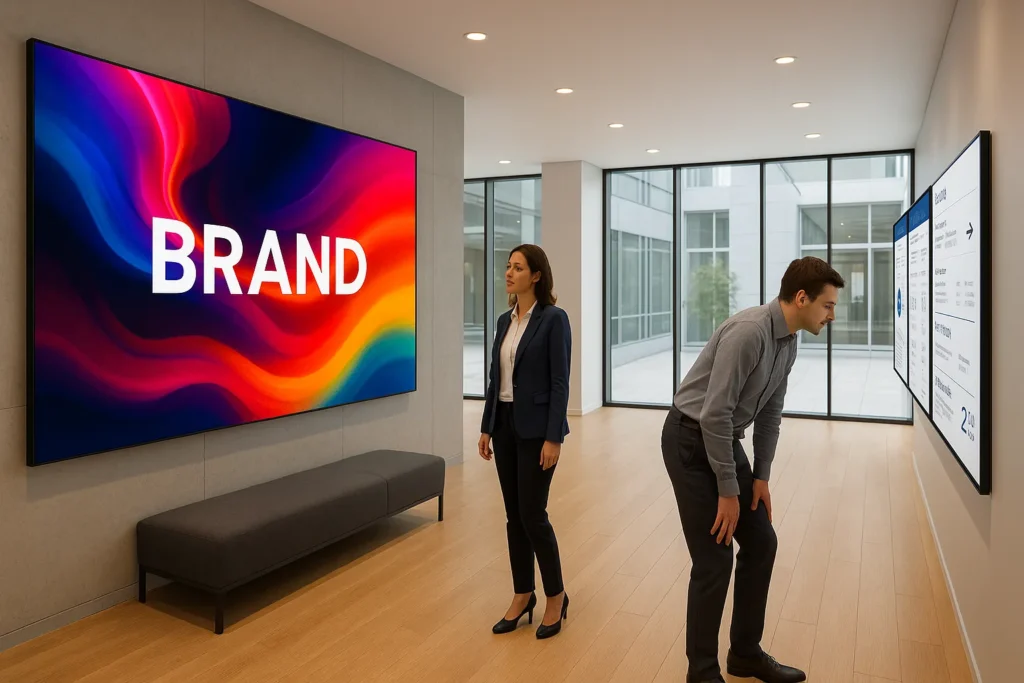
Choosing between an indoor LED display and a large format LCD isn’t just a tech decision, it’s a business decision. The screen you mount in your lobby, retail floor, or conference room will shape how customers perceive your brand, how effectively you communicate, and how much you’ll spend over the next five to ten years.
And yet, the indoor LED vs LCD display debate is full of oversimplified advice. You’ve probably seen articles that boil it down to “LED is brighter, LCD is cheaper.” That’s true on the surface, but it misses the dozens of variables that actually matter when you’re signing a purchase order for commercial-grade hardware.
We’ve helped businesses across industries navigate this exact choice, from quick-service restaurants needing menu boards to corporate campuses rolling out video walls. In this guide, we’ll break down how each technology works, where each one shines (literally), and how to match the right display to your specific indoor environment and budget. No vendor spin. Just a clear, honest comparison so you can invest with confidence.
Table of Contents
- How LED and LCD Display Technologies Work
- Key Differences Between LED Display vs LCD Signage
- When To Choose an Indoor LED Display
- When a Large Format LCD Makes More Sense
- Total Cost of Ownership: Commercial LED vs LCD
- How To Match the Right Display to Your Environment
- Conclusion
- Frequently Asked Questions
indoor LED vs LCD display: How LED and LCD Display Technologies Work
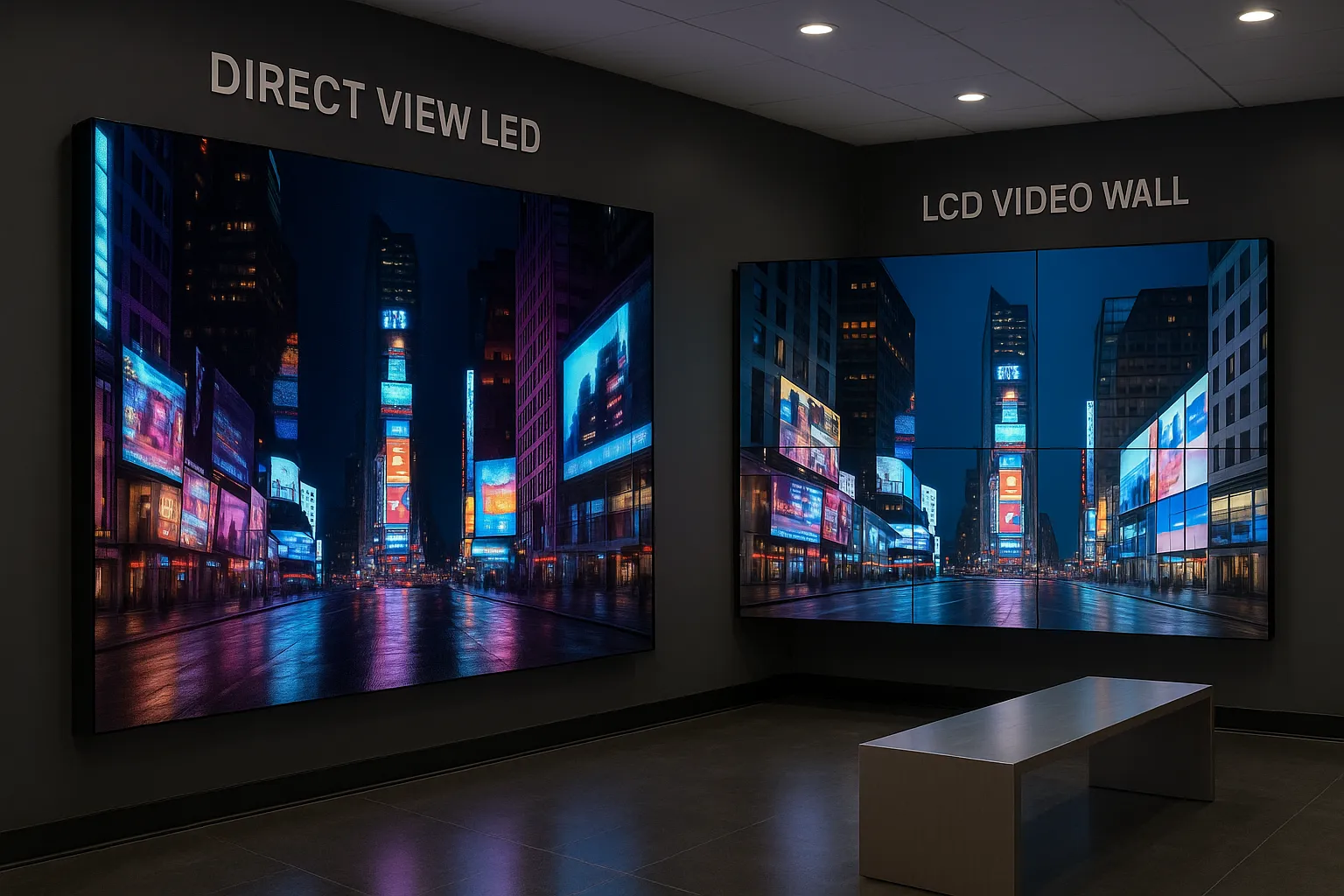
Before we compare performance specs, it helps to understand what’s actually happening behind the glass (or lack thereof). LED and LCD are often lumped together, but they rely on fundamentally different approaches to producing an image.
Direct View LED Displays
Direct view LED displays are built from thousands, sometimes millions, of tiny light-emitting diodes arranged in a grid. Each diode produces its own light and color. There’s no backlight, no liquid crystal layer, and no traditional “screen” in the way most people think of one.
Because every pixel is self-emitting, direct view LED panels deliver exceptional brightness and contrast. They can hit 1,000 to 5,000+ nits depending on the product, which is why you see them dominating large-scale installations like arena scoreboards and Times Square billboards. But indoor-specific models use finer pixel pitches, sometimes as tight as 0.9mm, to produce sharp images at closer viewing distances.
The modular nature of LED is one of its biggest advantages. Individual panels (called cabinets or tiles) snap together to form virtually any size or shape. Want a 20-foot-wide seamless video wall? No problem. An L-shaped display wrapping around a column? Also doable. There are no bezels interrupting the image.
Large Format LCD Panels
Large format LCD panels use a familiar architecture: a backlight (typically LED-based, which causes some naming confusion) illuminates a layer of liquid crystals that selectively block or pass light to create an image. Commercial-grade LCDs typically range from 43 inches to 98 inches per panel.
Modern commercial LCDs have gotten remarkably good. IPS and VA panel technologies deliver wide viewing angles and accurate color reproduction. Brightness levels on commercial models usually land between 350 and 700 nits, more than enough for most indoor settings without direct sunlight.
When you need a larger canvas, you can tile multiple LCD panels into a video wall. Ultra-narrow-bezel models have pushed seam widths down to around 0.88mm, though the bezels are still visible up close. For many applications, corporate lobbies, control rooms, retail endcaps, that’s a perfectly acceptable trade-off, especially given the lower entry cost per square foot.
Key Differences Between LED Display vs LCD Signage
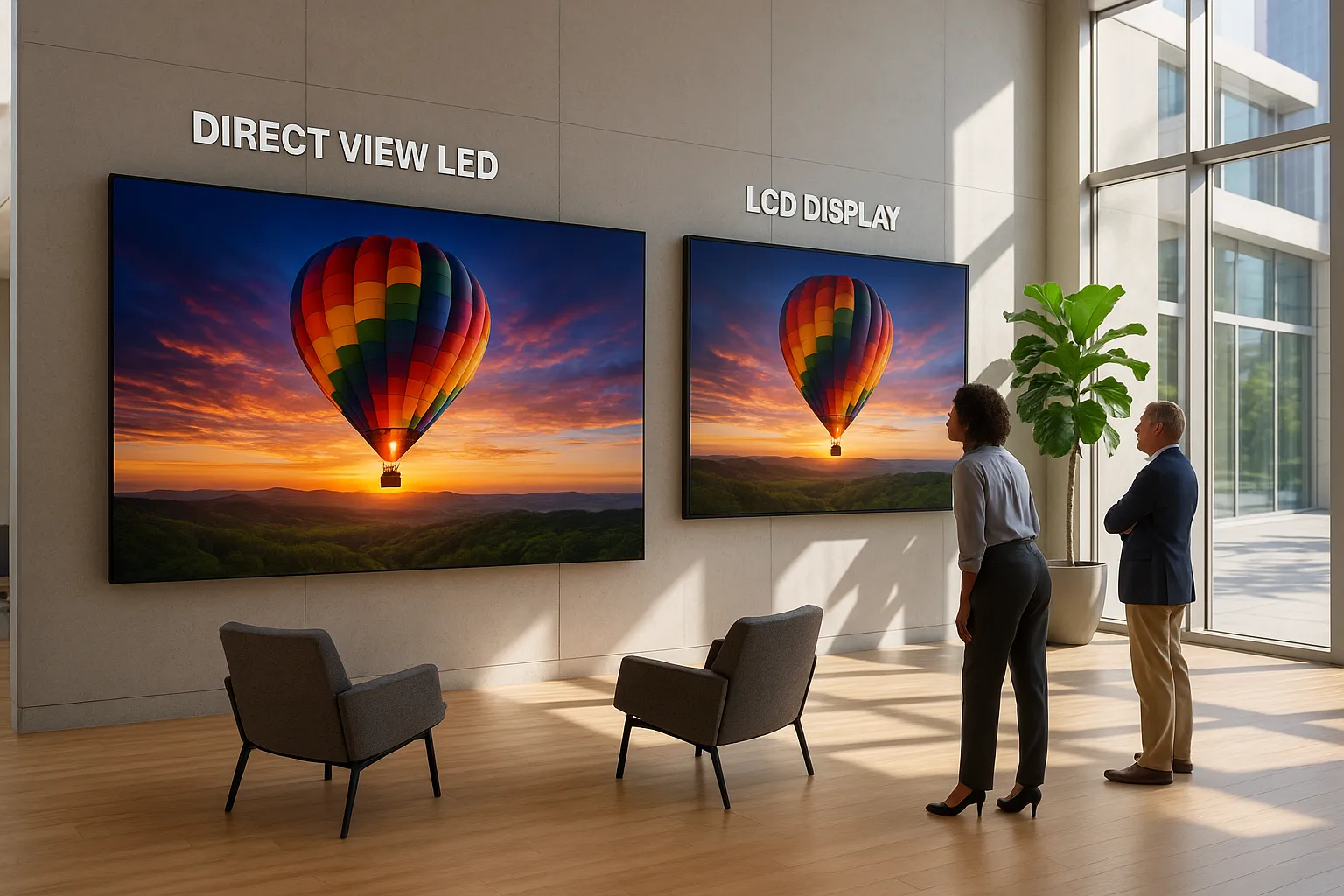
Now that we’ve covered how each technology works, let’s dig into the practical differences that actually influence a buying decision. This is where the LED display vs LCD signage comparison gets interesting.
Brightness and Viewing Angles
Direct view LED displays are significantly brighter. Even indoor models typically output 800 to 1,500 nits, with high-brightness variants exceeding 3,000 nits. That’s relevant if your installation faces large windows, sits in a sun-drenched atrium, or competes with heavy ambient lighting.
Commercial LCDs generally top out around 700 nits for standard indoor models (high-brightness variants can push to 2,500 nits, but they’re pricey). In a typical office, retail store, or restaurant interior, 500 nits is usually sufficient.
Viewing angles are strong on both sides. IPS-based LCDs offer 178° viewing angles, which is excellent. Direct view LED panels often match or exceed that, with minimal color shift even at extreme angles, a real advantage for wide lobbies or open floor plans where people approach from all directions.
Energy Efficiency and Lifespan
energy consumption depends heavily on the specific product, brightness settings, and content being displayed. As a rough benchmark, an LED video wall displaying mixed content typically consumes 150–300 watts per square meter. A comparable LCD video wall might use 100–200 watts per square meter, partly because LCDs run at lower brightness levels.
But here’s where it gets nuanced: LED displays can dim individual pixels to true black (since each pixel is self-emitting), which means dark content actually reduces power draw. LCDs keep the backlight running regardless of what’s on screen.
Lifespan favors LED. Most direct view LED panels are rated for 100,000 hours to half-brightness, that’s over 11 years of 24/7 operation. Commercial LCDs typically carry ratings of 50,000 to 60,000 hours. Both are more than adequate for standard business hours, but if you’re running screens around the clock, LED’s longevity advantage adds up.
Image Quality and Resolution
This is where LCD still holds a meaningful edge in certain scenarios. A 55-inch 4K LCD panel packs 3840 × 2160 pixels into a relatively small area, delivering a pixel density of about 80 PPI. That’s crisp, detailed, and ideal for close-up viewing, think interactive kiosks, detailed data dashboards, or retail displays where customers stand two to four feet away.
To achieve similar pixel density with direct view LED, you’d need an extremely fine pixel pitch (around 0.7mm or less), which gets expensive fast. For most commercial LED installations with pixel pitches between 1.2mm and 2.5mm, the optimal viewing distance is roughly six feet or more. Move closer and you’ll start to see individual diodes.
Color accuracy is excellent on both technologies. High-end LED walls can cover a wider color gamut, but for standard digital signage content, menus, promotions, wayfinding, commercial LCDs deliver perfectly accurate, vibrant images.
Size, Scalability, and Installation
If you need a display larger than 98 inches with zero bezels, direct view LED is the clear winner. Its modular design means there’s no upper limit on size, and the seamless result looks dramatically better than a tiled LCD wall at close range.
LCD panels, on the other hand, are simpler to install in standard configurations. A single 75-inch commercial display mounts on a wall with a bracket, it’s a straightforward job. LCD video walls require precise alignment and mounting structures but are still generally less complex (and less costly) to install than LED walls of equivalent size.
Weight is another consideration. LED cabinets can be heavier per square foot and may require reinforced mounting solutions, especially for larger installations. Your building’s structural capacity matters here, and it’s something we always evaluate during site surveys before recommending a solution.
Not Sure Which Display Is Right for Your Space?
Our display specialists can help you compare LED and LCD options for your specific environment. Request a free consultation today.
When To Choose an Indoor LED Display for Your Business
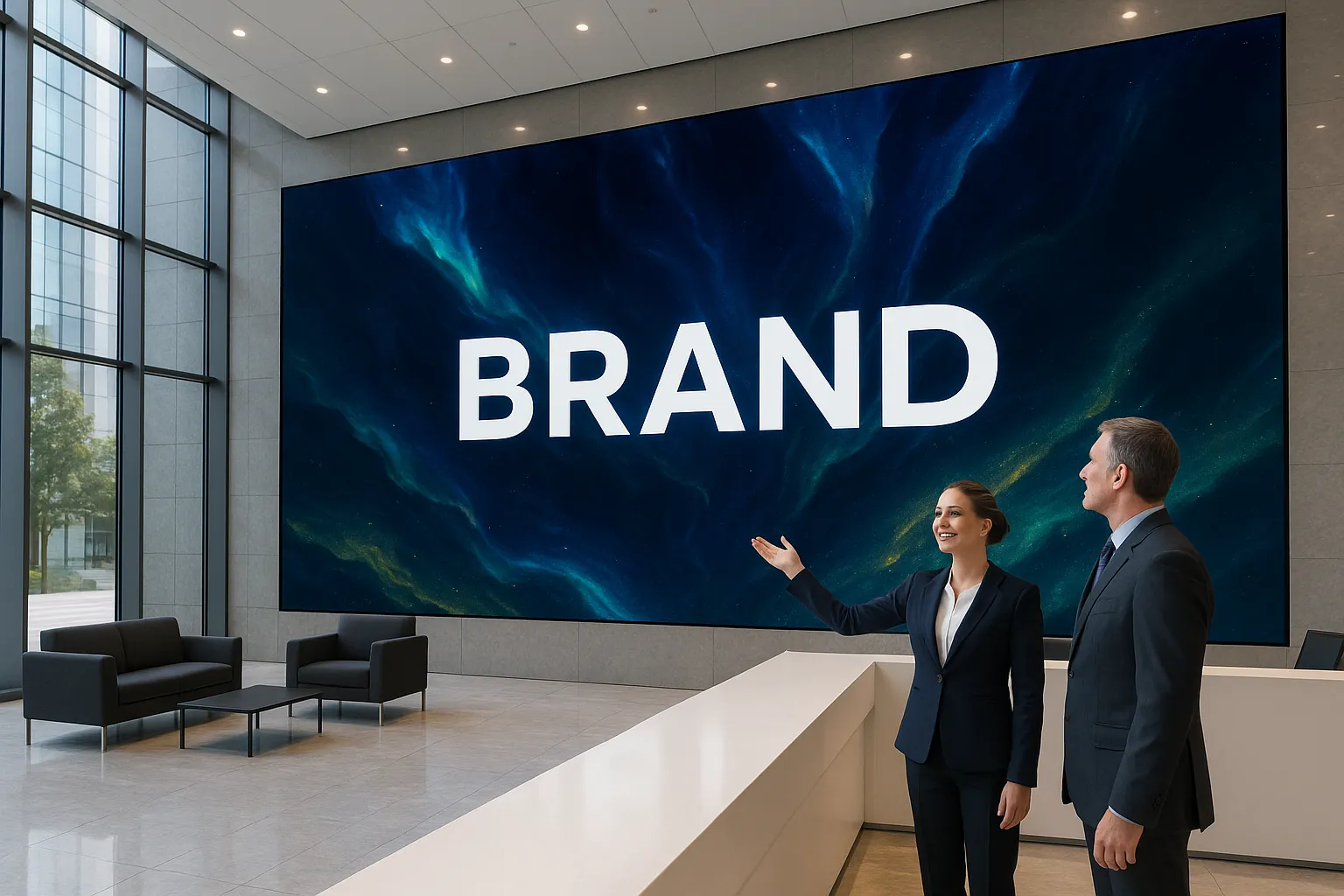
An indoor LED display makes the most sense when your priorities center on visual impact, scale, and long-term durability. Here are the scenarios where we’d steer a client toward LED without hesitation:
- Large-scale installations (over 100 inches diagonal). Once you cross the 100-inch threshold, LED’s seamless, bezel-free design becomes a massive visual advantage. Lobbies, event venues, houses of worship, and flagship retail stores all benefit from that uninterrupted canvas.
- High-ambient-light environments. Atriums with skylights, showroom floors with extensive overhead lighting, or spaces with large window walls, LED’s superior brightness cuts through ambient light without washing out.
- 24/7 operation. Airports, hospitals, transit hubs, and 24-hour retail locations benefit from LED’s longer rated lifespan and burn-in resistance. There’s no backlight to degrade, and individual modules can be swapped without replacing the entire display.
- Creative or non-standard shapes. If your design calls for a curved display, a wraparound installation, or a custom aspect ratio, LED’s modular architecture makes it possible. LCD panels are rectangles, period.
- Brand experience and wow factor. Sometimes the goal isn’t just information delivery, it’s impression. A seamless LED video wall in a corporate headquarters or experiential retail space communicates innovation and premium quality in a way that tiled LCDs simply can’t match.
The trade-off? Higher upfront cost and, in some cases, more complex installation. But for the scenarios above, the investment typically pays for itself in visual impact and reduced long-term maintenance.
When a Large Format LCD Makes More Sense
A large format LCD remains the smarter pick in plenty of common commercial scenarios. Don’t let the LED hype convince you otherwise, LCD technology has matured enormously, and it’s often the more practical choice.
- Close-viewing applications. If your audience will be standing within two to five feet of the screen, reading menus, browsing interactive directories, viewing detailed content, LCD’s higher pixel density delivers noticeably sharper text and imagery at those distances.
- Budget-conscious deployments. For small to mid-sized businesses rolling out their first digital signage network, commercial LCD displays offer a dramatically lower cost per screen. You can outfit five locations with quality LCD panels for roughly the same budget as one LED wall.
- Standard single-screen installations. Conference rooms, break rooms, individual retail locations, restaurant menu boards, anywhere a single 43″ to 86″ display does the job, there’s no compelling reason to spec LED. The installation is simpler, the hardware is proven, and replacement parts are widely available.
- Content requiring fine detail. Architectural firms displaying blueprints, financial services showing data-dense dashboards, healthcare facilities presenting patient information, these use cases demand pixel-level clarity that a 4K LCD delivers effortlessly.
- Multi-site rollouts on a timeline. When you’re deploying digital signage across 20, 50, or 200 locations, the speed and simplicity of LCD installation matters. Commercial LCD panels are lighter, easier to mount, and faster to configure, which reduces labor costs and compresses rollout schedules.
At CrownTV, we source commercial-grade LCD displays alongside our cloud-based digital signage software and nationwide installation services. For many of our clients, an LCD-based solution paired with our dashboard and media player delivers everything they need, without overbuilding.
Total Cost of Ownership: Commercial LED vs LCD
Sticker price is just the beginning. When comparing commercial LED vs LCD, total cost of ownership (TCO) over a five- to ten-year period paints a much more accurate picture.
Upfront hardware costs. LED video walls typically cost $800 to $3,000+ per square foot, depending on pixel pitch and manufacturer. Commercial LCD panels range from $1,000 to $8,000 per unit (43″ to 98″), and an LCD video wall with ultra-narrow bezels might run $3,000 to $6,000 per panel. On a per-square-foot basis, LED is usually two to five times more expensive upfront.
Installation. LED walls require specialized mounting structures, precise calibration, and often on-site engineering assessments. Installation costs for LED can represent 15–25% of the hardware budget. LCD installations, especially single-screen setups, are far less labor-intensive, with installation often costing a fraction of the hardware price.
Maintenance and repairs. Here’s where LED starts to close the gap. Individual LED modules can be hot-swapped without taking down the entire wall. If a section fails, you replace just that cabinet. An LCD panel failure typically means replacing the whole unit. Over a decade of operation, LED’s modular serviceability can translate to lower cumulative maintenance costs, particularly for large-format installations.
Energy costs. As we noted earlier, energy consumption varies by product and usage patterns. For most standard indoor deployments running 12–16 hours a day, the difference in electricity costs between LED and LCD is modest, typically a few hundred dollars per year for a mid-sized installation.
Software and content management. This cost is the same regardless of display type. You’ll need a content management system (CMS) to schedule, update, and monitor your screens. CrownTV’s cloud-based dashboard, for example, works with both LED and LCD hardware, so your software investment isn’t tied to your display choice.
The bottom line on TCO: For single screens and smaller deployments, LCD wins on total cost over any reasonable timeframe. For large-scale video walls running extended hours, LED’s longer lifespan and modular maintenance can make the TCO gap narrower than the upfront price difference suggests, sometimes significantly so.
How To Match the Right Display to Your Indoor Environment
We’ve seen businesses overspend on LED walls they didn’t need, and we’ve seen others cheap out on dim LCDs that looked terrible in bright environments. The right choice depends on your specific conditions. Here’s a practical framework:
1. Measure your ambient light.
Use a light meter (or even a smartphone app) to measure lux levels at the installation site during peak brightness hours. Under 500 lux? Standard commercial LCDs will perform beautifully. Between 500 and 2,000 lux? You’ll want a high-brightness LCD or an indoor LED display. Above 2,000 lux? LED is almost certainly the right call.
2. Determine your viewing distance.
This is the single most overlooked factor. If your nearest viewer will be eight feet away or more, an LED display with a 1.5mm to 2.5mm pixel pitch will look fantastic. If viewers will be within three to five feet, you either need a very fine-pitch (and very expensive) LED or a 4K LCD panel that delivers sharp detail at close range.
3. Define your display size.
Single screen under 98 inches? LCD is the default. Larger than 100 inches and you need seamless edges? LED takes over. In between, it depends on your budget and aesthetic requirements.
4. Consider your content.
Video-heavy, motion-graphics-driven content looks spectacular on LED walls. Text-heavy, data-dense, or interactive content generally performs better on LCD’s higher native resolution.
5. Assess your operational schedule.
Running screens 8–12 hours a day, five days a week? Both technologies will last years. Running 24/7/365? LED’s 100,000-hour lifespan gives you more runway before performance degrades.
6. Factor in future flexibility.
LED walls can be expanded by adding modules. LCD setups can be expanded by adding screens. But if you think you might want to change the size or shape of your display in the future, LED’s modular architecture offers more creative latitude.
If you’re unsure where your project falls, that’s exactly the kind of assessment we handle for clients. CrownTV’s team evaluates your space, content needs, and budget to recommend the right display technology, and then handles sourcing, installation, and ongoing software support as a complete turnkey package.
Ready to Upgrade Your Commercial Displays?
CrownTV offers turnkey digital signage solutions with commercial-grade LED and LCD displays, cloud software, and nationwide installation. Get a free quote and see what works best for your business.
Related Reading
- Hospitality Digital Signage: A Complete Guide for Hotel GMs and Property Managers
- LED Video Walls for Art Galleries & Museums: The Complete Guide
- Immersive Digital Signage Experiences: How Experiential Technology Is Transforming Brand Engagement
Conclusion
The indoor LED vs LCD display decision doesn’t have a universal right answer, it has a right answer for your situation. LED delivers unmatched scale, brightness, and visual impact for large, high-visibility installations. LCD offers sharper close-up resolution, simpler installation, and a lower entry cost that makes sense for the majority of standard commercial signage deployments.
What matters most is resisting the urge to overbuild or underbuild. A stunning LED video wall is wasted in a dim hallway where a single 55-inch LCD would’ve done the job. And a budget LCD panel looks underwhelming in a sun-drenched flagship lobby that demanded something bolder.
Start with your environment, your audience’s viewing distance, and your content, then let the technology decision follow from there. And if you’d rather not navigate the decision alone, reach out to our team at CrownTV. We’ll help you spec, source, install, and manage the right commercial displays for your business, whether that’s LED, LCD, or a combination of both.
Let Us Help You Choose the Right Display
Whether you need LED video walls or large-format LCD screens, CrownTV has the expertise to deliver. Talk to a display specialist now.
Frequently Asked Questions
What is the main difference between an indoor LED display and an LCD display?
The core difference is how each produces an image. An indoor LED display uses self-emitting diodes where each pixel generates its own light, delivering higher brightness and true blacks. An LCD display uses a backlight behind liquid crystals. This makes LED ideal for large, seamless installations and LCD better suited for close-up, detail-rich viewing.
Is an indoor LED or LCD display better for bright environments?
An indoor LED display is the stronger choice for high-ambient-light spaces. LED panels typically output 800 to 1,500+ nits, easily cutting through sunlight and overhead lighting. Standard commercial LCDs top out around 700 nits. If your space exceeds 2,000 lux during peak hours, LED is almost certainly the right pick.
How do I choose between LED and LCD based on viewing distance?
Viewing distance is a critical factor. If your nearest viewer stands eight feet away or more, an LED display with a 1.5mm to 2.5mm pixel pitch delivers excellent image quality. For audiences within three to five feet—reading menus or data dashboards—a 4K LCD panel offers noticeably sharper text and detail at close range.
Which has a lower total cost of ownership: commercial LED or LCD?
For single screens and smaller deployments, LCD wins on total cost over any timeframe due to lower hardware and installation expenses. However, for large-scale video walls running extended hours, LED’s 100,000-hour lifespan and modular, hot-swappable maintenance can significantly narrow the cost gap over a five- to ten-year period.
Can LED and LCD displays be used together in the same facility?
Yes, combining both technologies is a common and practical strategy. Many businesses install a large seamless LED video wall in high-traffic areas like lobbies for visual impact, while using LCD panels in conference rooms, menu boards, or kiosks where close-up clarity and lower cost matter most.
How long do indoor LED displays last compared to LCD panels?
Indoor LED displays are typically rated for around 100,000 hours to half-brightness—over 11 years of 24/7 use. Commercial LCD panels usually carry ratings of 50,000 to 60,000 hours. Both last years under standard business hours, but LED’s superior longevity is a significant advantage for always-on environments like airports or hospitals.